Seaborn Heatmap A comprehensive guide (original) (raw)
A **heatmap is a graphical representation of data where individual values are represented by color intensity. It is widely used in data analysis and visualization to identify patterns, correlations and trends within a dataset. **Heatmaps in Seaborn can be plotted using the seaborn.heatmap() function, which offers extensive customization options. Let's explore different methods to create and enhance heatmaps using Seaborn.
**Example: The following example demonstrates how to create a simple heatmap using the Seaborn library.
Python `
import numpy as np import seaborn as sns import matplotlib.pyplot as plt
Generating a 10x10 matrix of random numbers
data = np.random.randint(1, 100, (10, 10))
sns.heatmap(data) plt.show()
`

Basic heatmap
**Explanation: This will produce a heatmap where the intensity of color represents the magnitude of values in the matrix.
Syntax of seaborn.heatmap()
seaborn.heatmap(data, *, vmin=None, vmax=None, cmap=None, center=None, annot_kws=None, linewidths=0, linecolor='white', cbar=True, **kwargs)
**Parameters:
- **data: A 2D dataset that can be coerced into a NumPy ndarray.
- **vmin, vmax: Values to anchor the colormap; if not specified, they are inferred from the data.
- **cmap: The colormap for mapping data values to colors.
- **center: Value at which to center the colormap when plotting divergent data.
- **annot: If True, displays numerical values inside the cells.
- **fmt: String format for annotations.
- **linewidths: Width of the lines separating cells.
- **linecolor: Color of the separating lines.
- **cbar: Whether to display a color bar.
Note: All parameters except data are optional.
**Returns: returns an object of type **matplotlib.axes.Axes
**Examples
**Example 1: By setting vmin and **vmax, we explicitly define the range of values that influence the color scaling in the heatmap. This ensures consistency across multiple heatmaps, preventing extreme values from distorting the visualization.
Python `
import numpy as np import seaborn as sns import matplotlib.pyplot as plt
data = np.random.randint(1, 100, (10, 10))
sns.heatmap(data, vmin=30, vmax=70) plt.show()
`
**Output:

Anchoring the Colormap
**Explanation: The parameters vmin=30 and vmax=70 define the limits of the color scale range. Values lower than 30 are represented by the lowest intensity color, while values higher than 70 are mapped to the highest intensity color.
**Example 2: The **cmap parameter allows us to modify the color scheme of the heatmap, improving its visual appeal and making it easier to distinguish between different values.
Python `
import numpy as np import seaborn as sns import matplotlib.pyplot as plt
data = np.random.randint(1, 100, (10, 10))
sns.heatmap(data, cmap='tab20') plt.show()
`
**Output:
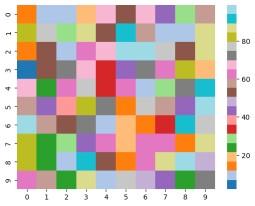
Choosing a Colormap
**Explanation: The argument **cmap='tab20' sets a categorical colormap. Sequential colormaps (Blues, Reds, Greens) suit continuous data, while diverging colormaps (coolwarm, RdBu) highlight variations.
**Example 3: By setting the **center parameter, we ensure that a specific value (such as the mean or median) appears neutral in the colormap. This adjustment makes deviations above and below this value more distinguishable.
Python `
import numpy as np import seaborn as sns import matplotlib.pyplot as plt
data = np.random.randint(1, 100, (10, 10))
sns.heatmap(data, cmap='coolwarm', center=50) plt.show()
`
**Output:
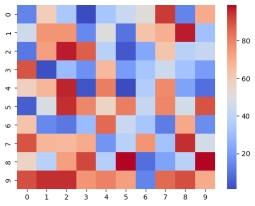
Centering the Colormap
Explanation: The center=50 parameter sets 50 as a neutral color. Values above it are shaded in one color (e.g., red) and below in another (e.g., blue), making it useful for highlighting deviations from a reference point.
Advanced customizations in seaborn heatmap
**Seaborn's heatmap() functionprovides various options for customization, allowing users to enhance visualization by adjusting color schemes, labels, scaling and spacing.
Python `
import matplotlib.pyplot as plt import seaborn as sns import numpy as np import matplotlib.colors as mcolors
data = np.random.rand(10, 10) * 100
plt.figure(figsize=(12, 8)) # Adjust figure size
sns.heatmap( data, xticklabels=list("ABCDEFGHIJ"), # Custom x-axis labels yticklabels=False, # Hide y-axis labels norm=mcolors.LogNorm(), # Logarithmic scaling cmap="coolwarm", # Color map linewidths=0.5 # Cell spacing )
Add title and labels
plt.title("Custom Heatmap", fontsize=16) plt.xlabel("X-axis") plt.ylabel("Y-axis")
plt.show()
`