Solve Differential Equations with ODEINT Function of SciPy module in Python (original) (raw)
Last Updated : 7 Jul, 2025
In science and engineering, many problems involve quantities that change over time like speed of a moving object or temperature of a cooling cup. These changes are often described using differential equations.
SciPy provides a function called odeint (from the scipy.integrate module) that helps solve these equations numerically. By giving it a function that describes how your system changes and some starting values, odeint calculates how the system behaves over time.
Syntax
scipy.integrate.odeint (func, y0, t, args=())
**Parameter:
- **func: function that returns the derivative (dy/dt).
- **y 0 : initial conditions.
- **t: time points to solve the ODE at.
- **args (optional): extra values passed to func.
Solving Differential Equations
Let's solve an ordinary differential equation (ODE) using the **odeint() function.
Example 1
\frac{dy}{dt} = -yt + 13
Python `
import numpy as np from scipy.integrate import odeint import matplotlib.pyplot as plt
Initial condition
y0 = 1
Time points
t = np.linspace(0, 5)
Define the differential equation using lambda
dy/dt = -y * t + 13
dydt = lambda y, t: -y * t + 13
Solve the ODE
y = odeint(dydt, y0, t)
plt.plot(t, y) plt.xlabel("Time") plt.ylabel("Y") plt.show()
`
**Output
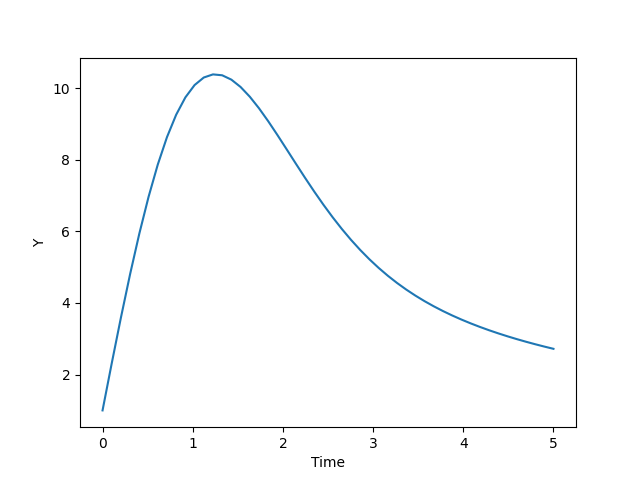
Graph for the solution of ODE
**Explanation:
- Defines and solves the ODE dy/dt = -y * t + 13 using odeint with initial value y = 1.
- The graph shows how **y changes over time.
- y increases first then slows as -y * t term grows.
Example 2
\frac{dy}{dt} = 13e^t + y
Python `
import numpy as np from scipy.integrate import odeint import matplotlib.pyplot as plt
Initial condition
y0 = 1
Time values
t = np.linspace(0, 5)
Define ODE directly using lambda: dy/dt = 13 * e^t + y
dydt = lambda y, t: 13 * np.exp(t) + y
Solve ODE
y = odeint(dydt, y0, t)
plt.plot(t, y) plt.xlabel("Time") plt.ylabel("Y") plt.show()
`
**Output
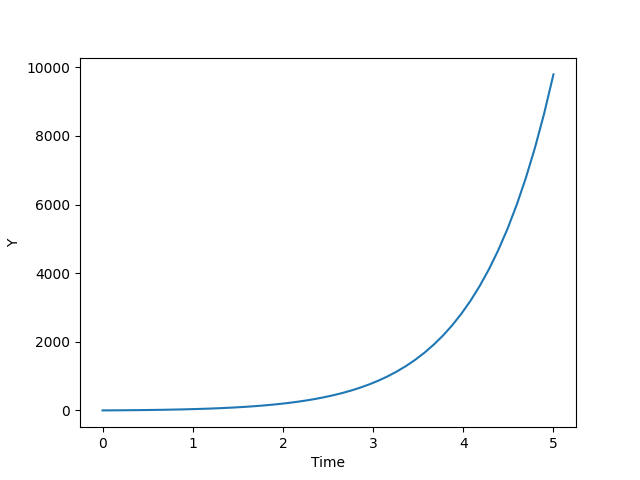
Graph for the solution of ODE
**Explanation:
- Defines and solves ODE dy/dt = 13*eᵗ + y using odeint starting from y = 1.
- The graph shows y grows rapidly, driven by both exponential and linear terms.
- The exponential term accelerates the growth of y as time increases.
Example 3
\frac{dy}{dt} = \frac{1 - y}{1.95 - y} - \frac{y}{0.05 + y}
Python `
import numpy as np from scipy.integrate import odeint import matplotlib.pyplot as plt
Initial conditions
y0 = [0, 1, 2]
Time values
t = np.linspace(1, 10)
Define the ODE using lambda
dydt = lambda y, t: (1 - y) / (1.95 - y) - y / (0.05 + y)
Solve the ODE
y = odeint(dydt, y0, t)
plt.plot(t, y) plt.xlabel("Time") plt.ylabel("Y") plt.show()
`