statsmodels.expected_robust_kurtosis() in Python (original) (raw)
Last Updated : 10 May, 2020
With the help of **statsmodels.expected_robust_kurtosis()** method, we can calculate the expected value of robust kurtosis measure by using statsmodels.expected_robust_kurtosis() method.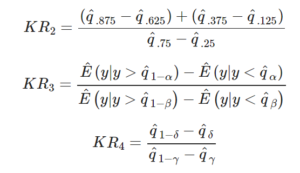
Syntax :
statsmodels.expected_robust_kurtosis(ab, db)Return : Return the four kurtosis value i.e kr1, kr2, kr3 and kr4.
**Example #1 :**In this example we can see that by using statsmodels.expected_robust_kurtosis() method, we are able to get the expected value of robust kurtosis measure by using this method.
Python3 1=1 `
import numpy and statsmodels
import numpy as np from statsmodels.stats.stattools import expected_robust_kurtosis
Using statsmodels.expected_robust_kurtosis() method
gfg = expected_robust_kurtosis()
print(gfg)
`
Output :
[3.0000000 1.23309512 2.58522712 2.90584695]
Example #2 :
Python3 1=1 `
import numpy and statsmodels
import numpy as np from statsmodels.stats.stattools import expected_robust_kurtosis
Using statsmodels.expected_robust_kurtosis() method
gfg = expected_robust_kurtosis([12, 22], [6, 7])
print(gfg)
`
Output :
[3.0000000 1.23309512 1.23859789 1.0535188 ]