Introduction to Appium Mobile Testing Framework (original) (raw)
Last Updated : 25 May, 2026
Mobile application testing is important for ensuring app quality, performance, and reliability. Appium is a popular open-source automation framework used to automate Android and iOS applications using the same test scripts.
- Enables automation for both Android and iOS applications.
- Supports cross-platform testing using a single codebase.
- Compatible with multiple programming languages such as Java, Python, and JavaScript.
Execution on Android
The following architecture diagram illustrates how Appium communicates with Android devices using the UIAutomator framework to execute automated test commands.
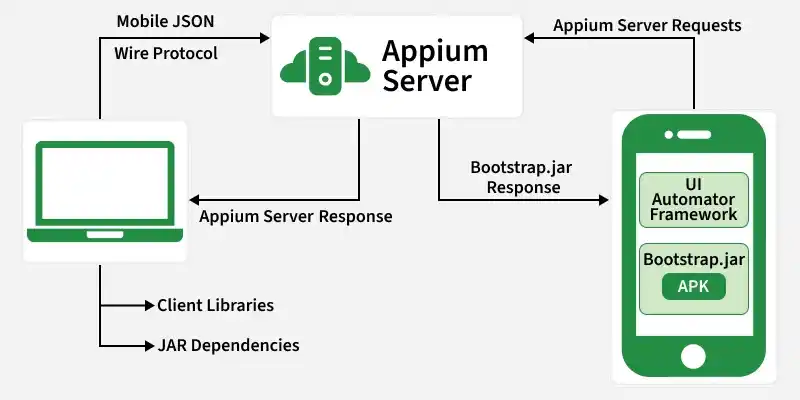
Execution on Android
- Test scripts written using client libraries are converted into Mobile JSON Wire Protocol requests.
- The requests are sent to the Appium Server through REST APIs.
- The Appium Server forwards the commands to the Android device or emulator.
- Bootstrap.jar (older approach) is deprecated; modern Appium uses the **UIAutomator2 driver to execute commands on Android apps.
- The execution response is sent back to the Appium Server.
- The Appium Server returns the test results to the client script.
Execution on iOS
The following architecture diagram shows how Appium communicates with iOS devices using the XCUITest framework and WebDriverAgent to perform automated testing.
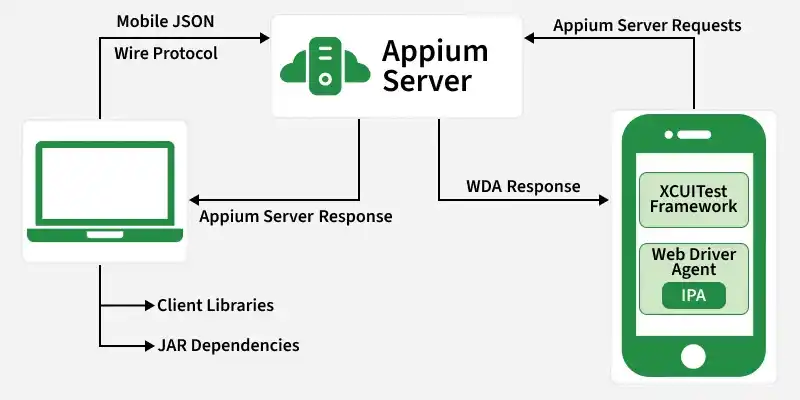
Execution on iOS
- Test scripts written using client libraries are converted into Mobile JSON Wire Protocol requests.
- The requests are sent to the Appium Server through REST APIs.
- The Appium Server forwards the commands to the iOS device or simulator using WebDriverAgent (WDA).
- The XCUITest framework executes the commands on the mobile application.
- The execution response is sent back to the Appium Server through WebDriverAgent.
- The Appium Server returns the test results to the client or test script.
Purpose of Appium
Appium is used to automate user interactions in mobile applications. It helps testers validate application functionality by simulating real user actions on Android and iOS apps.
- Automates user actions such as tapping, scrolling, typing, and navigation.
- Enables testing of both Android and iOS applications using a single framework.
- Supports validation of functional behavior across mobile platforms.
Installation and Setup of Appium
Before using Appium for mobile automation testing, you need to install Node.js, Appium, and start the Appium Server.
1. Install Node.js
Appium is built on Node.js, so Node.js must be installed on your system before installing Appium.
- Check whether Node.js is already installed using:
node --version
- If Node.js is not installed, download and install it from the official Node.js website
2. Install Appium
After installing Node.js, install Appium globally using npm (Node Package Manager).
- Run the following command to install Appium:
npm install -g appium
- Verify the Appium installation using:
appium --version
3. Start the Appium Server
The Appium Server acts as a bridge between the test scripts and mobile devices or emulators.
- Start the Appium Server using:
appium
- By default, the Appium Server runs on port 4723
Advantages of Appium
Appium provides several benefits for mobile automation testing:
- Reduces manual testing effort by automating repetitive test cases.
- Allows reuse of the same test scripts across Android and iOS platforms.
- Improves test coverage across multiple devices and operating systems.
- Supports testing on real devices as well as emulators and simulators.
Limitations of Appium
Despite its advantages, Appium also has certain limitations that can affect testing in complex scenarios.
- Test execution can be slower compared to native automation frameworks.
- Initial setup and configuration may be difficult for beginners.
- Limited access to some device-specific or advanced mobile features.
- Primarily designed for mobile application testing only.