GATE-CS-2007 (original) (raw)
Consider the following statements about user level threads and kernel level threads. Which one of the following statement is FALSE?
- Context switch time is longer for kernel level threads than for user level threads.
- User level threads do not need any hardware support.
- Related kernel level threads can be scheduled on different processors in a multi-processor system.
- Blocking one kernel level thread blocks all related threads.
Two processes, P1 and P2, need to access a critical section of code. Consider the following synchronization construct used by the processes:Here, wants1 and wants2 are shared variables, which are initialized to false. Which one of the following statements is TRUE about the above construct?v
/* P1 /
while (true) {
wants1 = true;
while (wants2 == true);
/ Critical
Section /
wants1=false;
}
/ Remainder section */
/* P2 /
while (true) {
wants2 = true;
while (wants1==true);
/ Critical
Section /
wants2 = false;
}
/ Remainder section */
- It does not ensure mutual exclusion.
- It does not ensure bounded waiting.
- It requires that processes enter the critical section in strict alternation.
- It does not prevent deadlocks, but ensures mutual exclusion.
There are n stations in a slotted LAN. Each station attempts to transmit with a probability p in each time slot. What is the probability that ONLY one station transmits in a given time slot?
In Ethernet when Manchester encoding is used, the bit rate is:
In a token ring network the transmission speed is 10^7 bps and the propagation speed is 200 meters/micro second. The 1-bit delay in this network is equivalent to:
The message 11001001 is to be transmitted using the CRC polynomial x3 + 1 to protect it from errors. The message that should be transmitted is:
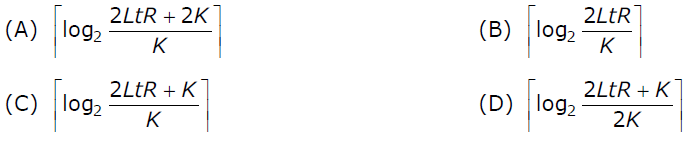
The distance between two stations M and N is L kilometers. All frames are K bits long. The propagation delay per kilometer is t seconds. Let R bits/second be the channel capacity. Assuming that processing delay is negligible, the minimum number of bits for the sequence number field in a frame for maximum utilization, when the sliding window protocolis used, is:
Consider the following segment of C-code:
int j, n;
j = 1;
while (j <= n)
j = j*2;
The number of comparisons made in the execution of the loop for any n > 0 is: Base of Log is 2 in all options.
Suppose the letters a, b, c, d, e, f have probabilities 1/2, 1/4, 1/8, 1/16, 1/32, 1/32 respectively. What is the average length of Huffman codes?
Suppose the letters a, b, c, d, e, f have probabilities 1/2, 1/4, 1/8, 1/16, 1/32, 1/32 respectively. Which of the following is the Huffman code for the letter a, b, c, d, e, f?
- 0, 10, 110, 1110, 11110, 11111
- 11, 10, 011, 010, 001, 000
- 11, 10, 01, 001, 0001, 0000
- 110, 100, 010, 000, 001, 111
There are 85 questions to complete.
Take a part in the ongoing discussion