Linear Algebra (original) (raw)
Assume that multiplying a matrix G1 of dimension 𝑝 × 𝑞 with another matrix G2 of dimension 𝑞 × 𝑟 requires 𝑝𝑞𝑟 scalar multiplications. Computing the product of n matrices G1 G2 G3 … Gn can be done by parenthesizing in different ways.
Define Gi Gi+1 as an explicitly computed pair for a given parenthesization if they are directly multiplied.
For example, in the matrix multiplication chain G1 G2 G3 G4 G5 G6 using the parenthesization (G1 (G2 G3))(G4 (G5 G6)), the explicitly computed pairs are G2 G3 and G5 G6.
Consider a matrix multiplication chain F1 F2 F3 F4 F5, where the dimensions of the matrices are:
- F1: 2 × 25
- F2: 25 × 3
- F3: 3 × 16
- F4: 16 × 1
In the parenthesization of F1 F2 F3 F4 F5 that minimizes the total number of scalar multiplications, the explicitly computed pair(s) is/are:
Which of the following is used to determine the specificity of requirements? (1) n1 / n2(2) n2 / n1(3) n1 + n2(4) n1 - n2Where n1 is the number of requirements for which all reviewers have identical interpretations, n2 is number of requirements in a specification.
A neuron with 3 inputs has the weight vector [0.2 –0.1 0.1]T and a bias θ = 0. If the input vector is X = [0.2 0.4 0.2]T then the total input to the neuron is :
Let R and S be two fuzzy relations defined as : Then, the resulting relation, T, which relates elements of universe x to the elements of universe z using max-min composition is given by :
If A is a skew symmetric matrix, then At
A 4×4 DFT matrix is given by :
[Tex]\frac{1}{2} \begin{bmatrix} 1 & 1 & 1 & 1 \\ 1 & x & -1 & y \\ 1 & -1 & 1 & -1 \\ 1 & -j & -1 & j \end{bmatrix}[/Tex]
(j2 = −1)
Where values of x and y are _____, _____ respectively.
In a compact one-dimensional array representation for a lower triangular matrix (all elements above the diagonal are zero) of size n x n, non-zero elements of each row are stored one after another, starting from the first row, the index of (i, j)th element in this new representation is
If C is a skew-symmetric matrix of order n and X is n x 1 column matrix, then XTCX is a
- matrix will all elements 1
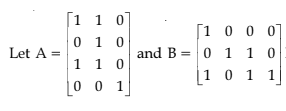 Find the boolean product A⊙B of the two matrices.
Consider a matrix **P(2x2) whose only eigenvectors are the multiples of [Tex]\begin{bmatrix}1 \\ 4 \end{bmatrix}[/Tex]
Consider the following statements.
(I) **P does not have an inverse
(II) **P has a repeated eigenvalue
(III) **P cannot be diagonalized
Which one of the following options is correct?
- Only I and III are necessarily true
- Only II is necessarily true
- Only I and II are necessarily true
- Only II and III are necessarily true
There are 76 questions to complete.
Take a part in the ongoing discussion