Regular languages and finite automata (original) (raw)
Consider the languages L1 = [Tex]\\phi [/Tex]and L2 = {a}. Which one of the following represents L1 L2* U L1*
Consider the DFA given.
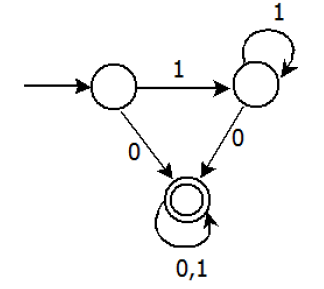
Which of the following are FALSE?
- Complement of L(A) is context-free.
- L(A) = L((11*0+0)(0 + 1)*0*1*).
- For the language accepted by A, A is the minimal DFA.
- A accepts all strings over {0, 1} of length at least 2.
Definition of a language L with alphabet {_a} is given as following.
L={|ank|k>0, and n is a positive integer constant}What is the minimum number of states needed in DFA to recognize L?
A deterministic finite automation (DFA)D with alphabet {a,b} is given below
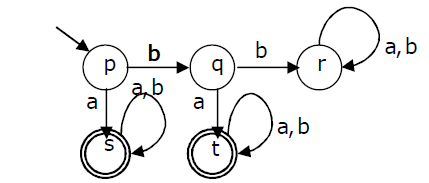
Which of the following finite state machines is a valid minimal DFA which accepts the same language as D?
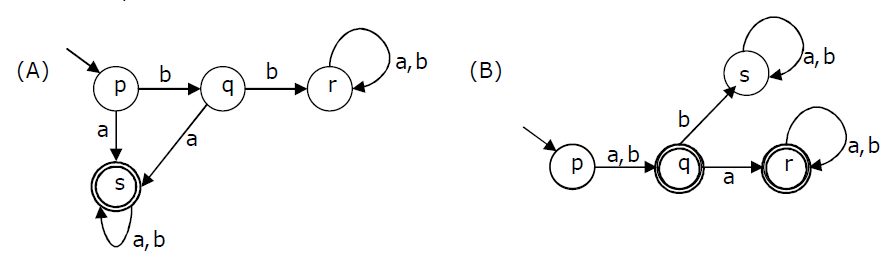
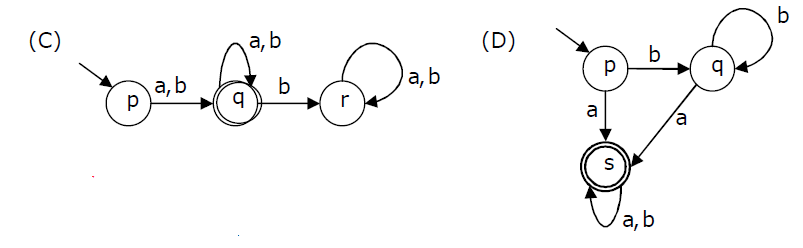
Let w be any string of length n is {0,1}*. Let L be the set of all substrings of w. What is the minimum number of states in a non-deterministic finite automaton that accepts L?
Which one of the following languages over the alphabet {0,1} is described by the regular expression: (0+1)*0(0+1)*0(0+1)* ?
- The set of all strings containing the substring 00.
- The set of all strings containing at most two 0’s.
- The set of all strings containing at least two 0’s.
- The set of all strings that begin and end with either 0 or 1.
The language [Tex]L=\{a^n b^n \mid n \geq 1\}[/Tex] is:
****(GATE 2004 | MCQ | 1-mark)**
- context-free but not regular
- context-sensitive but not context-free
- type-0 but not context-sensitive
Given the following state table of an FSM with two states A and B, one input and one output:
| Present State A | Present State B | Input | Next State A | Next State B | Output |
|---|---|---|---|---|---|
| 0 | 0 | 0 | 0 | 0 | 1 |
| 0 | 1 | 0 | 1 | 0 | 0 |
| 1 | 0 | 0 | 0 | 1 | 0 |
| 1 | 1 | 0 | 1 | 0 | 0 |
| 0 | 0 | 1 | 0 | 1 | 0 |
| 0 | 1 | 1 | 0 | 0 | 1 |
| 1 | 0 | 1 | 0 | 1 | 1 |
| 1 | 1 | 1 | 0 | 0 | 1 |
If the initial state is A=0, B=0, what is the minimum length of an input string which will take the machine to the state A=0, B=1 with Output = 1?
Given the language L = {ab, aa, baa}, which of the following strings are in L*?
There are 154 questions to complete.
Take a part in the ongoing discussion