Theory of Computation GATE CS PYQ Quiz (original) (raw)
Which of the following problems are decidable?
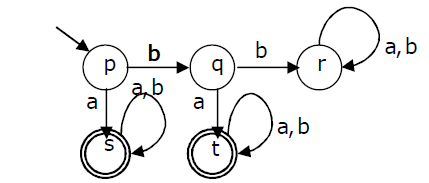
A deterministic finite automation (DFA)D with alphabet {a,b} is given below
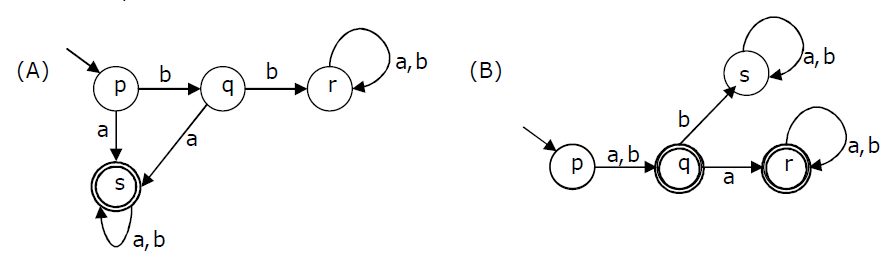
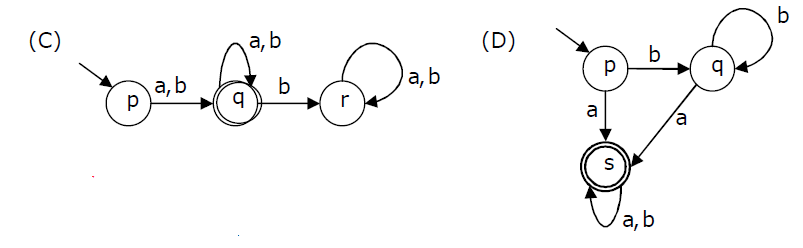
Which of the following finite state machines is a valid minimal DFA which accepts the same language as D?
Definition of a language L with alphabet {_a} is given as following.
L={|ank|k>0, and n is a positive integer constant}What is the minimum number of states needed in DFA to recognize L?
Consider the languages L1, L2 and L3 as given below.
LI= {0P1q |p, q∈N}
L2={0p1q |p, q∈ N and p=q} and
L3= {0P1q0r |p, q, r∈ N and p =q = r}
Which of the following statements is **NOT TRUE?
[GATE | CS | 2011 |]
- Push Down Automata (PDA) can be used to recognize L1 and L2
- All the three languages are context free
- Turing machine can be used to recognize all the three languages
Let P be a regular language and Q be context-free language such that Q ⊆ P. (For example, let P be the language represented by the regular expression p*q* and Q be {pn qn | n ∈ N}). Then which of the following is ALWAYS regular?
(A) P ∩ Q
(B) P - Q
(C) ∑* - P
(D) ∑* - Q
Which of the following pairs have DIFFERENT expressive power?
- Deterministic finite automata(DFA) and Non-deterministic finite automata(NFA)
- Deterministic push down automata(DPDA)and Non-deterministic push down automata(NPDA)
- Deterministic single-tape Turing machine and Non-deterministic single-tape Turing machine
- Single-tape Turing machine and multi-tape Turing machine
Let w be any string of length n is {0,1}*. Let L be the set of all substrings of w. What is the minimum number of states in a non-deterministic finite automaton that accepts L?
Consider the languages -
L1 = {0i1j | i != j}.
L2 = {0i1j | i = j}.
L3 = {0i1j | i = 2j+1}.
L4 = {0i1j | i != 2j}.
- Only L2 and L3 are context free
- Only L1 and L2 are context free
Let L={w in (0 + 1)*|w has even number of 1s}, i.e. L is the set of all bit strings with even number of 1s. Which one of the regular expression below represents L?
There are 112 questions to complete.
Take a part in the ongoing discussion