Comments in R (original) (raw)
Last Updated : 12 Jul, 2025
In R Programming Language, Comments are general English statements that are typically written in a program to describe what it does or what a piece of code is designed to perform. More precisely, information that should interest the coder and has nothing to do with the logic of the code. They are completely ignored by the compiler and are thus never reflected on the input.
- Code Readability
- Explanation of the code or Metadata of the project
- Prevent execution of code
- To include resources
There are generally three types of comments supported by languages :
- **Single-line Comments: Comment that only needs one line
- **Multi-line Comments: Comment that requires more than one line.
- **Documentation Comments: Comments that are drafted usually for a quick documentation lookup
Note: R doesn't support Multi-line and Documentation comments. It only supports single-line comments drafted by a '#' symbol.
Single-line comments are comments that require only one line. They are usually drafted to explain what a single line of code does or what it is supposed to produce so that it can help someone refer to the source code. Just like Python single-line comments, any statement starting with "****#**" is a comment in R.
**Syntax:
# comment statement
**Example 1:
R `
geeksforgeeks
`
The above code when executed will not produce any output, because R will consider the statement as a comment and hence the compiler will ignore the line.
**Example 2:
R `
R program to add two numbers
Assigning values to variables
a <- 9 b <- 4
Printing sum
print(a + b)
`
**Output:
[1] 13
As stated earlier that R doesn't support multi-lined comments, but to make the commenting process easier, R allows commenting on multiple single lines at once. There are two ways to add multiple single-line comments in R Studio:
- **First way: Select the multiple lines on which you want to comment using the cursor and then use the key combination ****"control + shift + C"** to comment or uncomment the selected lines. R `
This is a multiple-line comment
Each line starts with the '#' symbol
The following code will be executed
x <- 10 y <- 20 sum <- x + y print(sum) # This line will print the value of 'sum'
`
**Output:
[1] 30
- **Second way: The other way is to **use the GUI, select the lines on which you want to comment by using the cursor and click on "Code" in the menu, a pop-up window pops out in which we need to select "Comment/Uncomment Lines" which appropriately comments or uncomment the lines which you have selected.
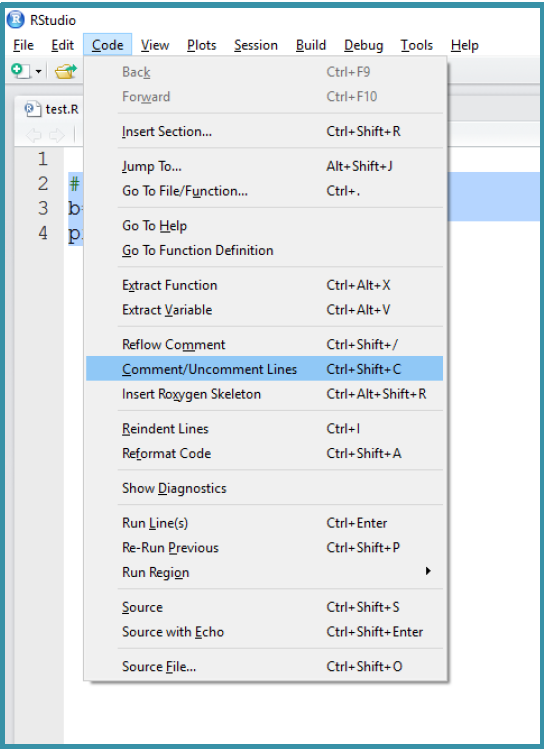
This makes the process of commenting a block of code easier and faster than adding # before each line one at a time.