Create Random Deviates of Uniform Distribution in R Programming runif() Function (original) (raw)
Last Updated : 12 Jul, 2025
**runif() function in R Language is used to create random deviates of the uniform distribution.
**Syntax:
runif(n, min, max)
**Parameters:
- **n: represents number of observations.
- **min, max: represents lower and upper limits of the distribution.
**Example 1:
In this example, we are generating a uniform distribution of 20 random numbers between -1 and 1 using the runif() function in R. The resulting values are evenly distributed across the specified range and are printed for inspection.
r `
x <- runif(20, min = -1, max = 1) print(x)
`
Output:
[1] 0.90453974 -0.97083088 0.83531295 0.19008941 0.52278078 -0.75730955
[7] 0.21659920 -0.26621211 0.11967620 0.42081991 0.75518470 -0.41519833
[13] -0.03734007 0.57365077 0.76156708 0.97314141 -0.41957919 -0.08910355
[19] 0.29047038 -0.67069856
**Example 2:
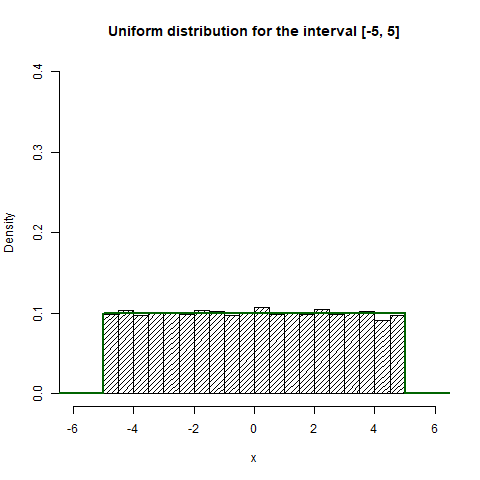
In this example, we are generating 10,000 random values from a uniform distribution between -5 and 5, and visualizing them with a histogram. We also overlay the theoretical probability density function to illustrate how the generated data aligns with the expected uniform distribution.
r `
unif <- runif(10000, min = -5, max = 5)
png(file = "runifGFG.png")
hist(unif, freq = FALSE,
xlab = 'x',
ylim = c(0, 0.4),
xlim = c(-6, 6),
density = 20,
main = "Uniform distribution for the interval [-5, 5]")
curve(dunif(x, min = -5, max = 5), from = -10, to = 10, n = 100000, col = "darkgreen", lwd = 2, add = TRUE, yaxt = "n", ylab = 'probability')
dev.off()
`
**Output: