Insert multiple rows in R DataFrame (original) (raw)
Last Updated : 8 Oct, 2021
In this article, we are going to see how to insert multiple rows in the dataframe in R Programming Language. First, let's create a DataFrame
To create a data frame we need to use vectors. We need to create vectors with some values and pass the vectors into data.frame() function as parameter. Thus, a data frame is created. Let us see an example that demonstrates the above statement.
Example 1:
R `
here num and branches are the vectors, ans those
are passed into data.frame() as parameters .
dataframe = data.frame(num=c(1:3),branches=c("IT","CSE","ECE"))
In this example we created vectors inside the
data frame() function and assigned values to vectors.
print(dataframe)
`
Output:
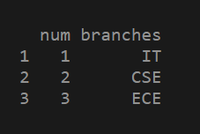
In the above example, we have created a data frame with vectors directly as parameters. We can create data frames with already created vectors. Let us see an example.
Steps to insert multiple rows into a data frame
- Create a dataframe.
- Create a vector that contains rows to be added to the dataframe.
- Use the below method to add rows to the data frame.
Implementation :
The predefined function used to add multiple rows is rbind(). We have to pass a data frame and a vector having rows of data. So, let see the example code.
Indexing for a dataframe in R:
variable = df([ row,column ])
If we want to extract multiple rows we can put row numbers in a vector and pass that vector as a row or column. If we want to extract 3 rows and all columns we can put row numbers in a vector and leave the column empty. The below example demonstrates the above statement.
Example :
a = df1([ c(1,2,3) , ]) # here we left column as empty which means we want extract all columns
If we want to extract specific columns then we can put column numbers in a vector and pass as a parameter. The below example demonstrates the above statement.
Example :
b = df1( [ c(1,2,3) , c(1,2) ] )
This is how indexing works. Let us see rbind() function introduction and implementation for inserting multiple rows into a dataframe.
rbind() method: rbind means row bind. Joining multiple rows with dataframe.
Syntax: rbind(a, b)
Parameters:
- a = data frame
- b = data to be binded with data frame
Example 1 :
R `
creating a data frame
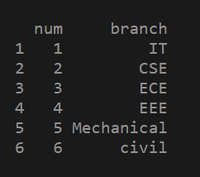
df1 = data.frame(num = c( 1 : 3), branch = c("IT", "CSE", "ECE"))
creating another data frame
df2 = data.frame(num = c( 4 : 6), branch = c("EEE", "Mechanical", "civil"))
selecting 1-2 rows , all columns from df1
new_row = df2[c(1, 2, 3),]
we can access data from a data frame through indexing .
since it is a 2 dimensional one we can access data
by row number and column number .
here c(1,2,3) represents row numbers and we left column
numbers as empty . then all columns are accessed .
new_row is appended to the df1
df1 = rbind(df1, new_row)
#printing updated data frame print(df1)
`
Output:
Example 2: Adding rows from 3 dataframe.
R `
creating one data frame
df1 = data.frame(num = c( 1 : 3 ), branch = c("IT", "CSE", "ECE"))
creating another data frame
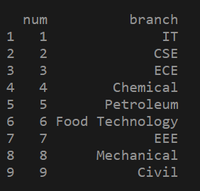
df2=data.frame(num = c( 4 : 6 ), branch = c("Chemical", "Petroleum", "Food Technology"))
df3=data.frame(num = c( 7 : 9 ), branch = c("EEE", "Mechanical", "Civil"))
here we accessing 1-3 rows and all columns
from df2 and storing in new_row variable
new_row=df2[c(1, 2, 3),]
here also we are accessing 1-3 rows and all
columns and storing in new_row2 variable
new_row2=df3[c(1, 2, 3),]
passing data frame1 i.e., df1 and the new_row .
df1=rbind(df1, new_row)
passing data frame1 i.e., df1 and new_row2
df1=rbind(df1, new_row2)
Here values in new_row will be appended with df1 .
if we pass df2,new_row ,
the data in the nw_row will be appended with df2
print(df1) # printing df1
`
Output: