which() Function in R (original) (raw)
Last Updated : 23 Aug, 2021
which() function in R Programming Language is used to return the position of the specified values in the logical vector.
Syntax: which(x, arr.ind, useNames)
Parameters: This function accepts some parameters which are illustrated below:
- X: This is the specified input logical vector
- Arr.ind: This parameterreturns the array indices if x is an array.
- useNames: This parameter says the dimension names of an array.
Return value: This function returns the position of the specified values in the logical vector.
Example 1: Which() function applying tothe alphabet
In the below example, which() function returns the alphabetical position of the specified letter. For example, a is the first letter in the alphabet sequence that's why 1 is returned and z is the last letter in the sequence so 26 is returned.
R `
R program to illustrate
which() function
Calling the which function
to return alphabetical position
of the given alphabet
which(letters == "a") which(letters == "d") which(letters == "z") which(letters == "p") which(letters == "g")
`
Output :
[1] 1 [1] 4 [1] 26 [1] 16 [1] 7
Example 2: which() function with vectors
In the below example, the position of some elements of the specified vector is being returned which the help of which() function.
R `
R program to illustrate
which() function
Creating a vector of some elements
vector <- c(3, 5, 1, 6, 12, 4)
Getting the position of element 12
in the above vector
which(vector == 12)
Getting the position of element 1
in the above vector
which(vector == 1)
Getting the position of element 6
in the above vector
which(vector == 6)
Getting the position of elements
those are greater than 5
which(vector > 5)
`
Output:
[1] 5 [1] 3 [1] 4 [1] 4 5
Example 3: which() function with dataframe
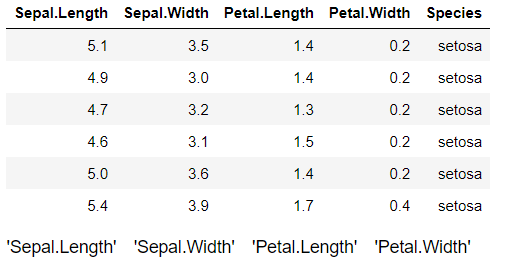
In the below example, which() function is used to find the columns in a data frame with numeric values.
An Iris data set is used as a data frame that contains 4 columns for numerical values and 1 column for categorical values i.e., Species. The which() function find the columns name from the data set that contain numeric values.
R `
Considering “Iris” dataset
data_set <- datasets::iris
Printing the Iris dataset values
along with its 5 columns out of which
4 columns are numerical and 1 is categorical
(Species)
head(data_set)
Calling the which() function over
the above specified data set that
returns the columns with numeric values
Result <- which(sapply(data_set, is.numeric))
Printing the columns with numeric values
colnames(data_set)[Result]
`
Output:
Example 4: which() function with the matrix
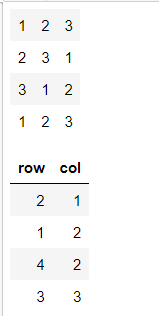
In the below example, which() function is used to find the position of an element in the specified matrix.
Here the position of value 2 in the specified matrix is being calculated.
R `
Creating a matrix of 3 columns and 4 rows
Matrix <- matrix(rep(c(1, 2, 3), 4), nrow = 4)
Printing the entire matrix with its values
Matrix
Calling the which() function to find the
position of value 2 in the above matrix
which(Matrix == 2, arr.ind = T)
`
Output: