Random Variable (original) (raw)
Last Updated : 11 May, 2026
A random variable is a key concept in statistics that connects theoretical probability with real-world data. It is a function that assigns a real number to each outcome in the sample space of a random experiment.
**For example: When you roll a die, the outcome is one of the six faces. A random variable can assign a number (like 1 to 6) to each of these outcomes, allowing us to analyze the results using statistical methods.
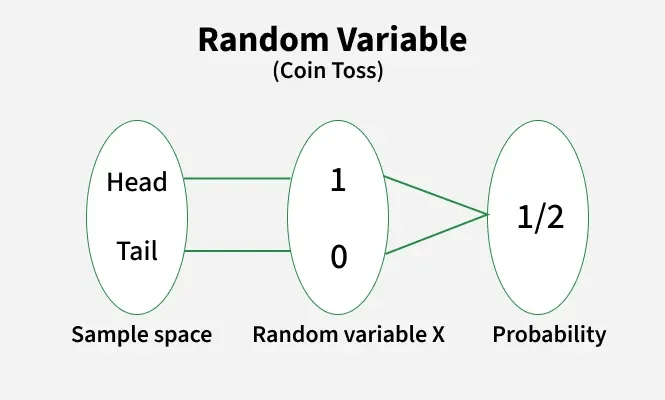
There are two possible outcomes, modeled as random variables
We define a random variable as a function that maps from the sample space of an experiment to the real numbers. Mathematically, a Random Variable is expressed as,
**X: S →R
**Where:
- **X is aRandom Variable (It is usually denoted using a capital letter)
- **S is Sample Space
- **R is a Set of Real Numbers
Random variables are generally represented by capital letters like X and Y.
**Random Variable Examples
**Example 1: If two unbiased coins are tossed, then find the random variable associated with that event.
**Solution:
Suppose Two (unbiased) coins are tossed
X = number of heads. [X is a random variable or function]Here, the sample space S = {HH, HT, TH, TT}
Suppose a random variable X takes m different values, X = {x1, x2, x3,..., xm}, with corresponding probabilities **P(X = x i ) = p i, where 1 ≤ i ≤ m.
The probabilities must satisfy the following conditions :
- 0 ≤ pi ≤ 1; where 1 ≤ i ≤ m
- p1 + p2 + p3 + ....... + pm = 1 or we can say 0 ≤ pi ≤ 1 and ∑pi = 1
**Example 2: Suppose a die is thrown (X = outcome of the dice) and the sample space S = {1, 2, 3, 4, 5, 6}.
**Solution:
The output of the function will be:
- P(X = 1) = 1/6
- P(X = 2) = 1/6
- P(X = 3) = 1/6
- P(X = 4) = 1/6
- P(X = 5) = 1/6
- P(X = 6) = 1/6
This also satisfies the condition ∑6i=1 P(X = i) = 1, since:
P(X = 1) + P(X = 1) + P(X = 2) + P(X = 3) + P(X = 4) + P(X = 5) + P(X = 6) = 6 × 1/6 = 1
Variate
A variate is a general term often used interchangeably with a random variable, particularly in contexts where the random variable is not yet fully specified by a particular probabilistic experiment.
- It is an abstract concept that represents a real-valued outcome of a random process, but is not necessarily tied to a specific probability distribution.
- It has the same properties as a random variable, such as a defined range of possible values.
- The range of values that a random variable X can take is denoted as Rx ( range of X ).
- Individual values within this range are called quantiles.
- The probability of the random variable X taking a specific value x is written as P(X = x).
Types of Random Variables
Random variables are of two types, that are as follows:
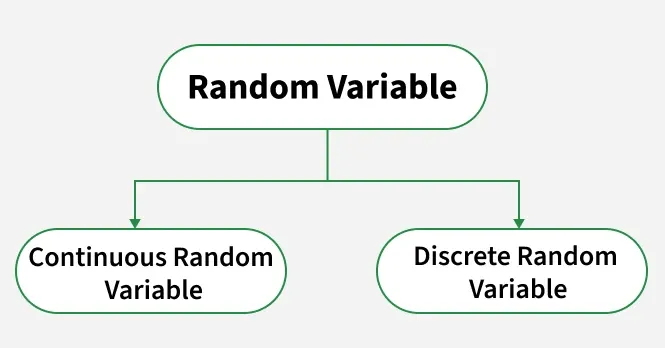
Types Of Random Variable
**Discrete Random Variable
A Discrete Random Variable takes on a finite or countably infinite number of values. The probability function associated with a discrete random variable is called as Probability Mass Function.
PMF(Probability Mass Function)
If X is a discrete random variable and the PMF of X is P(xi), then
- 0 ≤ pi ≤ 1
- ∑p(xi) = 1, where the sum is taken over all possible values of x
**Discrete Random Variables Example
**Example: **Let S = {0, 1, 2}
| xi | 0 | 1 | 2 |
|---|---|---|---|
| Pi(X = xi) | P1 | 0.3 | 0.5 |
**Find the value of P (X = 0)
**Solution:
We know that the sum of all probabilities is equal to 1. And P (X = 0) be P1
P1 + 0.3 + 0.5 = 1
P1 = 0.2Then, P (X = 0) is 0.2
**Continuous Random Variable
A Continuous Random Variable takes on an infinite number of values. The probability function associated with it is said to be PDF (Probability Density Function).
**PDF (Probability Density Function)
If X is a continuous random variable. P (x < X < x + dx) = f(x)dx then,
- 0 ≤ f(x) ≤ 1; for all x
- ∫ f(x) dx = 1 over all values of x
Then P (X) is said to be a PDF of the distribution.
**Example: Find the value of P (1 < X < 2) f(x) = kx 3 ; 0 ≤ x ≤ 3 = 0. Otherwise, f(x) is a density function.
**Solution:
If a function f is said to be a density function, then the sum of all probabilities is equal to 1.
Since it is a continuous random variable Integral value is 1 overall sample space s.
∫ f(x) dx = 1
∫ kx3 dx = 1
K[x4]/4 = 1Given interval, 0 ≤ x ≤ 3 = 0
K[34 – 04]/4 = 1
K(81/4) = 1
K = 4/81Thus,
P (1 < X < 2) = k × [X4]/4
P = 4/81 × [16-1]/4
P = 15/81
Random Variable Formulas
There are two main random variable formulas,
1. Mean of a Random Variable
For any random variable X where P is its respective probability, we define its mean as,
**Mean(μ) = ∑ X.P
**Where,
- **X is the random variable that consists of all possible values.
- **P is the probability of the respective variables
2. Variance of a Random Variable
The variance of a random variable tells us how the random variable is spread about the mean value of the random variable. The variance of the Random Variable is calculated using the formula,
**Var(x) = σ 2 = E(X 2 ) - {E(X)} 2
**Where,
- E(X2) = ∑X2P
- E(X) = ∑XP
Random Variable Functions
For any random variable X if it assume the values x1, x2,...xn where the probability corresponding to each random variable is P(x1), P(x2),...P(xn), then the expected value of the variable is,
Expectation of X, E(x) = ∑ x.P(x)
Now, for any new random variable Y in which the random variable X is its input, i.e., Y = f(X), then the cumulative distribution function of Y is,
**F y (Y) = P(g(X) ≤ y)
Probability Distribution and Random Variable
For a random variable, its probability distribution is calculated using three methods,
- Theoretical listing of outcomes and probabilities of the outcomes.
- Experimental listing of outcomes followed by their observed relative frequencies.
- Subjective listing of outcomes followed by their subjective probabilities.
The probability of a random variable X that takes values x is defined using a probability function of X that is denoted by f (x) = f (X = x).
Random Variables in Computer Science
Random variables are important in computer science for dealing with uncertainty and chance.
- They are used to study the average behavior of algorithms that use random steps, such as QuickSort.
- In machine learning, they help describe input data, predictions, and errors.
- Simulations use them to model events like customer arrivals or data flow in a network.
- In cybersecurity, random variables help create strong, unpredictable keys.
- They are also useful in checking how well data structures like hash tables perform.
- In networking, they help predict delays and traffic.
- Even in games and animation, random variables create random actions and natural-looking effects.
Solved Questions
**Question 1: Find the mean value of the continuous random variable with probability density function,f(x) = \frac{3x^2}{26}, 1 ≤ x ≤ 3.
**Solution:
Given,
f(x) = \frac{3x^2}{26} , 1 ≤ x ≤ 3The mean (expected value) of a continuous random variable is: E(X)=\int_{1}^{3}x\cdot f(x)\,dx
Substitute the value of f(x): E(X)=\int_{1}^{3}x\cdot \frac{3x^2}{26}\,dx
E(X)=\frac{3}{26}\int_{1}^{3}x^3\,dx
Using integration,
E(X)=\frac{3}{26}\left[\frac{x^4}{4}\right]_{1}^{3}
E(X)=\frac{3}{26}\times \frac{3^4-1^4}{4}
E(X)=\frac{3}{26}\times \frac{81-1}{4}
E(X)=\frac{3}{26}\times \frac{80}{4}
E(X)=\frac{3}{26}\times 20
E(X)=\frac{60}{26}Therefore, E(X)=\frac{30}{13}
**Question 2: Find the mean value for the continuous random variable, f(x) = ex, 1 ≤ x ≤ 3
**Solution:
Given,
f(x) = ex
1 ≤ x ≤ 3E(x) = \int_{1}^{3} x \cdot f(x) \, dx
E(x) = \int_{1}^{3} x \cdot e^x \, dx
E(x) = [x.ex - ex]31
E(x) = [ex(x - 1)]31
E(x) = e3(2) - e(0)
**Question 3: Given the discrete random variable X with the following probability distribution:
| **X | **1 | **2 | **3 | **4 |
|---|---|---|---|---|
| **P(X) | **0.1 | **0.2 | **0.4 | **0.3 |
Find the mean value (or expected value) of the random variable X.
**Solution:
To find the mean value (expected value) of a discrete random variable X, we use the formula:
Using the relation: E(X) = μX = x1P(x1) + x2P(x2) + ... + xnP(xn)
E(X) = ∑i Xi · P(Xi)**The expected value E(X), or mean μ X of a discrete random variable X
E(X) = μX = ∑ [ x__i_ * P(x__i_) ]
E(X) = 1 * 0.1 + 2 * 0.2 + 3 * 0.4 + 4 * 0.3
E(X) = 0.100 + 0.400 + 1.200 + 1.200 = 2.900
**E(X) = 2.900
**Question 4: Given the discrete random variable X with the following probability distribution:
Suppose a discrete random variable X represents the number of defective items in a sample of 10 items from a batch of 100 items. The possible values of X are 0, 3, 5, and 7 defective items, with the following probability distribution:
| X | 0 | 3 | 5 | 7 |
|---|---|---|---|---|
| P(X) | 0.2 | 0.5 | 0.2 | 0.1 |
Find the mean value (or expected value) of the random variable X.
**Solution:
The formula for the **mean (or **expected value) of a discrete random variable X is:
E(X) = ∑i Xi ⋅ P(Xi)**The expected value E(X), or mean μ X of a discrete random variable X
E(X) = μX = ∑ [ x__i_ * P(x__i_) ]
E(X) = 0 * 0.2 + 3 * 0.5 + 5 * 0.2 + 7 * 0.1
E(X) = 0.000 + 1.500 + 1.000 + 0.700 = 3.200
**E(X) = 3.200
Practice Problems
**Question 1: Find the mean value for the continuous random variable, f(x) = x3, 1 ≤ x ≤ 5
**Question 2: Find the mean value for the continuous random variable, f(x) = x, 1 ≤ x ≤ 4.
**Question 3: Given the discrete random variable X with the following probability distribution:
| **X | **1 | **2 | **3 | **4 |
|---|---|---|---|---|
| **P(X) | **0.2 | **0.3 | **0.4 | **0.1 |
Find the mean value (or expected value) of the random variable X.
**Question 4: Given the discrete random variable X with the following probability distribution:
| **X | **0 | **1 | **3 | **5 |
|---|---|---|---|---|
| **P(X) | **0.3 | **0.3 | **0.3 | **0.1 |
Find the mean value (or expected value) of the random variable X.
**Answer:-
- 624.8.
- 2.4.
- 1.7.