Solar System Introduction, Planets, Earth, FAQs (original) (raw)
Last Updated : 23 Jul, 2025
The universe is a vast and fascinating place. Our solar system is an exciting place. The solar system consists of the Sun and it's family of planets along with their satellites. Asteroids, comets and many other interesting objects are also a part of the Solar System.
The Planets
The Sun is the focal point of the sun-based system. It is a medium-sized star. Planets are brilliant bodies that rotate around the Sun, in fixed ways known as **orbits. Planets have no intensity or light of their own. They mirror the radiance of the Sun and so they show up splendidly. The eight planets that rotate around the Sun are Mercury, Venus, Earth, Mars, Jupiter, Saturn, Uranus, and Neptune. Let's look briefly at the 8 planets of our solar system.
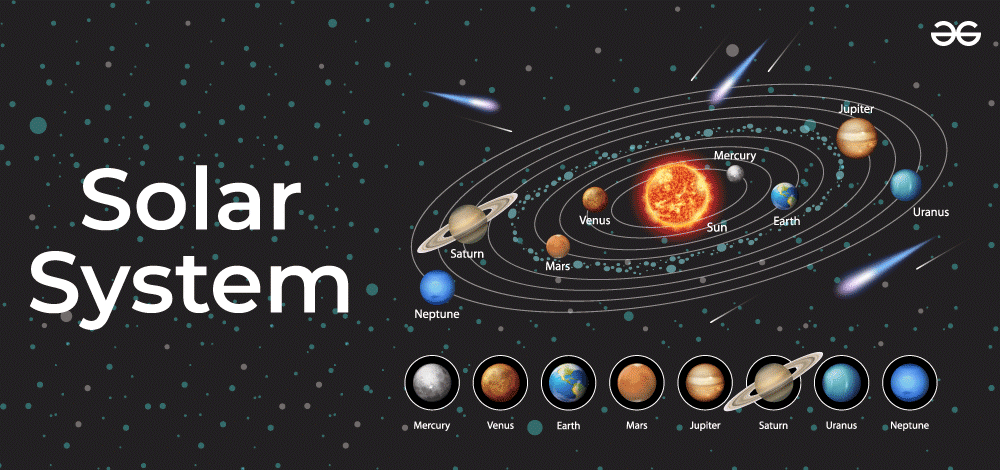
Solar System
- **Mercury: It is closest to the Sun. It is very hot during the day and freezing cold at night. It is the smallest planet in the System. It has no moons.
- **Venus: It is the brightest and hottest planet. It is visible in the evening and morning. Hence, it is also known as the evening star or morning star. It has no known moons.
- **Earth: It is the third planet from the sun. It is the only planet where life is known to exist. It is also known as the blue planet, as seventy percent of its surface is covered by water. It has only one Moon.
- **Mars: The surface of Mars is covered with red dust, so it appears to be red in color. Hence, it is also known as the red planet. Recently, scientists have found some water on Mars. It has two satellites.
- **Jupiter: It is the largest planet in the Solar System, and it weighs more than 318 Earths put together. Despite its weight, it spins very fast.
- **Saturn: It is the sixth planet from the Sun. It has a system of beautiful rings made up of ice, rocks, and dust. It has the maximum number of known moons.
- **Uranus: It appears to be blue-green in color. Like Saturn, Uranus also has a system of rings
- **Neptune: Like Earth. Neptune also appears to be blue in color. Fast-blowing ice-cold storms are a feature of this planet.
Previously, Pluto was also part of our Solar System. Pluto's status was downgraded to that of a "**dwarf planet" by the International Astronomical Union (IAU) because it did not meet the three criteria used by the IAU to define a full-sized planet.
The IAU's three criteria for a full-sized planet are:
- It is in an orbit around the Sun.
- It has enough mass to maintain hydrostatic equilibrium (a nearly round shape).
- It has "cleared the neighborhood" in which it is orbiting.
Pluto meets two of these criteria but failed to fulfill the third one.
Earth
Earth is the only planet in Solar System that is known to support life. It has land, water, and air. It is also situated at the right distance from the sun. Hence, the temperature is neither too hot nor too cold.

Earth''s Axis
**Imaginary Lines—Axis and Equator
- **Axis: The hub is a fanciful line that goes through the focal point of the Earth and joins the North Pole toward the South Pole. The pivot of the Earth is named.
- **Equator: A fanciful line goes around the earth and partitions it into equivalent parts, the Northern and the Southern sides of the equator.
Movements of Earth
The earth moves continuously. It has two different types of movements: rotation and revolution. Rotation gives rise to day and night :
- Movements: Spins on its axis like a top. The spinning motion of the Earth on its axis is called rotation.
- Earth rotates on a tilted axis. It takes about 24 hours to rotate once on its axis. The rotation of the Earth on its axis causes the formation of day and night. As the Earth rotates, the half that faces the Sun receives sunlight and has a day while the other half remains in darkness as it does not receive any sunlight. This half has night.