Conflict Resolution in Project Management: Complete Guide (original) (raw)
Last Updated : 23 Jul, 2025
In project management, conflicts are a natural part of working with different people and ideas. While conflicts might seem like a problem, they can actually be a chance to improve and come up with better solutions when handled well. This guide is here to help you understand how to deal with conflicts in your projects effectively.
We’ll cover simple strategies and tips to resolve disagreements, understand why conflicts happen, and keep your team working well together. Whether you’re new to managing projects or have been doing it for a while, learning how to handle conflicts smoothly will help you lead your team better and make sure your projects succeed.
Table of Content
- What is Project Conflict?
- Why is conflict management important in project management?
- Types of Conflicts In Project Management
- How do you handle conflict in project management
- Top 10 Conflict Resolution Strategies Convert Conflicts Into Growth Channels
- Conclusion: Conflict Resolution in Project Management
- FAQs: Conflict Resolution in Project Management
What is Project Conflict?
Interpersonal conflict is a situation or scenario that involves differences of opinions, attitudes, and aggressive feelings between members of or between the project team or between stakeholders and the project team. These conflicts may result from dissimilarities in matters of opinion, objectiveness, ethics, or restrictions on the available resources. These include relational, where disputes stem from differences affecting people’s interpersonal relations, and operational, arising from differences concerning project activities. Conflicts in academic teams must always be addressed because they affect cohesiveness and, thereby, project outcomes. There are ways to manage conflict, such as effective communication, bargaining and dealing with a deal, and setting the roles of project members. In approaches to conflict resolution, it will be observed that this can help in finding better solutions and inventions.
Why is conflict management important in project management?
Conflict management is crucial in project management for several reasons:
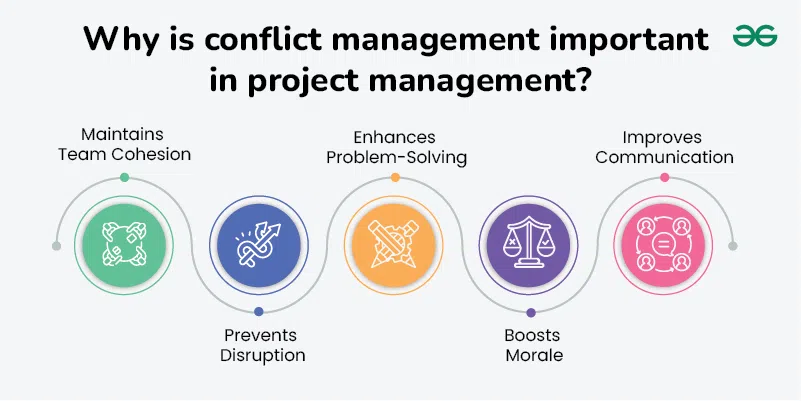
Why is conflict management important
- **Maintains Team Cohesion: Managing conflict impacts the manner in which people in organizational dealings interact with each other, hence the need for proper management of conflicts to ensure productive relationships between the parties.
- **Prevents Disruption: In particular, with proper identification of conflicts, managers are able to avoid problem situations that might hinder the outcome of the project.
- **Enhances Problem-Solving: One vital concept in conflict management is constructive conflict, which involves the creation of a solution that utilizes everyone’s viewpoint to achieve the most effective decision and outcome.
- **Boosts Morale: Proper conflict management keeps morale and motivation high because employees feel that their issues are being considered and solved.
- **Improves Communication: The aggressive disposition thrives on the approach to ensuring that all the conflicting parties engage in free-flowing communication and a common understanding of cost-related goals and tasks for the project.
Types of Conflicts In Project Management
In project management, conflicts can arise in various forms, including:
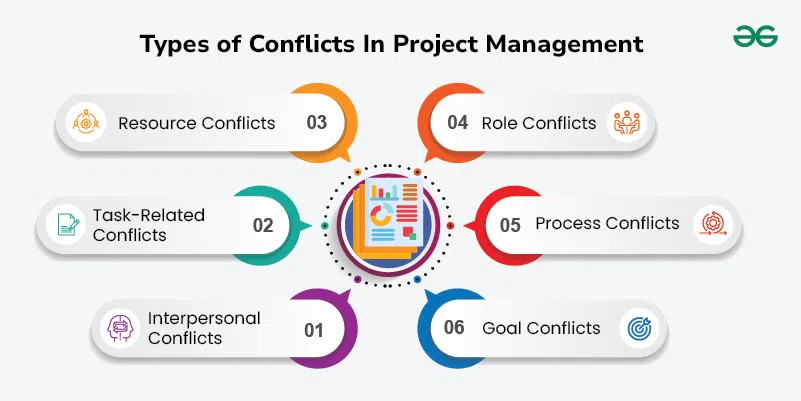
Types of Conflicts In Project Management
- **Interpersonal Conflicts: These are the result of partners’ individual characteristics or perceived differences, conflict derived from conflict between some partners, or communication failures within the team.
- **Task-Related Conflicts: These entail disputes about the specific assignments within a project, the order of tasks to be accomplished, or the roles of team members. It especially arises due to differences in perceiving how certain responsibilities should be performed or who should do them.
- **Resource Conflicts: The problems occur when the amounts of resources are scarce, for instance, budget, equipment, or manpower, and people or departments have to ‘‘fight’’ for them.
- **Goal Conflicts: These happen when individuals in the team or other stakeholders have divergent interests, goals, or perceptions of the project’s deliverables or expected results.
- **Process Conflicts: These are disputes over the tools or the way the project has been implemented, for example, approaches to project control or work flows.
- **Role Conflicts: These crop up whenever the scopes of tasks and responsibilities are not clearly defined or there is conflict over who does what task.
How do you handle conflict in project management
Handling conflict in project management involves several key steps:
- **Identify the source: Find out if it is an interpersonal, task, resource, goal, process, or role conflict.
- **Listen and Understand: Discuss the case with the related parties to listen to what they have to say and what they think is wrong or would happen. The process weaves through, clarifies issues, and shows empathy to the speaker during active listening.
- **Communicate Clearly: Some of the concepts common among exceptional teams and those defined by the state include the following: Avoid the use of abusive or provocative words when addressing the conflict issue, and look for ways to solve the problem.
- **Find Common Ground: Maximizing the gain for everyone enables one to select the issues that the various actors have in common. This can assist in coming up with a resolution that will be favorable to all the authorities that are in leadership positions.
- **Negotiate and Compromise: Organize a round table meeting where one is able to present the solutions and come up with the terms of implementation. Strive to achieve a middle ground that benefits companies, consumers, and the environment at the same time.
Top 10 Conflict Resolution Strategies Convert Conflicts Into Growth Channels
Here are ten conflict resolution strategies that focus on converting conflicts into opportunities for growth:
- **Reframe the Conflict: Use passion and conflicts as an opportunity and a tool for personal and organizational development. Teach the employees or your team members to embrace the conflict as a way through which they can grow.
- **Promote Learning and Development: The conflicts should therefore be used as strength by pinpointing the areas that require development and filling them. Facilitate members to sharpen their conflict-solving and interpersonal communication skills.
- **Foster a Culture of Feedback: Promote the practice as feedback as a message, not a criticism point of view. Specifically, conflicts should be effectively used as feedback sessions that can help individuals transform personally and professionally.
- **Encourage Collaborative Problem-Solving: Include all stakeholders in debates about the solution and the formation of tactics. It can indeed foster creativity as well as improve communication and cooperation within the primary working team.
- **Set Development Goals: Apply conflicts in order to establish new positive goals for individual or team improvements. For instance, the resolution of a conflict may result in better cooperation or an enhanced ability to manage people.
- **Enhance Communication Skills: Mitigate conflicts by enhancing communication processes. It plays an important role in the management of teams because, when it is done well, relations between workers may improve and there will be mutual understanding.
- **Build Resilience: Promote team members’ mental capital in conflict management so that the participants learn how to cope with conflict. Such people are prepared to face the next hurdle or adversity, as it is likely to occur in the future.
- **Encourage Reflection: A post-mortem of conflict resolution should be taken to ensure that an insight into what was learned during the conflict is gained. Engaging in this reflection allows us to achieve the goal of enhancing the ease of execution of our activities and our developments.
- **Create a supportive environment: support individual team members in handling inter-organizational conflicts. It is possible for support people to be closely related to growth and development when faced with difficult situations.
- **Recognize and Reward Growth: Appreciate or laurel those people or groups who managed to solve conflicts and utilize the scenario as a learning point. This acknowledgement also builds on the positive behavior concerning practice development.
Related Posts:
- Project Management Tutorial
- What is Project Management? Definition, Concepts and
- Phases of Project Management Process
- Software Project Management (SPM) - Software Engineering
- What are the Principles of Project Management?
- What is Project Management System?
Conclusion: Conflict Resolution in Project Management
Addressing conflicts in project management is critical since it impacts performance by promoting the unity and working ability of the project team in tackling problems as well as in the realization of project objectives. It means that conflicts can be seen from a proactive perspective by project managers, which creates a helpful chance of learning from difficulties. The important approaches include relabeling the issues, creating a culture of constructive critique, cooperation, and mindfulness. A supportive environment and appreciating progress also create a strong and creative team in the process of developing resistance. In conclusion, when conflicts are dealt with positively, the conflict is solved, and in the long run, the mastery of conflicts benefits the team and makes the undertaking of projects more advantageous and successful.