Container as a Service (CaaS) (original) (raw)
Last Updated : 19 May, 2021
What is a Container :
Containers are a usable unit of software in which application code is inserted, as well as libraries and their dependencies, in the same way that they can be run anywhere, be it on desktop, traditional IT, or in the cloud.
To do this, the containers take advantage of the virtual operating system (OS) in which OS features (in the case of Linux kernel, which are the first names and groups of domains) are used in both CPU partition, memory, and disk access processes.
Container as a Service (CaaS) :
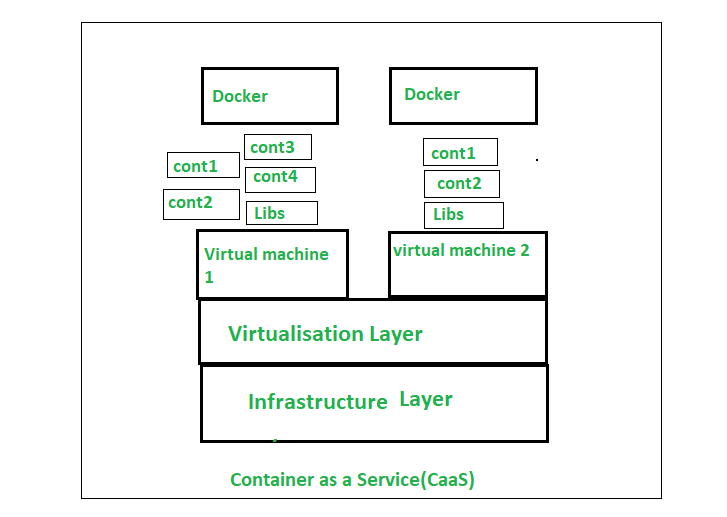
Containers as a service (CaaS) is a cloud service model that allows users to upload, edit, start, stop, rate and otherwise manage containers, applications and collections. It enables these processes through tool-based virtualization, a programming interface (API) or a web portal interface. CaaS helps users create rich, secure and fragmented applications through local or cloud data centres. Containers and collections are used as a service with this model and are installed in the cloud or data centres on the site.
CaaS assists development teams to deploy and manage systems efficiently while providing more control of container orchestration than is permitted by PaaS.
Containers-as-a-service (CaaS) is part of cloud services where the service provider empowers customers to manage and distribute applications containing containers and collections. CaaS is sometimes regarded as a special kind of Infrastructure-as-a-service (IaaS) model for cloud service delivery, but where larger assets are containers there are virtual machines and physical hardware.
Advantages of Container as a Service (CaaS) :
- Containers and CaaS make it much easier to deploy and design distributed applications or build smaller service.
- During development, a collection of containers may handle different responsibilities or different coding environments.
- Network protocol relationships between containers can be defined and binding to forwarding.
- CaaS promise that these defined and dedicated container structures can be deployed quickly in cloud capture.
- For considering an example, Think of a fake software program designed with a microservice design, in which the service plan is organized with a business domain ID. Service domains can be: payments, authentication, and a shopping cart.
- Using CaaS, these application containers can be sent instantly to a live system.
- Posting applications installed on the CaaS platform enables program performance using tools such as log integration and monitoring.
- CaaS also includes built-in automated measurement performance and orchestration management.
- It enables teams to quickly build high visibility and distributed systems for high availability.
- In addition, CaaS enhances team development with power by enabling faster deployment.
- Containers are used to prevent targeted deployment while CaaS can reduce engineering operating costs by reducing the DevOps resources needed to manage deployments.
Disadvantages of Container as a Service (CaaS) :
- Depending on the provider, there are limits to the technology available.
- Extracting business data from the cloud is dangerous.
Security Issues :
- Containers are considered safer than their counterparts like Microsoft Machines, but have some risks.
- Although they are agnostic platforms, containers share the same kernel as the operating system.
- This puts the containers at risk of being targeted if they are targeted.
- The risks increase exponentially as containers are deployed in the Cloud via CaaS.
Performance Limitations:
- Containers are visible areas and do not run directly on the bare metal.
- There is something missing with the extra layer between the bare metal and the application containers and its characters.
- Combine this with the network loss of the container associated with the hosting plan; the result is a significant loss of performance.
- Therefore, businesses must face some losses in the functionality of the containers even after the high quality hardware available.
- Therefore, it is sometimes preferred to use programs with a bare metal to test the full potential of the application.
How CaaS Works?
A container as a service is a computing and accessible computer cloud. Used by users to upload, create, manage and deploy container-based applications on the cloud platform. Cloud-based environment connections can be made using a graphical interface (GUI) or through API calls. The essence of the entire CaaS platform is an orchestration tool that enables the management of complex container structures. Orchestration tools combine between active containers and enable automated operations. The existing orchestrator in the CaaS framework has a direct impact on the services provided by service users.
Why containers are important:
- With the help of containers application code can be packaged so that we can run it anywhere.
- Helps in promoting portability between multiple platforms.
- Helps in faster release of products.
- Provides increased efficiency to develop and deploy innovative solutions and compose distributed systems.
Why Caas is important :
- Helps developers to develop fully scaled container as well as application deployment.
- Helps in simplifying container management.
- Helps in automating key IT functions like Google Kubernetes and docker.
- Helps in increasing team development velocity which results rapid development and deployment
Conclusion:
There is a reason why many industrialists swear by the containers. The benefits offered by containers far outweigh any disadvantages. Ease of operation, resource friendliness, elegance, and portability make it a clear favourite in the coding community.