Corrective Maintenance (CM) (original) (raw)
Last Updated : 22 Aug, 2024
**Corrective Maintenance (CM) is a reactive maintenance strategy employed to restore a system, machine, or software to its optimal working condition after a failure or malfunction has occurred. Unlike preventive maintenance, which aims to prevent issues before they happen, **Corrective Maintenance focuses on identifying, isolating, and repairing faults or defects once they are detected. This approach is crucial in ensuring that operations resume quickly and efficiently, minimizing downtime and maintaining productivity.
In the context of software development, **Corrective Maintenance involves fixing bugs or errors that are discovered during the use of the software, ensuring that the system remains functional and reliable.
Table of Content
- What is Corrective Maintenance?
- Examples of Corrective Maintenance
- Objectives of Corrective Maintenance (CM)
- Basic characteristics of Corrective Maintenance (CM)
- When to use CM?
- Advantages of Corrective Maintenance :
- Disadvantages of Corrective Maintenance :
- How Are Corrective Maintenance Needs Identified?
- How to Reduce Corrective Maintenance
- Corrective vs Breakdown Maintenance
- Conclusion
- Frequently Asked Questions on Corrective Maintenance
What is Corrective Maintenance?
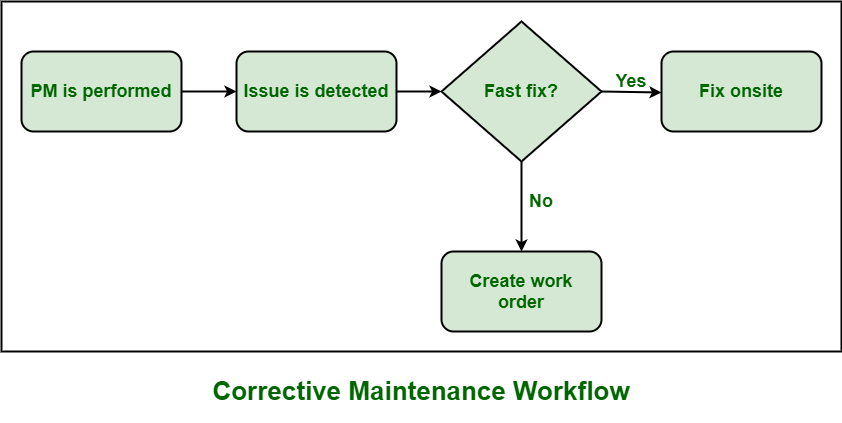
**Corrective maintenance (CM), as name suggests, is maintenance strategy that is used to correct something in its normal working condition. Whenever any equipment or asset gets failed, one needs to identify main problem and then make decision regarding whether particular equipment should require either repair or replacement. CM is a type of maintenance strategy that is generally required when an asset i.e. equipment, component, part of equipment, etc. gets failed or stops working or gets damaged, simply to bring assets back to their normal working condition. An asset can be corrected either by replacing it or repairing it. Its main aim is generally to restore broken assets or equipment. One can say that it is basically a rectification process that is mainly implemented after occurrence of failure or breakdown. CM can also be used as part of wider strategy to plan your maintenance strategy. There are several situations when such maintenance occurs :
- Whenever any problem is detected using condition monitoring.
- Whenever a potential fault is identified while routine inspection.
- Whenever an asset or equipment fails or breaks down.
 Examples of Corrective Maintenance
Some of examples of corrective maintenance in software are
- Fixing a Software Bug
- Patching Security Vulnerabilities
- Resolving Compatibility Issues
- Restoring Lost Data
- Repairing a Feature That Stopped Working
**Objectives of Corrective Maintenance (CM)
- Main aim of CM is to prevent production loss. For preventing production loss, CM simply brings equipment or asset back into their normal working condition to reduce effect on production. Equipment failure can affect cost of production, product quality, and customer satisfaction.
- Another main objective of CM is to effectively repair each failed piece of equipment. CM has to perform an appropriate number of repairs until failed equipment is bought back to its working condition.
- Another objective is to manage appropriate repair costs for each failure of equipment.
- Another objective is simply to reduce future chances of failure. CM simply makes sure to avoid any sudden failure that can be more severe in future.
- Another objective is to manage replacement cost that is required for backup equipment.
**Basic characteristics of Corrective Maintenance (CM)
- CM can be both i.e. either planned or unplanned.
- In such maintenance strategy, maintenance task is assigned only after occurrence of failure or breakdown and that too within given period of mine.
- Failure that is needed to be corrected should be less severe. CM is only effective if failure maintenance is less severe in nature.
- Corrective maintenance makes sure that particular equipment failure should not affect overall production loss by simply correcting it and bringing equipment back to its normal working condition.
**When to use CM?
- It's obvious that, at certain times, assets or equipment generally break down or gets failed. Maintenance team usually perform maintenance task in order to repair or replace failed equipment.
- Main question that arise is when one should use CM over another maintenance strategy because there are many maintenance strategies available nowadays.
- This decision of choosing CM mainly depends upon how fast equipment can be repaired if a problem occurs, reliability of a particular asset, and the cost of downtime.
- Sometimes performing corrective maintenance can be more costly than other performing types of maintenance.
- But it's better for one to prevent equipment from failure by performing preventive maintenance rather than performing corrective maintenance.
**Advantages of Corrective Maintenance :
- **Improves software quality: Corrective maintenance can help improve software quality by identifying and fixing bugs, errors, and defects in the software code. This can lead to a more stable, reliable, and efficient software product.
- **Enhances user satisfaction: Corrective maintenance can help enhance user satisfaction by addressing bugs or issues that impact the user experience. This can lead to higher user adoption and better customer feedback.
- **Minimizes the risk of downtime: Corrective maintenance can help minimize the risk of downtime by fixing issues that could potentially cause the software to crash or malfunction. This can help improve the overall reliability of the software system.
- **Reduces the cost of maintenance: Corrective maintenance can help reduce the cost of maintenance by only addressing issues when they actually occur. This can help save time and resources that would otherwise be spent on unnecessary maintenance activities.
**Disadvantages of Corrective Maintenance :
- **Increased downtime: Corrective maintenance involves fixing equipment or software after a fault has occurred, which can lead to increased downtime and reduced productivity. This can be especially problematic for critical equipment or systems.
- **Higher costs: Corrective maintenance can be more expensive than preventive maintenance or predictive maintenance, it involves repairing or replacing equipment or software that has already failed.
- **Reduced safety: Corrective maintenance can increase safety risks if equipment or software malfunctions before the corrective maintenance can be performed. This can be especially problematic in safety-critical systems.
- **Difficult to plan: Corrective maintenance can be difficult to plan, as it is based on when failures occur rather than a predetermined maintenance schedule. This can make it challenging to budget for and schedule maintenance activities.
How Are Corrective Maintenance Needs Identified?
Corrective Maintenance needs are identified through regular inspections, monitoring equipment performance, and analyzing past maintenance data. When technicians notice problems like unusual noises, breakdowns, or system errors they diagnose the issue to determine the necessary repairs. They may also use diagnostic tools and software to track equipment health indicators, which helps in spotting potential failures before they become serious problems.
So this approach allows for timely interventions, ensuring that equipment remains operational and efficient.
How to Reduce Corrective Maintenance
To reduce corrective maintenance, we should follow the simple techniques:
- **Regular Inspections: Schedule routine checks to catch problems early before they become major issues.
- **Preventive Maintenance: It helps to perform regular upkeep, which helps avoid unexpected breakdowns.
- **Train Staff: Educate employees on proper equipment use and maintenance practices so they can identify potential issues early.
- **Use Technology: Utilize monitoring tools that can predict equipment failures, allowing for timely repairs before problems escalate.
- **Analyze Data: Review maintenance records to identify patterns and address recurring issues proactively.
These can help us to keep equipment running smoothly and minimize the need for corrective maintenance.
Corrective vs Breakdown Maintenance
| Parameter | Corrective Maintenance | Breakdown Maintenance |
|---|---|---|
| Define | Fixing equipment after a problem is found. | Fixing equipment only after it stops working. |
| When it Happens | When issues are spotted or reported. | When equipment suddenly breaks down. |
| Planned or Unplanned | Can be planned or unplanned based on urgency. | Usually unplanned and happens right away. |
| Impact on Operations | May cause minor disruptions if planned. | Often leads to major downtime. |
| Cost | Can be less expensive in the short term. | Usually costs more due to emergencies. |
| Goal | Fix the problem and prevent future issues. | Get equipment working again quickly. |
Conclusion
Incorporating **Corrective Maintenance into your maintenance strategy is essential for addressing unexpected failures and ensuring the continued operation of systems and software. By quickly responding to and resolving issues, **Corrective Maintenance helps maintain productivity and reduce the impact of downtime on business operations. While it is a reactive approach, it plays a vital role in the overall maintenance process, complementing preventive and predictive strategies to keep systems running smoothly.
Understanding the importance of **Corrective Maintenance allows businesses to be better prepared for unforeseen issues, ensuring a swift return to optimal performance