Verification Vs Validation (original) (raw)
Last Updated : 16 May, 2026
Verification and Validation are two important concepts in software testing used to ensure software quality. Both help in delivering a correct and reliable product, but they differ in approach and purpose. Verification focuses on checking processes, while validation focuses on checking the final product.
- Both are part of quality assurance and testing process
- Help ensure software correctness and reliability
- Used at different stages of development
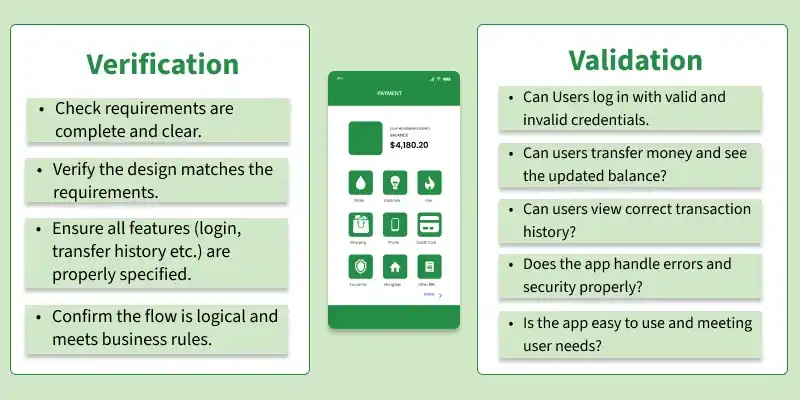
Verification Vs Validation
Verification
Verification is the process of evaluating work products to ensure they meet specified requirements. It checks whether the software is being developed correctly according to design and standards.
- Focuses on process and documentation
- Done without executing the code (static testing)
- Includes reviews, inspections, and walkthroughs
**Example: Reviewing requirement and design documents of a banking app to ensure all features are correctly planned before development.
Validation
Validation is the process of evaluating the final product to ensure it meets user needs and expectations. It checks whether the right product has been built.
- Focuses on final product behavior
- Done by executing the code (dynamic testing)
- Includes system testing, user acceptance testing
**Example: Testing a banking app to verify if users can successfully log in, transfer money, and view transactions.
Verification vs Validation
| Features | Verification | Validation |
|---|---|---|
| Definition | Ensures work products conform to specified requirements | Ensures the final product meets user and stakeholder needs |
| Focus | Requirements, design, and implementation correctness | Functional behavior and intended use |
| Nature | Often analytical and review-based | Typically evaluation- and execution-based |
| Execution | May or may not involve executing software | Usually involves executing the software |
| Methods Used | Methods used in verification are reviews, walkthroughs, inspections and desk-checking. | Functional testing, system testing, acceptance testing |
| Purpose | It checks whether the software conforms to specifications or not. | It checks whether the software meets the requirements and expectations of a customer or not. |
| Bug | Helps detect defects early by checking conformance to requirements and standards. | Detects defects during execution, including functional, usability, and integration issues. |
| Goal | The goal of verification is application and software architecture and specification. | The goal of validation is an actual product. |
| Responsibility | Involves developers, reviewers, QA, and engineers | Involves testers, users, QA teams, and stakeholders. |
| Timing | Performed throughout the software development lifecycle. | Performed throughout the lifecycle when the system or components are executable. |
| Lifecycle | Applied continuously across all lifecycle phases. | Applied iteratively as the system evolves and becomes usable. |
| Error Focus | Verification is for prevention of errors. | Validation is for detection of errors. |
| Stability | Based on defined criteria, standards, and expert judgment. | Based on observed system behavior and acceptance criteria. |