Different participants of Defect Life Cycle (original) (raw)
Last Updated : 18 May, 2026
The Defect Life Cycle involves key participants, each with a defined role and responsibility. Their coordination ensures proper defect tracking, timely resolution, and improved overall software quality.
- Each participant contributes at a specific stage of defect management.
- Clear responsibilities reduce confusion and speed up resolution.
- Proper coordination between participants minimizes miscommunication and prevents defects from being missed.
Stages of the Defect Life Cycle
The defect life cycle consists of several stages, each representing a specific status that a defect passes through during its resolution process.
- **New: A defect is discovered and logged for the first time in the defect tracking tool. It has not yet been reviewed or validated by the team.
- **Assigned: The defect is reviewed by the test lead or project manager and assigned to the appropriate developer for investigation and resolution.
- **Open: The developer begins analyzing and working on the defect. This is the active investigation and fixing stage.
- **Fixed: The developer has resolved the defect and updated the status to indicate that a fix has been applied. It is now ready for re-testing by the QA team.
- **Pending Retest: The fixed defect is waiting to be re-tested by the tester in the appropriate environment. It is in a queue for verification.
- **Retest: The tester actively re-tests the defect to verify whether the fix works correctly and whether the original issue has been resolved.
- **Verified: The tester confirms that the defect has been successfully fixed. The fix is validated and the defect passes re-testing.
- **Closed: The defect is officially marked as closed after successful verification. No further action is required on this defect.
- **Reopened: If the fix is found to be inadequate or the defect reappears, the tester reopens it and sends it back to the developer for further investigation. The cycle restarts from the Open stage.
- Rejected / Not a Bug: If the reported issue is not a valid defect — for example, it works as designed, is a duplicate, or cannot be reproduced — it is rejected by the developer or test lead.
- **Deferred: The defect is valid but will not be fixed in the current release. It is postponed to a future release based on priority and business decisions.
Participants of the Defect Life Cycle
The Defect Life Cycle is managed by key participants who collaborate to detect, report, fix, and close defects systematically.
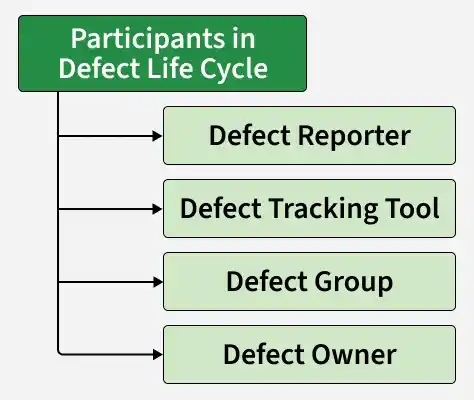
Participants of Defect Life Cycle
1. Defect Reporter
A Defect Reporter is the person who identifies and reports a defect in the software. Their primary responsibility is to validate the defect and provide complete, accurate information in the defect tracking tool so that the issue can be properly understood and resolved by the development team.
- Ensures the defect description is clear and detailed enough for developers to reproduce it without additional clarification.
- Attaches screenshots, logs, or supporting files to explain the defect clearly.
- Ensures the defect description is detailed enough for developers to reproduce the issue independently.
- Plays a crucial role in the initial stage of the defect management process.
2. Defect Tracking Tool
A Defect Tracking Tool is a software application used to record, report, track, assign, and manage defects throughout the software development lifecycle. It serves as the central system that gives all team members visibility and control over every defect from discovery to closure.
- Allows systematic logging, tracking, and monitoring of defects in one place.
- Helps in assigning defects to the right team members and tracking their current status.
- Provides clear visibility into defect trends, resolution rates, and overall software quality.
- Popular examples include Jira, Bugzilla, Assembla, and Azure DevOps.
- Improves communication between testers, developers, and project managers regarding defects.
3. Defect Group
A Defect Group refers to the team of people who are authorized to view, monitor, and participate in all activities related to a defect — from its identification until its final resolution. It includes all stakeholders involved in the defect lifecycle.
- Consists of testers, test leads, developers, project managers, and QA managers.
- Provides full visibility of defect details and progress to all group members.
- Ensures smooth collaboration and accountability throughout the defect resolution process.
- May include end-users or clients who report defects from a production or UAT environment.
- Collectively accountable for ensuring the defect progresses smoothly from identification to closure.
4. Defect Owner
A Defect Owner is the person assigned responsibility for reviewing, validating, and resolving a specific defect. They take full ownership of the defect and ensure it is fixed correctly and within the defined timeline based on its priority and severity.
- Reviews and validates the completeness of defect information provided by the reporter.
- Returns the defect to the reporter if additional details or clarification are required.
- Analyzes the root cause and either fixes the defect directly or coordinates with the development team to ensure resolution within the agreed deadline.
- Ensures the defect is properly resolved and verified before it is marked as closed.