Equivalence Partitioning Method (original) (raw)
Last Updated : 18 May, 2026
Equivalence Partitioning (EP) is a black-box testing technique that divides input data into valid and invalid partitions. It helps reduce the number of test cases while ensuring effective test coverage.
- Divides input data into partitions, where each partition represents similar behavior .
- Selects one representative value from each partition for testing
- Reduces test cases while maintaining good coverage
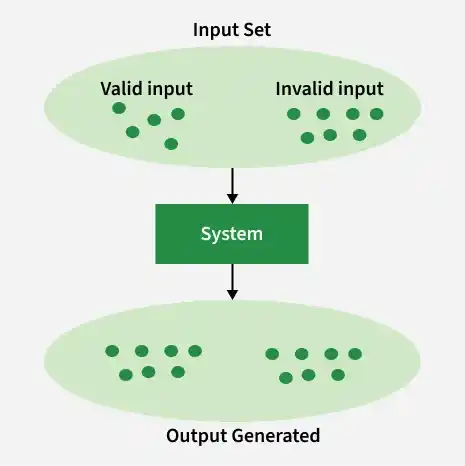
Input-set
Guidelines for EP
The way equivalence classes are defined depends on the type of input. Each input type has corresponding valid and invalid partitions.
| Input Type | Valid Class | Invalid Class(s) |
|---|---|---|
| Range Input | Values within the range | Values below or above the range |
| Specific Value | Exact valid value | Values less than or greater than the valid value |
| Set of Values | Values in the set | Values not in the set |
| Boolean Input | Expected value (true/false) | Unexpected value |
Steps of EP
Equivalence Partitioning is applied by dividing inputs into logical groups and selecting representative values. Following a structured approach helps ensure effective and efficient testing.
- **Identify input fields: Determine all input variables that need to be tested.
- **Define input ranges or conditions: Understand valid and invalid conditions for each input.
- **Divide into equivalence classes: Group inputs into valid and invalid partitions.
- **Select representative values: Choose one value from each partition for testing.
- **Design test cases: Create test cases using the selected values.
- **Execute and validate results: Run the test cases and compare actual results with expected results.
Limitations of EP
Equivalence Partitioning is useful for reducing test cases, but it has certain limitations. It may miss defects if partitions are not properly defined.
- May miss boundary defects if used alone without BVA.
- It depends on correct partitioning; incorrect grouping can lead to missed defects.
- Does not cover all combinations of inputs.
- Less effective for complex logic or interdependent inputs.
Example
Consider a college admission form where the percentage field accepts values between 50% and 90% only.
Using Equivalence Partitioning, the input can be divided into three classes:
- **Invalid Class 1: Percentage < 50%
- **Valid Class: Percentage between 50% and 90%
- **Invalid Class 2: Percentage > 90%
If a student enters a percentage outside the valid range, the application displays an error message. If the entered percentage is within 50%–90%, the input is accepted.
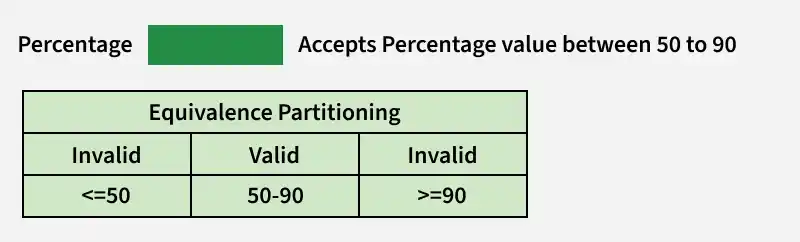
College Admission Percentage
Benefits of EP
Equivalence Partitioning helps simplify the testing process by reducing redundant test cases. It improves efficiency while still ensuring proper validation of system behavior.
- Reduces the number of test cases while maintaining good coverage
- Identifies valid and invalid inputs effectively
- Saves time and effort in testing large input domains
- Can be combined with BVA for more robust and effective testing
Equivalence Partitioning is most effective when input classes are defined accurately. Following best practices helps improve test coverage and defect detection.
- **Define clear partitions based on requirements and input conditions
- **Include both valid and invalid classes for complete testing
- **Select proper representative values from each partition
- **Avoid overlapping partitions to prevent confusion