ISO/IEC 9126 in Software Engineering (original) (raw)
Last Updated : 23 Jul, 2025
The International Organization for Standardization (ISO) has established a series of ISO and ISO/IEC standards for software quality. Starting with the ISO 9000-3 instructions for implementing the ISO 9001 standard, which is concerned with quality assurance processes, to the creation, supply, installation, and maintenance of computer software. The ISO/IEC 9126 standard for software product quality should be used in conjunction with ISO/IEC 14598 for evaluating software products.
Table of Content
- What is ISO/IEC 9126?
- Parts of ISO/IEC 9126
- Quality Model
- External Metrics
- Internal Metrics
- Quality in use metrics
- History of ISO/IEC 9126
- Questions For Practice ON ISO/IEC 9126
- Conclusion
- Frequently Asked Questions
What is ISO/IEC 9126?
**ISO/IEC 9126 is an international standard proposed to make sure ****'quality of all software-intensive products'** which includes a system like safety-critical where in case of failure of software lives will be in jeopardy. **ISO i.e. **International Organization for Standardization and **IEC i.e. **International Electrotechnical Commission have developed ISO/IEC 9126 standards for software engineering → **Product Quality to provide an all-inclusive specification and evaluation model for the quality of the software product.
Parts of ISO/IEC 9126
The standard is divided into 4 parts as depicted in the following figure:

Parts of Standard
- ISO/IEC 9126-1: Quality Model
- ISO/IEC 9126-2: External Metrices
- ISO/IEC 9126-3: Internal Metrices
- ISO/IEC 9126-4: Quality in use Matrices
Quality Model
Quality Model describes the quality model framework which explains relationships between different approaches to quality as well as identifying quality characteristics and sub-characteristics of software products.
Classification of Quality Model
Furthermore, the first part i.e. the Quality model is concerned classified into two categories as depicted in the following figure:
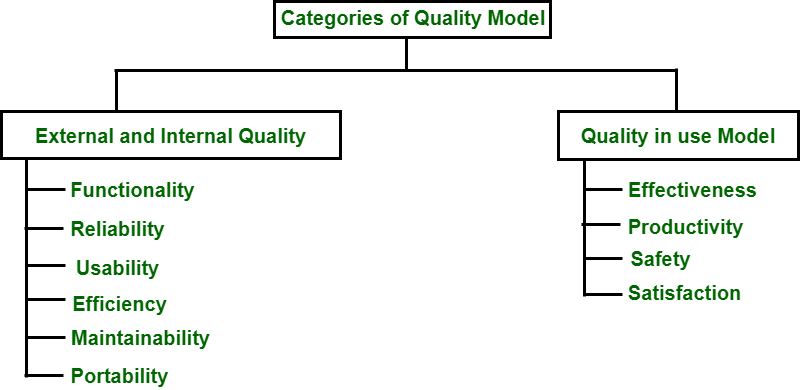
Characteristics of Quality Model
**Internal External Quality Part
Internal External Quality Part determines the quality of a software product through six characteristics which are Functionality, Reliability, Usability, Efficiency, Maintainability, and Portability.
**Functionality
The functions are those that will satisfy implied needs.
- Suitability
- Accuracy
- Interoperability
- Security
- Functionality Compliance
**Reliability
A set of attributes that will bear on the capability of software to maintain the level of performance.
- Maturity
- Fault Tolerance
- Recoverability
- Reliability Compliance
**Usability
A set of attributes that bear on the effort needed for use by an implied set of users.
- Understandability
- Learnability
- Operability
- Attractiveness
- Usability Compliance
**Efficiency
A set of attributes that bear on the relationship between the level of performance of the software under stated conditions.
- Time Behavior
- Resource Utilization
- Efficiency Compliance
**Maintainability
A set of attributes that bear on the effort needed to make specified modifications.
- Analyzability
- Changeability
- Stability
- Testability
- Maintainability Compliance
**Portability
A set of attributes that bear on the ability of software to be transferred from one environment to another.
- Adaptability
- Installability
- Co-existence
- Replaceability
- Portability Compliance
**Quality in Use Model
It identifies the four quality characteristics.
- Effectiveness
- Productivity
- Safety
- Satisfaction
External Metrics
External Metrices is used to describe external metrics that are used to measure characteristics and sub-characteristics which are identified in quality model.
**Internal Metrics
Internal Metrices is used to describe internal metrics that are used to measure characteristics and sub-characteristics which are identified in quality model.
**Quality in use metrics
Quality in use metrices is used to identify metrics that are used to measure the effects of combined quality characteristics for users.
History of ISO/IEC 9126
Below are some points related to history of ISO/IEC 9126
- Release date of ISO/IEC 9126: December 19, 1991.
- ISO/IEC 9126:2001 (four parts, 9126–1 to 9126–4) took the place of ISO/IEC 9126:1991 on June 15, 2001.
- ISO/IEC 25010:2011 Systems and software engineering - Systems and software Quality Requirements and Evaluation (SQuaRE) - System and software quality models took the role of ISO/IEC 9126 on March 1, 2011. "Security" and "compatibility" were introduced as primary features in comparison to 9126.
Questions For Practice ON ISO/IEC 9126
**1. According to the ISO-9126 Standard Quality Model, match the attributes given in List 1 with their definition in List-2. [UGC-NET CS 2019]
| List-1 | List-2 |
|---|---|
| **a. Functionality | **i. Relationship between level of performance and amount of resources |
| **b. Reliability | **ii. Characteristics related to the achievement of the purpose |
| **c. Efficiency | **iii. Efforts needed to make for improvement |
| **d. Maintainability | **iv. The capability of software to maintain the performance of Software |
**Choose the correct option from the ones given below.
****(A)** a-i, b-ii, c-iii, d-iv
****(B)** a-ii, b-i, c-iv, d-iii
****(C)** a-ii, b-iv, c-i, d-iii
****(D)** a-i, b-ii, c-iv, d-iii
**Solution: Correct Answer is ****(C).**
**Conclusion
ISO/IEC 9126 is a standard given by the international organization for standardization (ISO) for evaluating software product quality. It is divided into four parts: Quality Model, External Metrics, Internal Metrics, and Quality in Use Metrics, each gives different aspects of software quality assessment. It has six main characteristics: functionality, reliability, usability, efficiency, maintainability, and portability. It provides a structured approach for developers and evaluators to measure and improve software quality.