Measuring Product Success in Product Management (original) (raw)
Last Updated : 23 Apr, 2026
In product management, product success is defined by how well a product delivers value to users while achieving key business objectives. It goes beyond just launching a product, focusing on impact, adoption, and long-term growth. The Key Characteristics of Product Success:
- Solves real customer problems effectively
- Drives measurable business outcomes (revenue, retention, growth)
- Ensures strong user adoption and engagement
- Aligns with overall product and company strategy
Measuring Product Success in Product Management
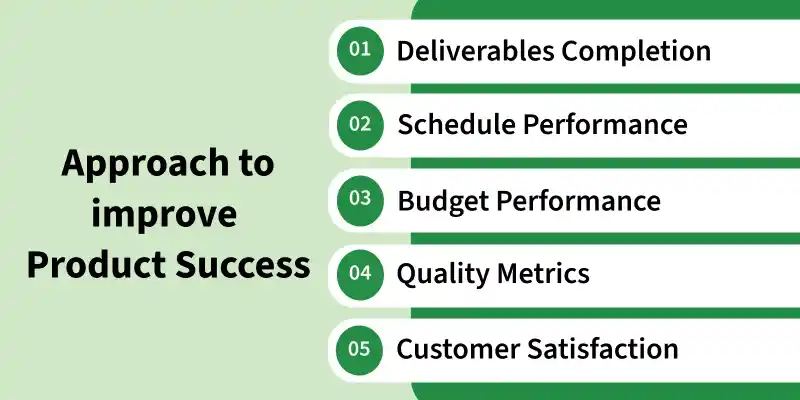
The process of measuring product success involves evaluating how effectively a product performs across multiple dimensions such as delivery, quality, cost efficiency, and customer satisfaction. It helps product managers understand whether the product is meeting its intended goals and delivering real value to users and the business. To gain a comprehensive understanding, product success is typically assessed across the following key measurement areas:
**1. Deliverables Completion
- Evaluate whether all planned features, functionalities, and tasks have been completed by comparing the final output with the project scope and specifications.
- Identify any gaps or missing elements to ensure the product fully meets the defined requirements.
**2. Schedule Performance
- Assess whether the product development aligns with the planned timeline by tracking milestones and delivery deadlines.
- Analyze any delays and their impact on the overall project to improve future time management and planning.
**3. Budget Performance
- Compare actual project costs with the estimated budget to determine financial efficiency.
- Identify cost overruns and analyze their causes to improve resource allocation and cost control strategies.
**4. Quality Metrics
- Measure product quality using indicators such as defect rates, system reliability, and compliance with established standards.
- Evaluate user-reported issues and performance consistency to ensure a seamless and reliable experience.
**5. Customer Satisfaction
- Gather feedback from users and stakeholders through surveys, interviews, and usage data.
- Analyze satisfaction levels to understand user expectations and identify areas for improvement.
For a deeper understanding of these metrics, refer to Key performance indicators (KPIs) in Product Management
Various tools and techniques are used to effectively measure product performance, user behavior, and overall success. These are mentioned below:
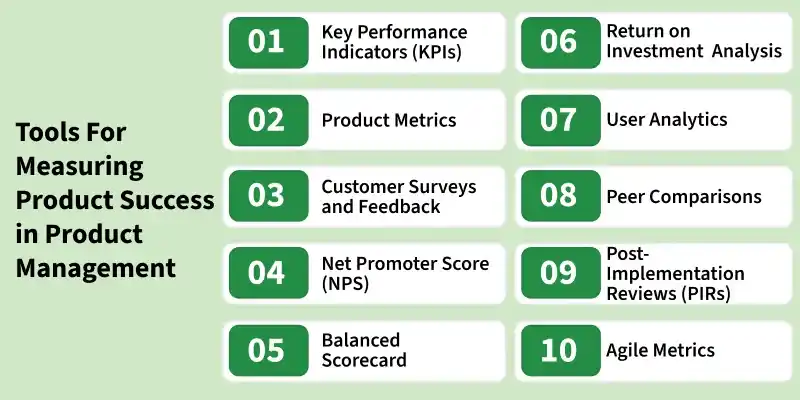
**1. Key Performance Indicators (KPIs): Used to track progress against defined goals, Key Performance Indicators (KPIs) help measure how effectively a product is achieving business objectives.
**2. Product Metrics: These provide detailed insights into product performance, where Product Metrics focus on usage patterns, engagement, and feature adoption.
**3. Customer Surveys and Feedback: Feedback collection methods play a crucial role, as Customer Surveys and Feedback help understand user needs, satisfaction, and expectations.
**4. Net Promoter Score (NPS): A widely used loyalty indicator, Net Promoter Score (NPS) measures how likely users are to recommend the product to others.
**5. Balanced Scorecard: Strategic performance evaluation can be done using frameworks like the Balanced Scorecard, which considers financial and non-financial metrics.
**6. Return on Investment (ROI) Analysis: Financial effectiveness is assessed through Return on Investment (ROI) Analysis, which compares gains from the product against its costs.
**7. User Analytics: User behavior and interaction patterns are analyzed using User Analytics, helping identify trends and areas for improvement.
**8. Peer Comparisons: Competitive positioning can be understood through Peer Comparisons, where the product is evaluated against similar offerings in the market.
**9. Post-Implementation Reviews (PIRs): Post-launch evaluation is essential, and Post-Implementation Reviews (PIRs) help assess performance and identify improvement areas after deployment.
**10. Agile Metrics: Agile teams often rely on iterative tracking methods, where Agile Metrics measure team efficiency, delivery speed, and adaptability.
Key Factors Behind Product Failure
Measuring product success involves identifying these potential failure points and addressing them effectively. Here are some common reasons why products fail and how they can be measured:
- **Poor Market Fit: Weak demand or unclear user need
- **Low User Engagement: Poor retention, low usage
- **Quality Issues: Bugs, crashes, poor performance
- **Weak Marketing: Low visibility and reach
- **No Competitive Advantage: Lack of differentiation
- **Pricing Issues: Misaligned pricing strategy
- **Poor Validation: Weak pre-launch testing
- **Execution Gaps: Budget and timeline failures
- **Market Changes: External shifts not adapted to
- **Lack of Post-Launch Support: No iteration or improvement
Strategies for Enhancing Product Success
- Understand your users deeply through research and feedback
- Define a strong value proposition that clearly solves problems
- Focus on quality and user experience
- Set measurable goals aligned with product stage
- Stay updated with industry trends
- Learn from competitors but differentiate
- Continuously refine your approach based on insights and evolving requirements
- Build a strong and aligned team