Introduction to Scaling (original) (raw)
Last Updated : 17 Jan, 2026
Scaling is one of the most important concepts in system design and software development. As an application grows, the number of users, requests, and data also increases.
- If the system is not designed to handle this growth, it can become slow, crash frequently, or stop working completely.
- Scaling is the process of increasing the system’s capacity so it can handle more traffic and workload smoothly.
Client-Server Model in Scaling
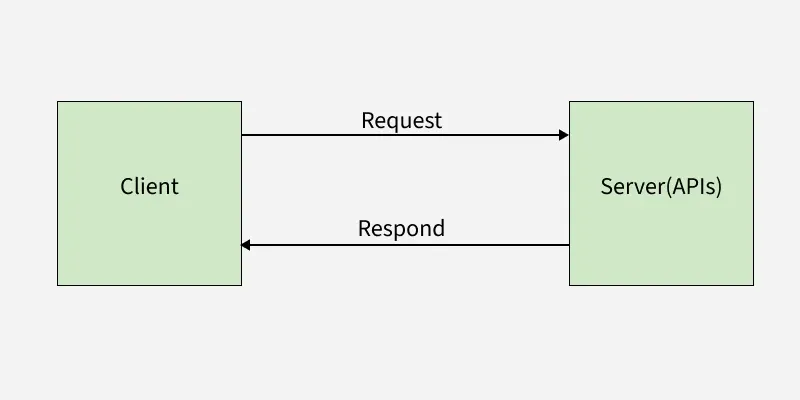
Most applications work on the Client-Server architecture, where:
- Client (Browser/Mobile App) sends a request.
- Server processes the request and sends a response.
When users increase, the server gets more requests, which can cause overload. Scaling helps the server handle more clients without downtime or slow performance.
Types of Scaling
These scaling types help systems handle more users and workload efficiently without slowing down.
1. Vertical Scaling
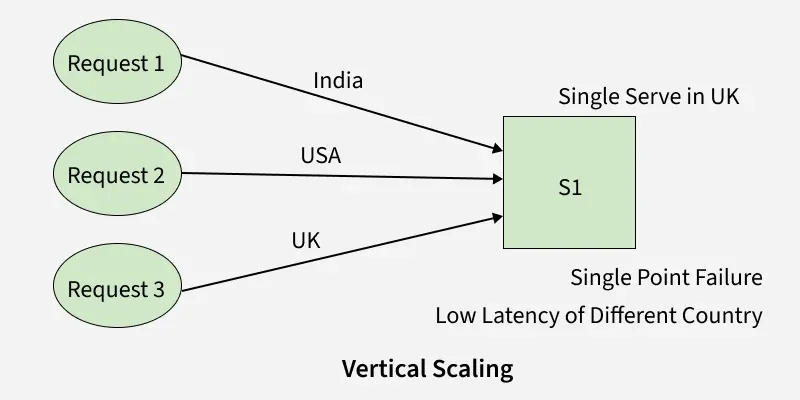
- It is defined as the process of increasing the capacity of a single machine by adding more resources such as memory, storage, etc. to increase the throughput of the system.
- No new resource is added, rather the capability of the existing resources is made more efficient.
- This is called Vertical scaling. Vertical Scaling is also called the Scale-up approach.
- **Example: MySQL
**Advantages
- It is easy to implement
- Reduced software costs as no new resources are added
- Fewer efforts required to maintain this single system
**Disadvantages
- Single-point failure
- Since when the system (server) fails, the downtime is high because we only have a single server
- High risk of hardware failures
**A Real-time Example of Vertical Scaling
- When traffic increases, the server degrades in performance.
- The first possible solution that everyone has is to increase the power of their system.
- For instance, if earlier they used 8 GB RAM and 128 GB hard drive now with increasing traffic, the power of the system is affected.
- So a possible solution is to increase the existing RAM or hard drive storage, for e.g. the resources could be increased to 16 GB of RAM and 500 GB of a hard drive but this is not an ultimate solution as after a point of time, these capacities will reach a saturation point.
Horizontal Scaling
It is defined as the process of adding more instances of the same type to the existing pool of resources and not increasing the capacity of existing resources like in vertical scaling. This kind of scaling also helps in decreasing the load on the server. This is called Horizontal Scaling.
- Horizontal Scaling is also called the Scale-out approach.
In this process, the number of servers is increased and not the individual capacity of the server. - This is done with the help of a Load Balancer which basically routes the user requests to different servers according to the availability of the server.
- Thereby, increasing the overall performance of the system. In this way, the entire process is distributed among all servers rather than just depending on a single server.
- **Example: NoSQL, Cassandra, and MongoDB
**Advantages
- **Fault Tolerance means that there is no single point of failure in this kind of scale because there are 5 servers here instead of 1 powerful server. So if anyone of the servers fails then there will be other servers for backup. Whereas, in **Vertical Scaling there is single point failure i.e: if a server fails then the whole service is stopped.
- **Low Latency: Latency refers to how late or delayed our request is being processed.
- Built-in backup
**Disadvantages
- Not easy to implement as there are a number of components in this kind of scale
- Cost is high
- Networking components like, router, load balancer are required
**A Real-time Example of Horizontal Scaling
For example, if there exists a system of the capacity of 8 GB of RAM and in future, there is a requirement of 16 GB of RAM then, rather than the increasing capacity of 8 GB RAM to 16 GB of RAM, similar instances of 8 GB RAM could be used to meet the requirements.