Test Data Management (TDM) in Software Testing (original) (raw)
Last Updated : 25 May, 2026
Test Data Management (TDM) is the process of creating, organizing, maintaining, and managing data used during software testing. It ensures that accurate, secure, and relevant test data is available for validating application functionality and performance.
- Helps improve software quality by providing reliable and consistent test data.
- Supports efficient testing across different testing phases and environments.
- Reduces testing errors, improves productivity, and ensures better test coverage.
Working of TDM
Test Data Management (TDM) follows a structured process to create, manage, secure, and provide test data efficiently for software testing activities.
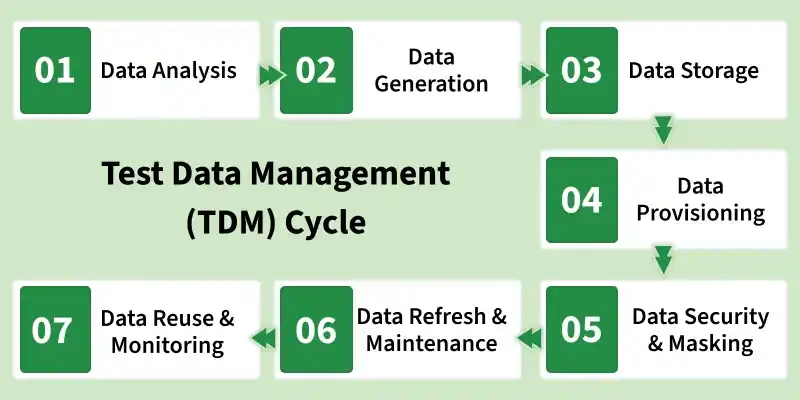
- **Data Analysis: Existing data is analyzed to identify missing, duplicate, or inconsistent information. It helps determine data quality and identify additional data requirements.
- **Data Generation: Required test data is created using production, synthetic, or automated methods. It provides realistic data for different testing scenarios.
- **Data Storage: Prepared test data is stored in a centralized repository for easy access and reuse. It improves consistency across testing environments.
- **Data Provisioning: Test data is automatically supplied to testing teams and environments when needed. It reduces manual effort and testing delays.
- **Data Security and Masking: Sensitive data is protected using masking and anonymization techniques. It prevents unauthorized access and ensures data privacy compliance.
- **Data Refresh and Maintenance: Test data is regularly updated to keep it accurate and relevant. It ensures reliable testing with current application changes.
- **Reuse and Monitoring: Reusable datasets are managed and monitored for future testing cycles. It saves time and improves overall testing efficiency.
Types of Test Data
Different types of test data are used to verify application behavior under various testing conditions.
- **Valid Data: Valid data contains correct input values that the application should accept and process successfully. It verifies proper system functionality with expected inputs.
- **Invalid Data: Invalid data includes incorrect or unsupported values used to test validation rules. It ensures the application properly rejects wrong inputs and shows error messages.
- **Boundary Data: Boundary data contains minimum and maximum acceptable input values. It helps test system behavior at input limits and detect boundary-related errors.
- **Null Data: Null data includes empty or missing input fields. It verifies whether the application correctly handles blank or unfilled values.
- **Duplicate Data: Duplicate data contains repeated entries used to test duplicate handling. It ensures the system prevents redundant records and processing issues.
- **Large Volume Data: Large volume data consists of huge datasets used for performance testing. It checks system stability, scalability, and data handling capability under heavy load.
- **Special Character Data: Special character data includes symbols and unusual characters in inputs. It verifies proper handling of special symbols, encoding, and validation rules.
Test Data Management (TDM) tools help create, manage, secure, and deliver accurate test data efficiently for software testing activities.
- **Informatica: Used for data masking, profiling, provisioning, and subsetting.
- **Compuware: Simplifies extraction and delivery of test data.
- **Delphix: Creates virtual and masked copies of test data.
- **Micro Focus Data Express: Helps protect sensitive data and manage test datasets.
- **IBM InfoSphere Optim: Supports secure test data creation and masking.
Best Practices for TDM
Following best practices in Test Data Management helps improve testing efficiency, data quality, security, and overall software reliability.
- **Data Profiling: Be aware of the characteristics of your test data to recognize problems and assure data quality.
- **Data Versioning: Keep versions of test data to track the changes; also, perform rollbacks if needed.
- **Automation: Automate test data generation, provisioning, and cleanup to improve efficiency and accuracy.
- **Data Refresh: Refresh test data periodically to reflect changes in the application under test.
Challenges and Solutions of TDM
Test Data Management faces several challenges related to data availability, quality, storage, security, and management, which can impact the effectiveness of software testing.
- **Availability of Test Data: Ensuring sufficient and accurate test data is available when required.
**Solution: Prepare and collect the required test data before testing begins. - **Maintaining Data Quality: Poor-quality data can affect testing accuracy and results.
**Solution: Validate and verify test data quality before usage. - **Test Data Storage: Managing large volumes of test data can increase storage and processing costs.
**Solution: Use efficient storage management and optimize data handling processes. - **Lack of Tools and Skills: Teams may face difficulties using data extraction and management tools.
**Solution: Provide proper training and use suitable TDM tools effectively.