Requirements Gathering (original) (raw)
Last Updated : 27 Dec, 2025
Requirements gathering is the process of collecting and understanding what a software system should do by working closely with stakeholders. It helps define features, expectations, and constraints so the final product aligns with business goals and user needs.
- Clarifies project objectives and expectations.
- Identifies stakeholder and user requirements.
- Defines system scope and boundaries.
- Reduces misunderstandings and rework.
- Helps in accurate planning and estimation.
- Improves overall software quality.
Main Requirements Gathering Subprocesses
Requirements gathering is a critical phase in the software development lifecycle, and it involves several subprocesses to ensure a comprehensive understanding of the project's needs. The main sub-processes include:
Stakeholder Identification:
- **Objective: Identify all stakeholders who will be affected by the system, directly or indirectly.
- **Process: Conduct interviews, surveys, or workshops to determine the key individuals or groups involved.
Stakeholder Analysis:
- **Objective: Understand the needs, expectations, and influence of each stakeholder.
- **Process: Analyze stakeholder inputs to prioritize requirements and manage conflicting interests.
**Problem Definition:
- **Objective: Clearly define the problems or opportunities that the software system aims to address.
- **Process: Engage stakeholders in discussions to uncover and articulate the core problems or opportunities.
- **Objective: Gather detailed requirements by interacting with stakeholders.
- **Process: Employ techniques such as interviews, surveys, observations, or brainstorming sessions to extract requirements.
Requirements Documentation:
- **Objective: Document gathered requirements in a structured format.
- **Process: Create requirements documents, use cases, user stories, or prototypes to capture and communicate requirements effectively.
Validation and Verification:
- **Objective: Ensure that gathered requirements are accurate, complete, and consistent.
- **Process: Conduct reviews, walkthroughs, or use validation tools to verify that the requirements meet the defined criteria.
Processes of Requirements Gathering in Software Development
There are 6 steps crucial for requirement gathering processes:
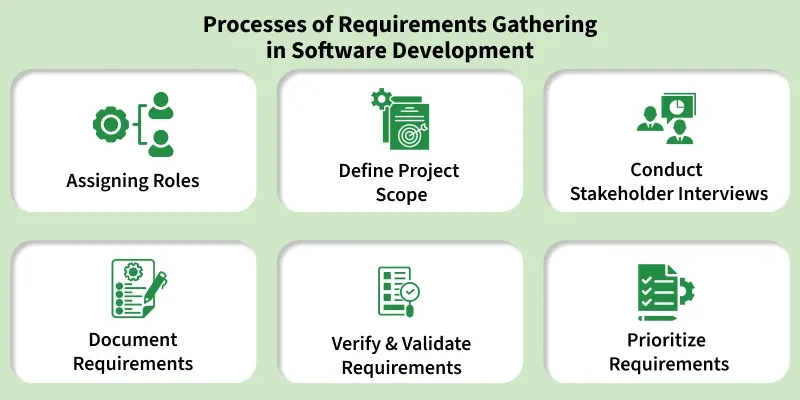
**[Step 1]- Assigning roles:
- The first step is to identify and engage with all relevant stakeholders. Stakeholders can include end-users, clients, project managers, subject matter experts, and anyone else who has a vested interest in the software project. Understanding their perspectives is essential for capturing diverse requirements.
**[Step 2]- Define Project Scope:
- Clearly define the scope of the project by outlining its objectives, boundaries, and limitations. This step helps in establishing a common understanding of what the software is expected to achieve and what functionalities it should include.
**[Step 3]- Conduct Stakeholder Interviews:
- Schedule interviews with key stakeholders to gather information about their needs, preferences, and expectations. Through open-ended questions and discussions, aim to uncover both explicit and implicit requirements. These interviews provide valuable insights that contribute to a more holistic understanding of the project.
**[Step 4]- Document Requirements:
- Systematically document the gathered requirements. This documentation can take various forms, such as user stories, use cases, or formal specifications. Clearly articulate functional requirements (what the system should do) and non-functional requirements (qualities the system should have, such as performance or security).
**[Step 5]- Verify and Validate Requirements:
- Once the requirements are documented, it's crucial to verify and validate them. Verification ensures that the requirements align with the stakeholders' intentions, while validation ensures that the documented requirements will meet the project's goals. This step often involves feedback loops and discussions with stakeholders to refine and clarify requirements.
**[Step 6]- Prioritize Requirements:
- Prioritize the requirements based on their importance to the project goals and constraints. This step helps in creating a roadmap for development, guiding the team on which features to prioritize. Prioritization is essential, especially when resources and time are limited.
Requirement Gathering Techniques:
Effective requirement gathering is essential for the success of a software development project. Various techniques are employed to collect, analyze, and document requirements.
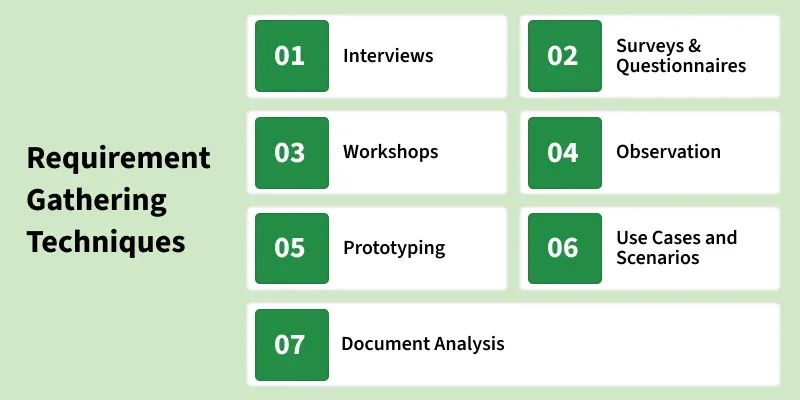
Here are some commonly used requirement gathering techniques:
- **Interviews – One-on-one or group discussions with stakeholders to capture needs, expectations, and concerns.
- **Surveys & Questionnaires – Collect large-scale feedback from diverse stakeholders, useful in big projects.
- **Workshops – Collaborative sessions to define requirements, resolve conflicts, and generate ideas.
- **Observation – Watching end-users in their environment to identify workflows, pain points, and hidden needs.
- **Prototyping – Building mockups or prototypes for early feedback and refining requirements.
- **Use Cases & Scenarios – Describing system interactions in real situations to identify functional needs.
- **Document Analysis – Reviewing existing manuals, reports, and forms to extract process insights.
Why Requirement Gathering is important?
Requirement gathering holds immense importance in software development for several critical reasons:
- **Clarity of Objectives – Defines project goals and ensures all stakeholders share the same vision.
- **Customer Satisfaction – Captures user needs to build a product that meets expectations.
- **Scope Definition – Establishes project boundaries, preventing scope creep and keeping work on track.
- **Reduced Misunderstandings – Promotes clear communication, minimizing ambiguity and errors.
- **Risk Mitigation – Identifies issues early to avoid costly rework, delays, and failures.
Benefits of Requirements Gathering:
The benefits of effective requirements gathering in software development include:
- **Cost Reduction – Minimizes costly changes and rework by defining requirements clearly at the start.
- **Customer Satisfaction – Ensures the product meets stakeholder expectations, enhancing trust and future collaboration.
- **Improved Communication – Acts as a bridge between stakeholders, reducing misunderstandings and aligning vision.
- **Efficient Resource Utilization – Enables accurate allocation of time, manpower, and technology.
- **Enhanced Quality – Provides a foundation for quality assurance and effective testing strategies.
- **Risk Management – Identifies potential risks early for proactive mitigation.
- **Accurate Planning – Supports realistic schedules, milestones, and deliverables, keeping the project on track.
Common Obstacles in Software Requirements Gathering:
Common obstacles in software requirements gathering include:
- **Unclear Objectives – Stakeholders unsure of goals can cause confusion and scope creep.
- **Ambiguous Requirements – Vague or conflicting requirements lead to misunderstandings and rework.
- **Poor Stakeholder Involvement – Missing input from key stakeholders risks incomplete requirements.
- **Changing Requirements – Frequent changes (scope creep) cause delays, cost overruns, and focus loss.
- **Communication Barriers – Misinterpretations or inadequate channels hinder clarity.
- **Overreliance on Documentation – Solely using documents may miss context; interactive processes are needed.
- **Lack of User Involvement – Ignoring end-users can result in unusable or unsatisfactory systems.
Requirements Gathering help in Agile Software Development
Agile development emphasizes flexibility, collaboration, and continuous improvement. The requirements gathering process in Agile is iterative and adaptive, allowing for changes and adjustments throughout the development lifecycle. Here's a detailed explanation of the requirements gathering process in Agile:
- **User Stories: Requirements written from the user’s perspective.
- **Product Backlog Refinement: Continuous prioritization and clarification.
- **Iterative Development (Sprints): Incremental delivery and learning.
- **Continuous Stakeholder Collaboration: Regular reviews and feedback.
- **Prototyping & Visual Aids: Faster understanding and validation.
- **Daily Stand-ups: Ongoing alignment and issue detection.
- **Acceptance Criteria: Clear definition of “done”.
- **Sprint Retrospectives: Improve requirement practices continuously.
Challenges and Considerations in Agile Requirements Gathering
- **Changing Priorities: Agile embraces changes in requirements, but frequent changes can pose challenges. It's crucial to strike a balance between flexibility and stability, ensuring that changes are well-understood, prioritized, and communicated effectively to the development team.
- **Balancing Detail and Flexibility: Agile requires enough detail to guide development, but also the flexibility to adapt as requirements evolve. Striking the right balance ensures that the team can respond to changes while maintaining a clear understanding of the project's direction.
- **Effective Communication: Agile heavily relies on communication and collaboration. Ensuring that all team members, including stakeholders, have open channels for communication is essential to prevent misunderstandings and align everyone with the project's goals.
- **Overemphasis on Documentation: While Agile values working software over comprehensive documentation, it's important to strike a balance. Minimal but effective documentation, such as user stories and acceptance criteria, should be maintained to ensure a shared understanding among team members and stakeholders.
- **Ensuring Continuous Feedback: Agile places a strong emphasis on continuous feedback, but ensuring active stakeholder involvement can be challenging. Efforts should be made to encourage regular feedback through sprint reviews, demos, and other collaborative sessions to avoid potential misunderstandings and to keep the development aligned with stakeholder expectations.
By embracing these Agile practices and considering the associated challenges, teams can effectively gather and adapt requirements throughout the development process, delivering value to stakeholders in a dynamic and responsive manner.
Requirements gathering tools play a crucial role in streamlining the process of collecting, documenting, and managing project requirements. These tools are designed to enhance collaboration, improve communication, and facilitate the organization of complex information. Here are several types of requirements gathering tools and their roles:
- **Collaboration Tools: Collaboration tools, such as project management platforms (e.g., Jira, Trello, Asana), facilitate teamwork and communication among project stakeholders. These platforms often include features like task assignment, progress tracking, and discussion forums, enabling teams to collaboratively gather, discuss, and manage requirements in real-time.
- **Document Management Tools: Document management tools (e.g., Confluence, SharePoint) help organize and store project documentation. These tools provide a centralized repository for requirements, ensuring easy access, version control, and collaboration. Document management tools are particularly valuable for maintaining a structured record of evolving project requirements.
- **Survey and Form Builders: Tools like Google Forms, Typeform, or SurveyMonkey enable the creation of online surveys and forms. These are useful for gathering structured data from a large audience, such as feedback, preferences, or specific information required for project requirements. The collected data can be easily analyzed and integrated into the requirements gathering process.
- **Prototyping Tools: Prototyping tools (e.g., Sketch, Balsamiq, Figma) allow the creation of visual or interactive prototypes. These tools are valuable for translating requirements into tangible representations that stakeholders can interact with, providing a clearer understanding of the proposed features and functionalities.
- **Mind Mapping Tools: Mind mapping tools (e.g., MindMeister, XMind) help visualize and organize complex ideas and relationships. During requirements gathering, these tools can be used to create visual representations of interconnected requirements, helping stakeholders and the project team understand the relationships between different features and functionalities.
- **Version Control Systems: Version control systems (e.g., Git, SVN) are essential for managing changes to project documentation. These tools track revisions, allowing teams to review, revert, or merge changes seamlessly. This is particularly valuable in dynamic projects where requirements may undergo frequent updates or refinements.
- **Requirements Management Software: Specialized requirements management tools (e.g., IBM Engineering Requirements Management DOORS, Jama Connect) are designed specifically for capturing, tracking, and managing requirements throughout the project lifecycle. These tools often offer features such as traceability, impact analysis, and integration with other project management tools.
- **Visual Collaboration Tools: Visual collaboration tools (e.g., Miro, Lucidchart) facilitate collaborative diagramming and visual representation of ideas. These tools can be used for creating flowcharts, diagrams, or visual models that help communicate complex requirements in a more intuitive and accessible way.