Software Development Team Structure (original) (raw)
Last Updated : 23 Apr, 2026
Software development team's organizational structure is essential to the project's success. It describes how team members work together, communicate, and contribute to the main goal of creating software that satisfies high standards. Numerous factors affect this structure, and depending on the needs of the project, different kinds of teams can be used.
Affecting Factors of Software Development Team Structure
One should consider several important factors when defining the software development structure, such as project size, timeline, and so on. Let's take a closer look at the main factors influencing the structure of the development team:
1. Project Size and Complexity
Large projects typically necessitate large teams of developers, testers, designers, and project managers. Complex tasks, such as the development of large, scalable systems, may necessitate the use of architecture experts and performance optimization specialists. Software development team organization may be more compact in smaller projects, but it must still be versatile to ensure a complete development cycle.
2. Project Type
Developing software for a specific industry or domain may necessitate an expert understanding of that industry or domain. When developing a telemedicine app, for example, your software development team should include experts who understand the domain regulatory requirements. You can also use strategies like staff augmentation to temporarily bring in experts from other organizations. A dedicated development team, as an alternative to this solution, allows you to have a team of all the experts you need without incurring additional search and maintenance costs.
3. Budget and Resources
Financial constraints can also have a significant impact on the software development team structure. If your budget is limited, you may opt for more cost-effective solutions, such as reducing team size or utilizing open-source technologies to accelerate development. A larger budget, on the other hand, will allow you to attract more talent and use more expensive development tools.
4. Timeline
If the project has a short time frame, the team size may need to be increased. Additional developers, for example, or distributing tasks across teams can help to accelerate development. Limited deadlines may necessitate more intensive work and the addition of additional QA engineers to the software team structure in order to quickly identify and fix bugs.
5. Technology Stack
Specific technologies and frameworks might require the use of specialists who are familiar with these tools. If you want to implement Internet of Things (IoT) technology, for example, your software engineering team structure should include specialists who are familiar with the specifics of developing IoT solutions. In addition, if you want to create an app, you'll need developers who have experience developing solutions for the platform you've chosen (iOS, Android, or web).
6. Client Requirements
Team structure can be influenced by the expectations and preferences of clients.
Types of Software Development Teams
The following describes the different types of software development teams based on their structure, skills, and suitability for various project requirements.
1. Generalist team
A generalist team is a group of developers with a diverse set of skills who can work on a variety of projects. These software engineers are capable of handling both front-end and back-end development, database management, testing, and other project-related tasks. They are typically generalists who can adapt to a variety of tasks and situations.
**Pros:
- **Versatility: Generalists have a diverse skill set and can perform a variety of tasks. This is useful in smaller projects or at the start of development to respond to various requirements.
- **Expertise was shared: Developers in such a team can share knowledge and experience, allowing for more creative problem-solving.
**Cons:
- **Expertise is limited: Experts may be lacking in highly specialized knowledge in a given field. This can make solving complex or technical issues difficult.
- **Productivity is limited: Due to a lack of specialized skills, such teams may work less efficiently in large and complex projects.
2. Specialist team
A specialist team is made up of highly qualified experts in a specific field. They have extensive knowledge and experience in a specific development area, such as custom app development, offshore mobile app development, UI/UX design services, and so on. These teams typically focus on complex and industry-specific projects.
**Pros:
- **High level of expertise: Specialized teams have extensive knowledge and experience in specific fields (Healthcare, FinTech, Logistics, etc.), making them ideal for complex projects.
- **Productivity is high: These teams are typically more efficient at performing tasks related to their specific sub-specialization and produce higher-quality products.
**Cons:
- **Limited adaptability: Specialists are typically unable to perform a wide range of tasks. Many specialized teams may be required for various aspects of a project.
- **Difficulties with communication: There are issues with information sharing and coordination among specialized teams, which can stymie solution development.
3. Hybrid team
A hybrid team is made up of both generalists and specialists. This approach strikes a balance between versatility and expertise, which can be useful in a variety of projects with varying requirements.
**Pros:
- **Balance: Hybrid teams can balance versatility and expertise by combining generalists and specialized experts, resulting in a higher ROI.
- **Flexibility: You can customize the team composition based on project requirements and milestones by bringing in the right specialists.
**Cons:
- **Complexity management: Managing hybrid teams can be more difficult, necessitating additional planning and coordination efforts.
- **Costs associated with training and development: Keeping your team up to date on new technologies and methods may necessitate additional resources.
| Type of team structure | When to apply |
|---|---|
| Generalist team | Small projects with a limited budgetProjects with a wide range of tasks and short deadlinesPrototyping and experimentation |
| Specialist team | Projects requiring high expertise in a narrow areaComplex and specialized developmentsProjects with large budgets and long timeframes |
| Hybrid team | Medium-sized projects with a variety of tasksProjects that require a balance between versatility and expertiseWhen flexibility to adapt the team to the project requirements is important |
Approaches to Software Development and how they affect the Development Team Structure
A traditional Waterfall project team is structured on the basis of hierarchical relationships among team members, so there are managers and subordinates with clearly defined responsibilities. A team structure like this gives the project manager more control over the project workflows. They, too, are accountable for critical decisions.
Agile teams, on the other hand, organize and manage themselves. There are still organizational leaders, such as a Scrum Master in Scrum or a Kanban Service Delivery Manager. Their responsibilities differ significantly from those of a traditional Waterfall project manager in that they are more concerned with fostering relationships within the team and creating a working environment in which each team member can be effective. Agile teams, which can have a maximum of nine to ten members, allow for some autonomy, allowing team members to prioritize their workloads and shape their workflows as they see fit.
**The table below summarizes the main differences between teams that use sequential approaches and those that use Agile:
| Waterfall Team | Agile Team |
|---|---|
| Management from the top down. The project manager is in charge of delivering results. | Self-management. Every team member is accountable for the outcomes. |
| A team may work on multiple projects at the same time. | A team concentrates on a single project. |
| Concentrate on assessing each individual's performance. | Concentrate on evaluating the overall performance of the team. |
| Different roles and titles | Cross-functional talent |
| No team size limit | Approach based on two pizzas, with four to ten people per team |
| Because of the larger team size and vertical hierarchy, there is less team synchronization. | Small teams that are highly coordinated and synchronized. |
Members of the Software Project Development Team
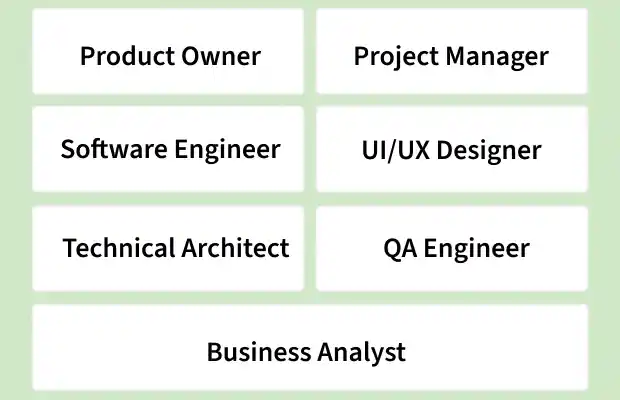
Members of the Software Project Development Team
Product Owner
Represents end-users and stakeholders, ensuring the product meets business goals and user needs. Plays a key role in defining priorities and guiding the development process. Its responsibilities are:
- Define product vision
- Prioritize product backlog
- Communicate with stakeholders
- Ensure value delivery
Product Manager/Scrum Master
Oversees the product lifecycle and ensures smooth execution of Agile practices within the team. Focuses on coordination, process efficiency, and team support. Its responsibilities are:
- Manage product lifecycle
- Facilitate Agile practices
- Coordinate with teams
- Remove obstacles
Business Analyst
Acts as a bridge between business needs and technical solutions by analyzing requirements. Helps the team understand client expectations and business processes. Its responsibilities are:
- Gather requirements
- Perform gap analysis
- Understand business processes
- Support decision-making
Software Architect
Designs the overall system architecture and selects appropriate technologies for development. Ensures the system is scalable, efficient, and well-structured. Its responsibilities are:
- Design system architecture
- Choose technology stack
- Define coding standards
- Ensure scalability and performance
Software Developers
Responsible for developing software by converting requirements into functional code. Work collaboratively to build, test, and maintain applications. Developer roles are divided into two categories based on the part of the software they develop, into Frontend Developer & Backend Developer. Its responsibilities are:
- Write and maintain code
- Implement features
- Fix bugs
- Collaborate with team
DevOps Engineer
Ensures smooth integration and deployment by bridging development and operations. Focuses on automation and continuous delivery processes. Its responsibilities are:
- Implement CI/CD pipelines
- Automate workflows
- Manage deployments
- Monitor system performance
UX/UI designer
Focuses on designing user-friendly and visually appealing interfaces. Enhances user experience through research and continuous improvement. Its responsibilities are:
- Conduct user research
- Create wireframes and prototypes
- Design interfaces
- Improve user experience
Quality Assurance Lead/Tester
Ensures the software meets quality standards by identifying defects and validating functionality. Plays a key role in maintaining reliability and performance. Its responsibilities are:
- Perform testing
- Identify defects
- Ensure quality standards
- Evaluate performance and usability