Rapid Application Development Model (RAD) Software Engineering (original) (raw)
Last Updated : 19 Jan, 2026
The RAD (Rapid Application Development) Model is a software development methodology that focuses on fast development and frequent releases of working software. It emphasizes iterative development, quick user feedback, and flexibility, allowing changes to be easily incorporated during the development process. Unlike traditional models such as the Waterfall Model, RAD adapts quickly to changing requirements and user needs.
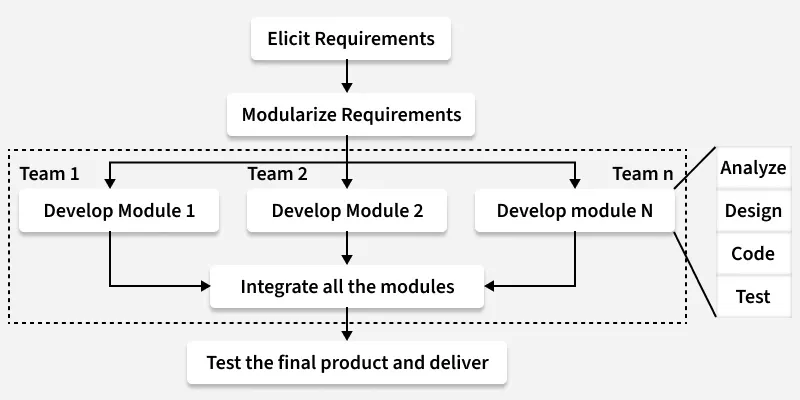
RAD Model
RAD Model
The RAD (Rapid Application Development) Model is an incremental software development model proposed by IBM in the 1980s that focuses on fast development using short time-boxed cycles (usually 60–90 days). It divides the system into small modules developed in parallel using powerful tools, with continuous user feedback through prototypes.
The use of powerful developer tools such as JAVA, C++, Visual BASIC, XML, etc. is also an integral part of the projects. This model consists of 4 basic phases:
- **Requirements Planning – In this phase, developers and users meet to discuss what the software should do. All requirements are gathered, analyzed, and a basic plan for the project is created.
- **User Design – Developers create simple prototypes or models of the software. Users try them, give feedback, and suggest changes. This helps ensure the software meets user needs.
- **Construction – The actual software is developed in this phase. Coding, improving features, and fixing issues are done using fast development tools.
- **Cutover – The completed software is tested, different modules are integrated, and the final system is deployed for user use. User acceptance testing is also done here.
The process involves building a rapid prototype, delivering it to the customer, and taking feedback. After validation by the customer, the SRS document is developed and the design is finalized.
When to use the RAD Model?
- **Well-understood Requirements – RAD is best used when the project requirements are clear and unlikely to change much.
- **Time-sensitive Projects – It is suitable when the software must be delivered quickly within a short time.
- **Small to Medium-Sized Projects – RAD works well for projects that are not too large and can be handled by small teams.
- **High User Involvement – It is ideal when users can give regular feedback during development.
- **Innovation and Creativity – RAD is useful for projects that need experimentation, new ideas, and flexible design.
- **Prototyping – It is best when building and improving prototypes is an important part of development.
- **Low Technological Complexity – RAD suits projects that use simple and familiar technologies.
Objectives of Rapid Application Development Model (RAD)
**Fast Development
The main objective of RAD is to develop software quickly. By using rapid prototyping and short development cycles, a working system can be delivered in less time.
**Flexibility and Adaptability
RAD easily supports changes in requirements. If users suggest modifications, they can be included without affecting the entire system.
**Active User Involvement
Users participate throughout the development process. Their continuous feedback helps in building a system that meets real user needs.
**Improved Communication
Regular interaction between developers and users ensures clarity, reduces misunderstandings, and keeps everyone aligned with project goals.
**Better Quality through Prototyping
Prototypes allow early testing and validation. Errors and design issues are identified early, improving overall software quality.
**Higher Customer Satisfaction
Since users are involved and working versions are delivered quickly, the final product closely matches expectations, leading to better customer satisfaction.
Advantages of RAD Model
- **Fast development: Reusable components reduce development time.
- **Early customer feedback: Users see prototypes early and give feedback.
- **Lower development effort: Fewer developers are needed due to automation.
- **Better quality: Powerful tools help build quality software quickly.
- **Easy progress tracking: Development progress is visible in each phase.
- **Flexible to changes: Changing requirements are easy to handle due to short cycles.
- **High productivity: Small teams can deliver results faster.
Disadvantages of RAD Model
- **Needs skilled professionals: Developers must be experienced with advanced tools.
- **Depends on reusable components: Lack of reusable parts can cause failure.
- **High coordination needed: Team leader must closely manage developers and customers.
- **Not suitable for all systems: Systems that cannot be modularized cannot use RAD.
- **Continuous customer involvement required: Lack of user commitment can fail the project.
- **Costly for small projects: Tool and automation costs may exceed the budget.
- **Not suitable for every application: Some projects do not fit RAD structure.