Principles of Software testing Software Testing (original) (raw)
Last Updated : 13 Jun, 2026
Software testing is a crucial part of software development that ensures the application works as expected and meets user requirements. It helps in identifying defects early and improving overall software quality. A structured testing approach leads to more reliable and user-friendly products.
- Ensures the software meets functional and non-functional requirements
- Helps detect bugs and issues before release
- Improves product quality and user satisfaction
**Principles of Software Testing
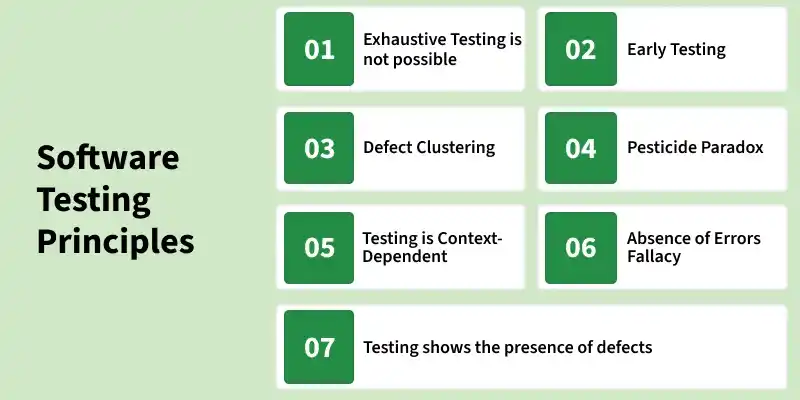
Software Testing Principles
Testing shows the Presence of Defects
Software testing helps identify defects in a system, but it cannot prove that the software is completely error-free. Even if no defects are found, it does not guarantee that the application is 100% bug-free. Testing reduces the number of defects but does not eliminate them entirely.
Exhaustive Testing is not Possible
Exhaustive testing means testing the software with all possible inputs (valid and invalid) and preconditions. It is practically impossible because the number of test cases can be infinite or extremely large. Hence, we test only a subset of cases and assume the system will behave correctly for untested inputs as well.
Early Testing
Testing should begin as early as possible in the Software Development Life Cycle (SDLC). Detecting defects in early stages, such as requirement analysis, is more cost-effective and prevents defects from becoming more complex later.
Defect Clustering
In most projects, a small number of modules contain the majority of defects. This follows the Pareto Principle, which states that approximately 80% of defects are found in 20% of modules.
Pesticide Paradox
Repeated execution of the same test cases will eventually stop finding new defects. To discover new bugs, test cases must be regularly reviewed, updated, and improved.
Testing is Context-Dependent
Testing strategies vary depending on the type of software. For example, web applications, mobile applications, and safety-critical systems all require different testing approaches.
Absence of Errors Fallacy
If a system is developed without defects but fails to meet user requirements or business needs, it is still considered a failure. Software must be both bug-free and useful to the end user.
Importance of Software Testing Principles
Software Testing Principles are important because they provide a clear guideline for conducting effective and efficient testing. They help testers improve software quality, reduce errors, and optimize the testing process.
- Helps in detecting defects early, reducing development cost and effort
- Improves software quality and ensures better user satisfaction
- Provides a structured and systematic approach to testing
- Avoids unnecessary or repetitive testing efforts
- Ensures optimal use of time, resources, and testing tools
- Helps testers focus on high-risk and critical areas of the software
- Supports better decision-making during test planning and execution