Spiral Model in Software Engineering (original) (raw)
Last Updated : 19 Jan, 2026
The Spiral Model is one of the most important SDLC models, combining the structured approach of the Waterfall Model with the flexibility of the Iterative Model. It is mainly used for risk handling in large and complex projects.The Spiral Model was proposed by Barry Boehm.
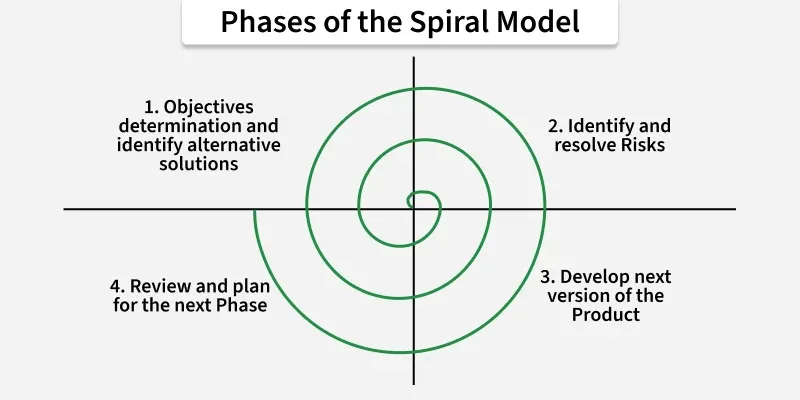
Spiral Model
The Spiral Model is a risk-driven and iterative software development model. Development progresses in a spiral shape consisting of multiple loops, where each loop represents a complete development cycle.
The number of loops depends on project size, complexity, and risk.
Each loop includes:
- Planning
- Risk analysis
- Development
- Evaluation
Phases of the Spiral Model
Focus is on managing risk through multiple iterations of the software development process. Each phase of the Spiral Model is divided into four Quadrants.
1. Objectives Definition
- Project goals and requirements are identified
- Functional and non-functional requirements are analyzed
- Possible solutions are explored
2. Risk Analysis and Resolution
- Risks related to cost, schedule, performance, and technology are identified
- Best solution is selected
- Prototypes are built to reduce risks
3. Development and Testing
- Selected features are designed, developed, and tested
- The next working version of the software is created
4. Review and Planning
- Customers evaluate the current version
- Feedback is collected
- Planning for the next iteration begins
The next iteration of the spiral begins with a new planning phase, based on the results of the evaluation.
The Spiral Model is often used for complex and large software development projects, as it allows for a more flexible and adaptable approach to **Software development. It is also well-suited to projects with significant uncertainty or high levels of risk.
The Radius of the spiral at any point represents the expenses (cost) of the project so far, and the angular dimension represents the progress made so far in the current phase.
Risk Handling
- Risks are identified after development starts
- Prototypes help detect and resolve risks early
- Continuous risk evaluation at every iteration
- More flexible than Prototyping and Waterfall models
The Spiral model is called a **Meta-Model because it subsumes all the other SDLC models.
Example of Spiral Model (E-Commerce Website)
**1. First Spiral - Planning and Requirements:
Basic requirements like product listing, cart, and payment are collected. Risks such as security and scalability are identified, and a simple prototype is built.
**2. Second Spiral - Risk Analysis and Refining the Design
Feedback from the prototype is used to improve design. Secure payments, user registration, and cart features are added and tested.
**3. Third Spiral - Detailed Implementation
Advanced features like order tracking, reviews, and search are developed. Scalability and performance risks are tested under heavy load.
**4. Final Spiral - Deployment
The website is fully tested, launched for users, and monitored for remaining risks and improvements.
This example shows how the Spiral Model supports continuous improvement and risk management at every stage.
Advantages
- **Effective Risk Handling: Identifies and resolves risks at every phase, making it ideal for projects with high uncertainty.
- **Suitable for Large Projects: Best suited for large and complex software systems.
- **Flexible Requirements: Allows changes in requirements even at later stages of development.
- **Early Customer Feedback: Customers can review early versions of the product, improving satisfaction.
- **Iterative Development: Software is developed in repeated cycles, allowing gradual improvement.
- **Better Communication: Regular reviews improve coordination between customers and developers.
- **High Software Quality: Continuous testing and refinement lead to reliable and high-quality software.
Disadvantages
- **Complex to Manage: The model is complex due to multiple iterations and continuous risk analysis.
- **High Cost: Not suitable for small projects because it requires more time, effort, and resources.
- **Depends Heavily on Risk Analysis: Success depends on accurate risk identification, which requires experienced professionals.
- **Difficult Time Estimation: The number of iterations is not fixed, making scheduling difficult.
- **Time-Consuming: Frequent reviews and evaluations can increase development time.
- **Resource Intensive: Requires significant investment in planning, risk management, and testing.
When To Use the Spiral Model?
- Large and high-risk projects
- Unclear or changing requirements
- Frequent releases required
- Prototyping is needed
- Risk and cost evaluation is critical
- Long-term projects with uncertainty