Introduction of OKRs (original) (raw)
Last Updated : 27 Apr, 2026
Objectives and Key Results (OKRs) are a goal-setting framework used to define clear and ambitious objectives. It measures progress through specific, measurable key results. OKRs help organisations maintain alignment, transparency, and focus on achieving business goals.
- Developed in the 1970s by Andrew Grove and later popularised by John Doerr at Google.
- Consists of Objectives (what to achieve) and Key Results (how to measure success).
- Promotes alignment between team goals and overall business objectives.
- Focuses on transparency, measurable outcomes, and continuous progress tracking.
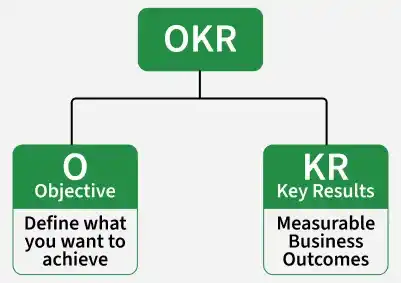
OKR Framework: Objectives and Key Results
OKR Methodology: Evolution and Core Principles
The OKR framework has evolved over time and is built on key principles that drive alignment, focus, and continuous improvement.
1. Origins
- **1970s: A technique created by Andy Grove of Intel Corporation as a tool for enhancing direction and performance.
- **1999: Coined by John Doerr, who adopted the methodology and incorporated it with Google.
2. Principles
- **Transparency: Specifically, the OKRs are typically visible organisation-wide so that everyone can see what has been established and why.
- **Ambitious Goals: Most goals should be slightly out of our comfort zone, so new solutions will have to be adopted to meet them.
- **Regular Check-ins: It is critical to conduct reviews and modify the plan and goals more regularly to monitor the frequency and processes of execution.
Way to Use OKRs
OKRs provide an idea to the group members on how to measure the milestones of the path and what they are exactly trying to achieve. It tries to provide a framework for the teams, and it ensures that all parts of the company are working together for the same objective. There are two types of components present in OKRs, which are mentioned below:
- **Objectives: Objectives refer to the clear goals that the teams are working on. Therefore, it is a clearly defined common goal in a company which impact on the business of the company. It should align with the company's strategies and the company's goals.
- **Key Results: These key results refer to the progress of objectives, which are measured on the basis of achieving the particular goal. They serve as a result which provide the evidence of whether the objective have been achieved or not.
When to Use OKRs
Objectives and key results are used in setting the goal quarterly, annually and biannually which completely depend on the requirement of the businesses and what the group of teams agrees on. OKRs have been in demand due to rise in remote work even if the teams are spread in multiple locations this framework helps in encouraging the effective workflow which further enables the communication and align the team to obtain their goal or objective.
OKR Examples
The following examples illustrate how OKRs can be applied at personal, team, and organizational levels.
1. Personal Objective: Increase personal efficiency.
- Successfully execute at least three large-scale projects in a single month.
- Employment flexibility: A new policy proposed to the workers is that you are to work 10% more hours in a week than you have been working.
- Time spent in meetings is to be cut by a fourth.
2. Team Objective: Introduce team interaction.
- Maintain a 90% satisfaction level of team members through Conduct surveys.
- Install 2 new collaboration applications.
- Conduct bi-weekly team-building activities.
- Increase the level of annual revenues by 15%.
- Introduce three new products a year.
- Achieve an increase of the market share by 10 % in the specified region.
Types of OKRs
There are two types of OKRs which are mentioned below:
1. Committed OKRs
The committed OKRs are also known as "stretch goals". The result of committed OKRs are real and it needs to be achieved by the team or the group of the business. These are the main goals of the business which every individual agrees to and these main goal needs to be achieved by the teams of the company and the particular team are even willing to adjust the resources to achieve this main goal.
2. Aspirational OKRs
Aspirational OKRs are also known as "moonshot". These are the large and ambitious goals which the business sets for itself. These type of OKRs mainly focuses on the companies vision and they are also very challenging.
Advantages of OKRs
Some of the main advantages of OKRs are mentioned below:
- OKRs optimizes the allocation and the resource management.
- With the help of OKRs individuals can find the problems and their root cause and to create a good environment for decision making.
- OKRs helps in tracking the common goals and the progress which align with the business goals.
- OKRs establishes productivity around the goals and also align individuals with the business goals.
- With the help of OKRs within the company the individuals can promote collaboration.
Common OKR Mistakes
- **Lack of Focus: The problem arises when there are too many OKRs or variants of them that are too general can weaken focus.
- **Unrealistic Key Results: Targets that can easily be worked on within the set time-frame should be the key ones since it is unproductive to set targets that cannot be realized.
- **Inadequate Measurement: It can also be challenging to track the work’s progress when quantifying key results or when not establishing such specific measurements in the first place.
- **Neglecting Regular Check-ins: A failure to review and update the OKRs from time to time will make it a misfire as well as have decreased oversight.