What is the Kanban System, and How Does it Work? (original) (raw)
Last Updated : 23 Jul, 2025
The Kanban system, rooted in Toyota's practices, is a dynamic project management methodology. It visualizes workflow on a board, featuring columns like "To-Do," "In-Progress," "Validation," and "Done."Leading in software development, Kanban emphasizes continuous delivery and incremental changes. Tasks progress through phases, fostering transparency, adaptability, and optimized workflows. Versatile and widely applied, Kanban proves effective across diverse industries.
The Kanban system is a visual workflow management method that increase teams productivity, streamline their processes and improve efficiency using Kanban System. In this article, we are going to learn the kanban System in detail.
Table of Content
- What is Kanban?
- Understanding Kanban System
- What is Kanban Board?
- How a Kanban Board Works?
- Electronic Kanban Systems
- The 6 Core Practices of Kanban Methods
- How does Kanban Work?
- Is Kanban Agile or Lean?
- Conclusion
- FAQs on Kanban System & its working
What is Kanban?
**Kanban is a visual workflow management system that enables teams to manage and optimize their processes by visualizing tasks, limiting work in progress (WIP), and facilitating continuous improvement through a pull-based system.
Kanban is an effective process management tool that boosts team productivity. It is a flexible tool that may be used in a variety of team structures and industries due to its visual design, emphasis on limiting WIP, and emphasis on continual improvement. Kanban can be applied to software development, marketing, or personal productivity to help teams become more organised and collaborative.
Understanding Kanban System
The Kanban system is a visual workflow management method that increase teams productivity, streamline their processes and improve efficiency using Kanban System. The principles of Kanban, which have their roots in Toyota's production method, are to visualise work, reduce work-in-progress (WIP), and improve flow. It focuses on Continuous improvement and adaptation by enabling teams to pull work via a predetermined process and guaranteeing that tasks are finished successfully and efficiently, One such tool is the Kanban board, which facilitates transparency and teamwork by showing tasks as cards arranged in columns that correspond to the various workflow stages.
What is Kanban Board?
A Kanban Board is a system, tracking tool that manages workflow using a visual management tool called a Kanban board. It is made up of cards that represent individual work items and columns that indicate various stages of a process. it is a visual tool that is used to manage and optimize workflow in various industries, including software development, project management, and manufacturing. Originating from lean manufacturing practices in Japan, the Kanban method has evolved into an agile project management approach, emphasizing continuous improvement and efficiency.
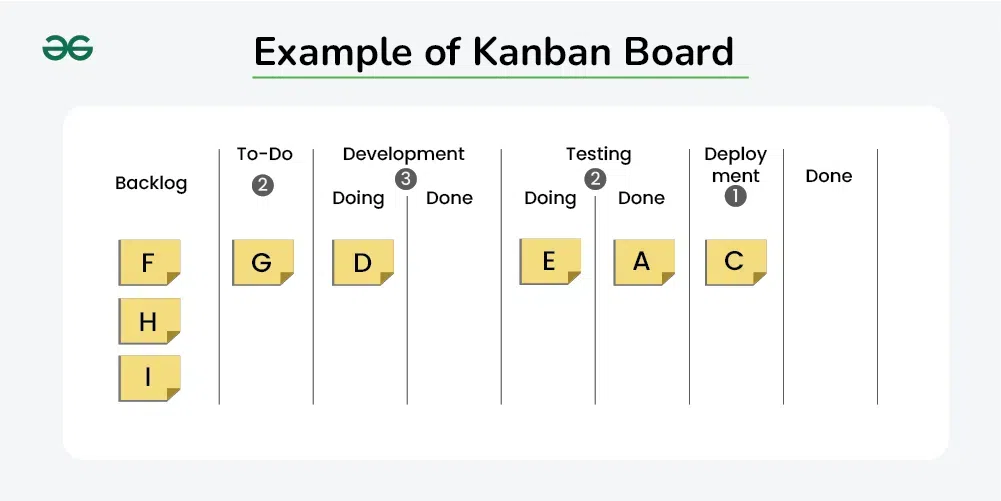
Examples of Kanban Borad
How a Kanban Board Works?
A Kanban board works by visually representing the flow of work items through different stages of a process. Here’s how it typically functions:

How a Kanban Board Works
- **Initiation:
- Tasks are added to the “**To Do” column, representing the backlog or work that needs to be done.
- **Progression:
- As work begins, task cards move across columns, reflecting their progress through stages like development, testing, and review.
- **Completion:
- Tasks eventually move to the “**Done” column upon completion. The goal is to have a steady flow of tasks through the system.
- **Continuous Improvement:
- Regular reviews and retrospectives allow teams to analyze performance, identify bottlenecks, and make adjustments for continuous improvement.
Understanding Electronic Kanban Systems
Traditional Kanban boards have been digitalised into Electronic Kanban Systems ****(eKanban)**, which use software tools to monitor and visualise workflow. These methods are appropriate for remote teams and more complicated projects since they improve the usability and accessibility of Kanban concepts. Electronic kanban systems provide a cutting-edge, adaptable method for streamlining processes, boosting teamwork, and increasing productivity. By bringing classic Kanban ideas into the digital world, they facilitate teams' ability to visualise their work, communicate clearly, and use data to drive continuous improvement.
The 6 Core Practices of Kanban Methods
The Kanban process improvement method has six most important core practices which are as follows:
- **Visualization In Workflow: Make your work visible with Kanban. Break it into cards and put them on a Kanban board with columns representing stages from idea to completion. It's about transparency in the workflow.
- **Limitations in the progress of work: In Kanban, restrict work in progress by assigning a cap to items in each board column. Each stage, whether done by an individual or a team, has a limit, aiding bottleneck detection.
- **Optimizing Workflow: In Kanban, manage workflow for continuous value delivery and sustainable delivery pace. Prioritize managing and enhancing the flow, avoiding rushed attempts that compromise product quality or lead to workforce burnout.
- **Clear Path to Value: Clearly state process policies for seamless value delivery. Ensure everyone knows the guidelines, whether through SOPs, Definitions of Ready, or Done. These standards are vital for work progression within each stage.
- **Driving Improvement: Use feedback loops in Kanban, the system adjusts when it deviates. Kanban practitioners inspect and tweak their processes regularly for improvements.
- **Collaborative Evolution in Kanban: In Kanban, the team owns the workflow. Improvements are a team effort. Changes are most effective when driven by team members, promoting collaboration and experimentation for continuous process enhancement.
How does Kanban Work?
In Kanban, teams begin by visualizing their current processes and consistently refining them. The Kanban toolbox, equipped with values, principles, and practices, guides this journey of continuous improvement, fostering adaptability for more efficient and effective workflows.

Works Flow of classic kanban boards
In the model of a classic Kanban board, there are three main columns, as shown in the picture above:
1. TO DO
- The To Do column lists that tasks which are not yet started. All those kinds of tasks are listed here for picking like geeks for geeks article picking concepts (aka “backlog”)
- Alright, check it out: "To Do" is where our tasks chill before we dive in.
- **Picture this: our team spots a task, like creating a software feature. It's "To Do" bound.
- This is the calm zone, where tasks sit tight before the action begins, just waiting.
- Think backstage vibes – the "To Do" column is like the prep area for upcoming tasks.
- So, in a nutshell, "To Do" is the quiet before the storm, where tasks queue up.
2. Doing
- The Doing column consists of the tasks that are in progress. It means that tasks that are running are put down here.
- Team member kicks off a task; it steps into the "Doing" zone, ready for action.
- Developer starts coding; task shifts from "To Do" to "Doing," bringing ideas to life.
- "Doing" column: backstage of productivity, where tasks get real, someone's in the groove.
- Task says, "Let's do this!" as it confidently strides onto the stage of progress.
3. Done
- The Done column consists of the tasks that are completed. It means they are just end to completion listed down here.
- The "Done" column is like a victory stage for completed tasks.
- Developers proudly move tasks, saying, "We nailed it!"
- It signifies polished work ready for action.
- "Done" is backstage, prepping for reviews and deployment.
- In "Done," each task marks progress, and high-fives to the team.
Is Kanban Agile or Lean?
Kanban is primarily associated with **Lean principles, but it is also utilized within **Agile methodologies.
Lean
- Kanban focuses on eliminating waste, optimizing workflow, and improving efficiency. Lean thinking is based on these principles.
- It emphasizes continuous improvement and delivering value to the customer by streamlining processes.
Agile
- While Kanban is not exclusive to Agile, it is often integrated into Agile frameworks to manage workflows and enhance flexibility.
- It complements Agile practices by providing a visual system for iteratively managing work.
In summary, Kanban can be seen as both a Lean tool and an Agile practice, depending on the context in which it is applied.
Conclusion
The Kanban approach is easy to use and adaptable for a variety of teams and industries, including project management and software development. Organizations that implement the principles of Kanban might witness a rise in production, decrease in lead times and enhance teamwork, ultimately creating a work environment that is more adaptable and durable.