What Is The Project Management Triangle? (original) (raw)
Last Updated : 23 Jul, 2025
The Project Management Triangle, also known as the Triple Constraint Model and Iron Triangle, is the concept that explains the relationships among three constraints of any given project: scope, time, and cost. The successful delivery of projects depends on understanding and controlling these constraints. This article explores the meaning and significance of the Project Management Triangle as a sub-area of Project management, its intentions, components, management of the triangle in the course of a project, and recommended particulars.
Table of Content
- The Project Management Triangle
- Why Is the Project Management Triangle Important?
- 3 Components of the Project Management Triangle
- 5 Strategies to Manage the Project Management Triangle
- Tools to Manage the Project Management Triangle
- How Does the Triple Constraint Work?
- Controlling the Triple Constraint With Project Management Software
- Best Practices for Managing Triple Constraints Theory
- Conclusion
- Frequently Asked Questions (FAQs)
The Project Management Triangle
The Project Management Triangle is a model that demonstrates the compromise that managers have to make while handling a project. There are three sides of the triangle, namely:
- **Scope: The work that has to be done in order to deliver a product, service or result as per it's specifications.
- **Time: A factor that refers to the timeline set for the accomplishment of the project plus the different deadlines that the various tasks and deliverables have to meet.
- **Cost: It covers the financial aspects involved in a given project from human resources, materials used as well as the time taken.
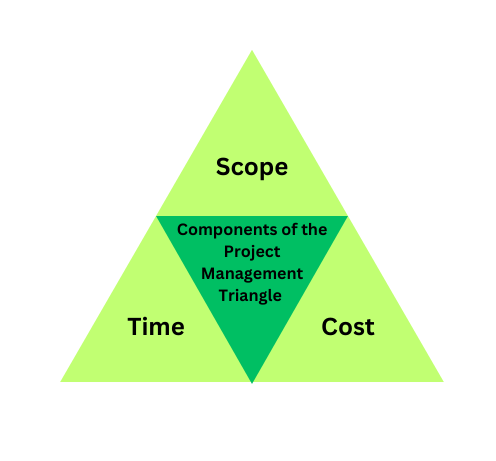
Components of the Project Management Triangle
Interdependence exists among these three elements, since changes in one constraint will change the other two as well. For example, it is not possible to change the scope of the project and leave the time and cost unchanged because it will end up postponing the completion of the project or increasing the cost if soon over budget.
Why Is the Project Management Triangle Important?
The importance of the Project Management Triangle lies in the provision of balance to competing demands in a project. It guides project managers in trade-off situations and ensure organization’s objectives are achieved with constraints. With regard to the stakeholders, the knowledge of the relation between scope, time, and cost enables project managers to manage their aspirations in a better way and communicate with them.
Controlling the Triple Constraint is essential for preventing such project failures as the s ravocation of the deadlines, no-time budgets, or the loss of the produced product’s quality, which is required. It aids as well in dealing with reasonable targets, predicting possible problems and taking actions towards solving them when needed.
3 Components of the Project Management Triangle
Scope:
- Scope provides boundaries to a project by stipulating the expected outcomes, deliverables and the orders of tasks that must be performed for any success to be achieved. It encompasses what is covered as part of the project and what is not commonly captured in a document called the Scope Statement.
- **Challenges: Scope change (the constant growth or the uncontrolled modifications of the project scope), is the most reoccurring problem in instance of ambiguity in the scope level and there is nobody in charge of the escalation of the project.
Time:
- Time means the timeline for the project, which incorporates the start and end date, the timetable of milestones, and the deadlines. Planning and controlling the time of the activities, the relations amongst the tasks and the critical path which is the least time in which the project can be completed.
- **Challenges: Delay has a range of causes some of which were not implementable, inaccurate forecast level or the resources were poorly managed.
Cost:
- Cost consists of all financial resources necessary for the project, namely, labour, materials, equipment or any other costs involved. Establishing the budget is important in order to determine the viability of the project.
- **Challenges: If the costs are overseen than the actual costs then budgets may be exceeded, scope is varied without considering the budget change, and resources are squandered.
5 Strategies to Manage the Project Management Triangle
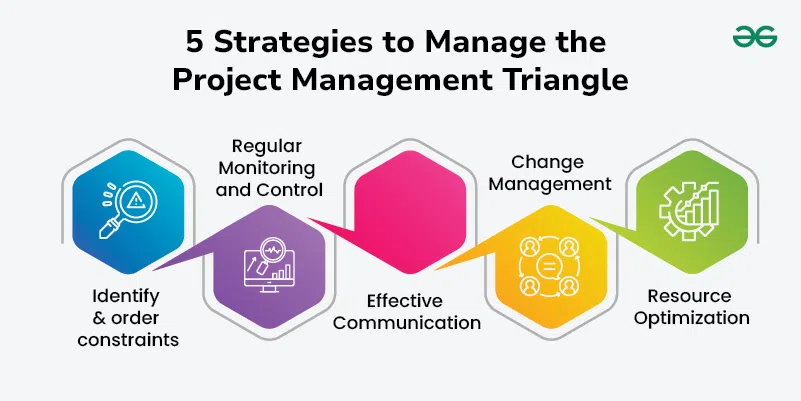
5 Strategies to Manage the Project Management Triangle
- **Identify and order constraints: Decide among the three constraints of the project which one is more important to the success of the project- in other words, the project scope, project time span, or the financial resources. This allows addressing other constraints if some degree of variation is required.
- **Regular Monitoring and Control: Monitor the project during its execution in relation to the baseline plan against which the project was started. Benchmark and track key variables time, cost and scope performance using KPIs. The sooner the variation is noticed the faster easy solutions will be provided.
- **Effective Communication: Provide information to all affected individuals in a consistent manner regarding what the status of the project is and any variances that may occur both in scope, time and cost. Assists in setting of objectives and ensuring that they are met by the project.
- **Change Management: Make use of controlled change on the project and review its effects on the project constraints. Changes executed on the scope are recorded and approved before they are executed.
- **Resource Optimization: Maximize usage amongst given resources to further strength the effectiveness in the project. Rebalance the resources in accordance with the project requirements so that the most important activities are resourced appropriately.
**Project Management Software:
Planning, scheduling work, and monitoring progress can be done through the tools like Microsoft Project, Asana, or Trello. Work breakdown structures, timelines, and resources can be organized through project management software.
Cost Management Tools:
Softwares such as QuickBooks or FreshBooks assist in the planning and administration of finances for projects and cost tracking.
Scope Management Tools:
Such tools include JIRA or Confluence which accommodate writing up project technical requirements and scope creep to address further alterations in scope.
Gantt Charts and Critical Path Method (CPM):
This type of tools acts to visualize the project time plan and activities, which masks the time management of the project.
Resource Management Tools:
Software such as Resource Guru or Hub Planner helps eliminate the wastage of resources in case the resources were underutilized or overutilized so that proper staffing of the project is ensured.
How Does the Triple Constraint Work?
The Triple Constraint works by establishing that a change in one constraint will impact the others. For Example:
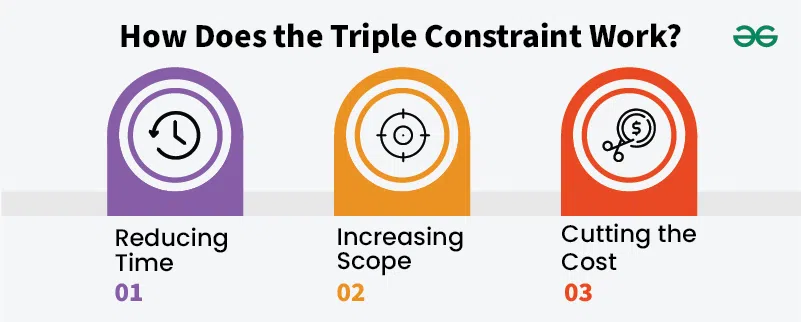
How Does the Triple Constraint Work
- **Reducing Time: To expedited the timelines for the project deadlines imposed; would require more resources within the scope which would increase the project costs or, the scope could be reduced.
- **Increasing Scope: Integrating more features or tasks to a project results in increased time and/or greater costs.
- **Cutting the Cost: Cost reduction may imply some project reduction or prolonging the timeline to execute with lesser resources.
Knowing this relationship, helps the Project managers take the required decisions and retain the equilibrium of the project.
Controlling the Triple Constraint With Project Management Software
Offering features and brainpower, project management tools has great impact on the management of the Triple Constraint. In such tools, it is possible to do the following:
- **Track Time: This enables the project refocusing of baselines by establishing the beginning and end of a project phase and working on its variance.
- **Manage Costs: It provides a summary of payments made against the project service and other financial support.
- **Scope Management: This entails changes needed in the project and how and what the changes will be targeted at to avoid scope creep or misalignment of all parties involved.
Furthermore, project management solution avails information and strategies that assists the decision making, problem identification, and action-taking timeliness.
Best Practices for Managing Triple Constraints Theory
Set Clear Objectives
Make certain that the agreed and well communicated objectives of the project are in place and acknowledged by all parties engaged in the problem. Limiting write up also assists in scope management since it has to be in line with time and cost.
Use Agile Methodology
This means adoption of methods that will aid incremental increase in scope, time and cost management of a project such as Scrum by parting the project into series of short and conspicuous sprints. This is extended throughout the project and thus no delays are booked any more.
Continuous Risk Management
Control and monitor risks on a regular basis in the project. Make risk response plans concerning the possible most important areas of the Triangular Feature.
Stakeholder Involvement
Take the stakeholders’ wishes into account at all stages of the project ensuring any changes implemented to scope, time, or cost are communicated and agreed upon promptly.
Learning and Adaptation
Tracking performance of the project regularly, any problems that arise, or success that is achievable should be noted and documented for reference. Change your methods and organization on how scope, time, and cost are managed in the subsequent projects.
Conclusion
The Project Management Triangle is a basic principle which allows formulating the dependency between the three constraints, known in normal language as the scope, schedule and cost of the project. Project managers operate a lot more effectively when these constraints are mitigated in active project delivery. Controlling the market factors other than providing core satisfaction i.e. strategy, tool, or the adherence to the best plan in order to fulfill the Triple Constraint does not only permit achievement in project completion that is on time and within budget but also contributes toward the achievement of expectations and the business case of the project. Thus, the focus on these elements will be the main secret why project management will persist in achieving greater heights.