Agile Software Testing (original) (raw)
Last Updated : 2 Jun, 2026
Agile Testing is a type of software testing that follows agile principles where testing is performed continuously alongside development phases like requirements, design, and coding. It is a dynamic and iterative approach carried out in every stage of the SDLC with a strong focus on collaboration, continuous improvement, and customer satisfaction.
- Continuous and iterative testing ensures early bug detection and faster delivery.
- Involves the entire team with strong communication, collaboration, and self-organization.
- Uses a simple approach with constant feedback to improve quality and meet customer needs.
Principles
Agile testing combines traditional testing with development to provide continuous feedback, faster fixes, and better alignment with customer needs. The main principles of Agile testing focus on:
- **Continuous feedback: Feedback in every iteration reduces response time and cost.
- **Parallel testing: Testing is done alongside development, not after it.
- **Team involvement: All members (developers, testers, experts) participate.
- **Lightweight documentation: Uses simple checklists instead of heavy documents.
- **Clean code: Bugs are fixed in the same iteration.
- **Constant feedback: Regular responses help meet business needs.
- **Customer focus: Customers give feedback and can change requirements anytime.
- **Test-driven approach: Testing guides development and speeds up delivery.
Methodologies
Agile testing methodologies focus on flexibility, collaboration, and continuous improvement. Here are some key Agile testing methods explained in simple terms:
- **Test-Driven Development (TDD): Tests are written before the code is developed, followed by coding and refactoring.
- **Behavior-Driven Development (BDD): Focuses on user behavior and collaboration to meet expectations.
- **Exploratory Testing: Testers freely explore the software to find hidden bugs.
- **Acceptance Test-Driven Development (ATDD): Developers, testers, and customers define requirements before coding.
- **Extreme Programming (XP): Focuses on simplicity, customer involvement, and frequent releases.
- **Session-Based Testing: Time-based focused testing sessions (45–90 mins).
- **Dynamic Software Development Method (DSDM): Structured Agile framework for development.
- **Crystal Method: Focuses on people, communication, and flexibility over processes.
Strategies
Agile testing strategies focus on continuous testing across different development stages to ensure quality, flexibility, and faster delivery through iterative validation.
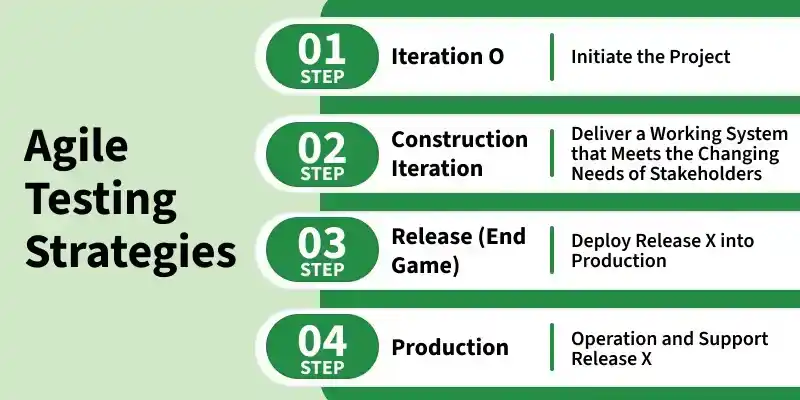
Strategies
- **Iteration 0: Initial setup phase where requirements are analyzed, risks are identified, resources are planned, and the testing environment is prepared.
- **Construction Iteration: Core development phase where features are built and tested continuously using confirmatory testing (to verify requirements) and investigative testing (to find hidden defects).
- **Release Phase: Final phase where system testing and acceptance testing are performed to ensure the product is ready for deployment.
- **Production: The product is released to users, and any real-time issues are fixed through maintenance and updates.
Quadrants
Agile Testing Quadrants divide testing activities into four categories based on business-facing and technology-facing goals to ensure both functional and non-functional quality throughout development.
- **Quadrant 1 (Q1 – Unit & Component Testing): Focuses on code quality through unit testing, component testing, and integration testing. These tests are mostly automated and performed by developers to support the development process and detect defects early.
- **Quadrant 2 (Q2 – Functional and Business Testing): Focuses on validating business requirements and user expectations through functional testing, user stories, acceptance testing, and scenario-based testing. Both manual and automated testing approaches are used to support business-facing requirements.
- **Quadrant 3 (Q3 – User Experience and Exploratory Testing): Focuses on user experience and product usability through exploratory testing, usability testing, user acceptance testing (UAT), and feedback sessions. These tests are mainly manual and help evaluate how users interact with the application.
- **Quadrant 4 (Q4 – Non-Functional Testing): Focuses on performance, security, scalability, reliability, and load testing. These tests are often integrated into CI/CD pipelines and performed continuously during development to ensure system stability and faster feedback.
Integrating Functional and Performance Testing in Agile
In Agile projects, functional testing (Quadrant 2) and non-functional testing (Quadrant 4) should not be treated as separate activities. Instead of performing performance testing only during the release phase, teams can integrate lightweight performance checks into the CI/CD pipeline. This allows functional validation and performance verification to happen together during each iteration.
- Detects performance issues early in the development cycle.
- Prevents performance bottlenecks from accumulating until release.
- Provides faster feedback to developers.
- Ensures both feature correctness and system stability before deployment.
- Supports continuous testing and continuous delivery practices.
Life Cycle
The Agile Testing Life Cycle consists of phases that ensure continuous testing, quick feedback, collaboration, and high-quality software delivery in every sprint.
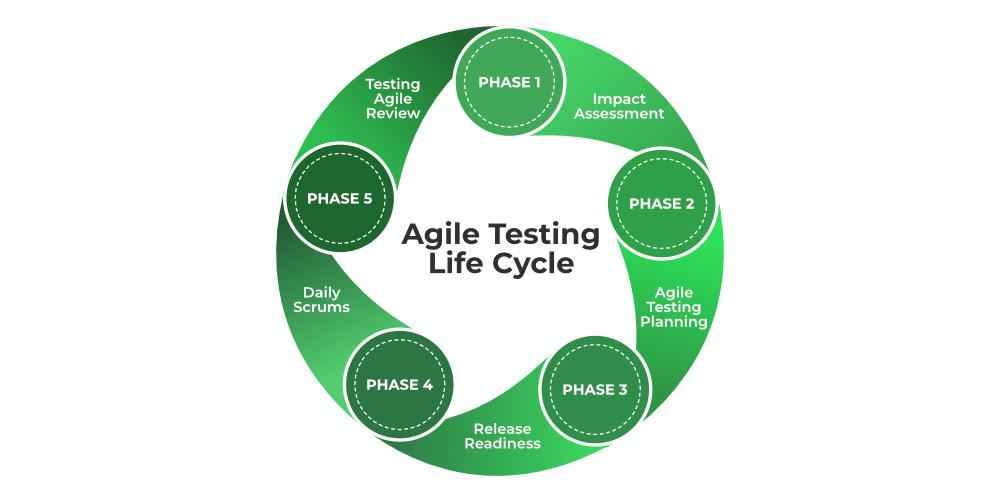
Life Cycle
- **Impact Assessment: Feedback is collected from users and stakeholders to understand requirements, identify changes, and define testing objectives for the next iteration.
- **Agile Test Planning: The team plans testing activities, including strategy, tools, resources, schedules, and risk management for the upcoming sprint.
- **Release Readiness: Features are thoroughly tested to ensure they meet quality standards and are ready for deployment or need further improvement.
- **Daily Scrums: Short daily meetings are conducted to track testing progress, discuss issues, and align the team on daily goals.
- **Test Agility Review: Regular reviews are held with stakeholders to evaluate progress, gather feedback, and improve future testing cycles.
Test Plan
An Agile Test Plan defines the testing approach, scope, strategy, resources, and tools required for each iteration and is continuously updated based on changing requirements and sprint goals.
- **Test Scope & Objectives: Defines what features, modules, and functionalities will be tested in the current iteration along with the goals of testing. It ensures that testing is aligned with user stories and business requirements.
- **Test Strategy & Approach: Describes the types of testing to be performed such as functional, non-functional, regression, and exploratory testing. It also defines whether testing will be manual or automated.
- **Resources & Team Roles: Identifies team members involved in testing, including testers, developers, and stakeholders, along with their roles and responsibilities. Collaboration among all members is emphasized.
- **Tools, Environment & Test Data: Specifies the tools (like automation tools), testing environment setup, and the data required to perform testing effectively during the sprint.
Benefits
Agile testing improves software quality through continuous testing, quick feedback, faster delivery, flexibility, and strong collaboration.
- **Early Bug Detection & Cost Reduction: Continuous testing helps identify defects early, reducing the cost and effort of fixing them later.
- **Faster Delivery: Features are delivered in small iterations, enabling quicker releases and faster time-to-market.
- **Improved Product Quality: Regular testing and feedback ensure fewer defects and a more reliable system.
- **Better Customer Satisfaction: Continuous customer involvement ensures the product meets user expectations.
- **Flexibility & Collaboration: Easily adapts to changes with strong teamwork between developers, testers, and stakeholders.
Limitations and Tips to avoid
Agile testing has challenges due to its dynamic nature, but proper planning and collaboration help minimize risks and improve efficiency.
- **Limited Documentation: Less documentation can create confusion, so maintain clear user stories, checklists, and acceptance criteria.
- **Dependency on Team Members: The loss of key team members can affect progress, so encourage knowledge sharing and collaboration.
- **Automation Challenges: Poor or excessive automation can cause issues, so use a balanced mix of manual and automated testing.
- **Unstable/Flaky Tests: Frequent changes may cause tests to fail, so regularly maintain and update test cases.
- **Lack of Expertise: Agile testing requires skilled team members, so provide training and continuous learning opportunities.
Risks
Agile testing involves continuous changes and fast-paced development, which can introduce risks that may affect product quality, testing efficiency, and project success if not properly managed.
- **Slow automation execution: Automated UI tests can be time-consuming and expensive to run, which may slow down the feedback cycle and delay the development process.
- **Poor test planning: Inadequate or unstructured test planning can result in missing critical test cases, leading to defects remaining undetected until later stages.
- **Over-reliance on automation: Relying too much on automated tests can overlook important real-world scenarios that require manual testing and human observation.
- **Unreliable or flaky tests: Frequent code changes in Agile can cause tests to fail randomly, reducing trust in test results and increasing maintenance effort.
- **Lack of expertise: Agile testing requires skilled team members, and lack of experience can lead to poor test design, ineffective testing, and reduced product quality.