Big Bang Integration Testing (original) (raw)
Last Updated : 23 Jul, 2025
Integration testing is a type of testing that is used to check the functionality of integrated components of a software system. It is usually performed after unit testing and before validation testing. In integration testing, individual software components are combined and tested as a group. The purpose of this testing is to check if the components work together as expected. Integration testing can be either bottom-up or top-down.
- In bottom-up integration testing, the lowest-level components are integrated first and tested.
- In top-down integration testing, the highest-level components are integrated first and tested.
What is Big Bang Integration Testing?
Big bang integration testingis a testing approach where all components or modules are integrated and tested as a single unit. This is done after all modules have been completed and before any system-level testing is performed. This is in contrast to incremental integration testing, in which components are tested one at a time or in small groups. This approach is typically used when there is a tight deadline for delivering the software product, and all development teams are working in parallel on their respective components.
For example,consider a simple system with three modules A, B, and C. Module A has been tested and found to be working correctly. The same is true for modules B and C. To test the system as a whole, all three modules are integrated and tested together.
In some cases, big bang integration testing may be the only option available. For example, if the system to be tested is too complex or too large to test piecemeal, then big bang integration testing is the only option. Big bang integration testing is a testing methodology in which all components or modules of a system are combined and tested as a whole. It is often used when it is not practical to test all components together incrementally.
Features of Big Bang Integration Testing
Below are the features of big bang integration testing:
- Simulation of the complete system: Big bang integration testing involves simulating the complete system. This means that all components and modules are integrated and tested at the same time.
- Testing all components together: Since all components are integrated and tested at the same time, this means that all components are tested together. This is beneficial as it allows for the testing of interactions between components.
- No component is left untested: Since all components are integrated and tested together, this means that no component is left untested. This is beneficial as it ensures that all aspects of the system are tested.
- Early detection of errors: Big bang integration testing can detect errors early on in the development process. This is beneficial as it allows for the correction of errors before the system is deployed.
- Allows for testing of complex interactions: Big bang integration testing allows for testing of complex interactions between components. This is beneficial as it allows for the identification of errors that may not be detected by other testing methods.
- Simulate the behavior of lower-level components: Big bang integration testing uses stubs and drivers to simulate the behavior of lower-level components.
- Top-down approach: It is also known as a top-down approach because testing starts from the highest level component and moves down the component hierarchy.
- The basic form of integration testing: It is the most basic form of integration testing, where all components are integrated and tested together.
- Risky: It can be very risky, as all components need to be working correctly for the system to work correctly. This approach is not recommended for large or complex projects.
- End of the development cycle: This type of testing is usually done at the end of the development cycle when all the modules are ready to be integrated. It can be used to test the functionality of the system as a whole.
- Manual: This type of testing is usually done manually, as it can be difficult to automate all the modules at once.
- Time-consuming and expensive: It can be time-consuming and expensive, as all the modules need to be tested together.
Workflow Diagram
The Big-bang integration workflow diagram is a process diagram that shows how different parts of a system are integrated. It is typically used to show how different software components are integrated. It is a graphical representation of the software development process that is used in many organizations. It is a process that starts with the idea for a new software project and ends with the delivery of the software to the customer.
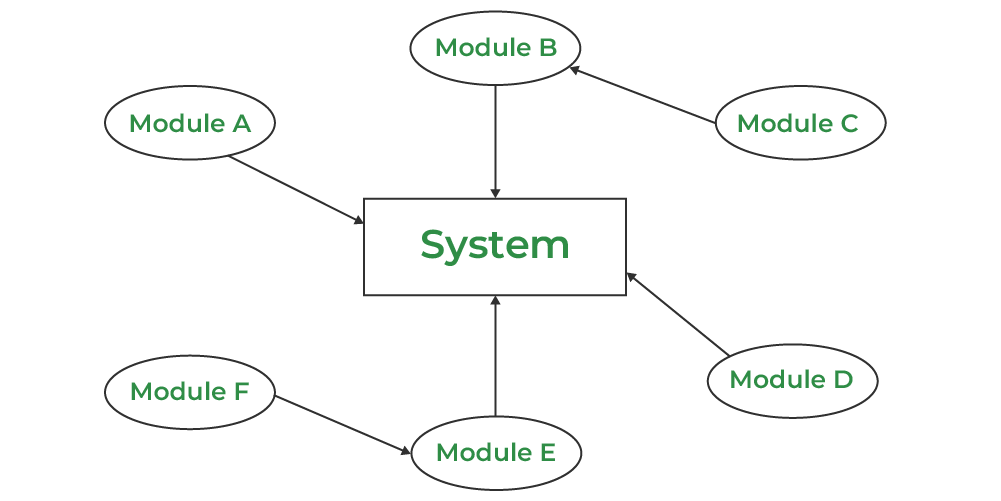
Workflow explanation:
- Modules A and D are all tested individually for the system.
- Module C is combined with module B and module F is combined with module E to be tested as a group.
- Module A is tested first, followed by module B, then D, and finally F.
- Each module is tested for functionality and compatibility with the other modules.
- After all, modules are tested, they are integrated into the system and the entire system is tested for functionality.
Types of Big Bang Integration Testing
Below are the two types of big bang integration testing:
- Top-down Integration: In this approach, the higher-level modules are integrated first and then the lower-level modules are integrated. This approach is generally used when the lower-level modules are not yet ready or when the dependencies between the modules are not well known. In this type of testing, the module at the top of the control hierarchy is tested first, followed by the module at the next level down, and so on. This type of testing is also known as a "trickle-down" approach.
- Bottom-up Integration: In this approach, the lower-level modules are integrated first and then the higher-level modules are integrated. This approach is generally used when the higher-level modules are not yet ready or when the dependencies between the modules are not well known. In this type of testing, the module at the bottom of the control hierarchy is tested first, followed by the module at the next level up, and so on. This type of testing is also known as a "bubble-up" approach.
Benefits of Big Bang Integration Testing
Below are some of the advantages of using big bang integration testing:
- The simplest form of integration testing: It is the simplest form of integration testing as all the modules are integrated at once and tested as a whole.
- Easy to implement: It is easy to implement as all the modules are already present and just need to be integrated.
- Bugs can be identified at once: All the errors and bugs can be identified at once as all the modules are tested together.
- Suitable for small projects: This approach is suitable for small projects where all modules can be integrated at once.
- Thorough test: All interfaces between modules are tested very thoroughly.
- Potential problems are fixed early: All components are tested at once, so potential problems can be identified and fixed early on.
- Save resources: It can save resources by avoiding the need to test individual components separately.
- Uncover hidden dependencies: It can uncover hidden dependencies between components that might not be apparent from testing them individually.
- Simplify the testing process: It can simplify the testing process by avoiding the need to set up and configure testing environments for each component.
Limitations of Big Bang Integration Testing
Below are some of the limitations of using big bang integration testing:
- Can cause Delays: All modules must be completed and ready for testing before integration can begin. This can cause delays if any module is not completed on time. So, it can cause disruptions to normal workflows.
- Difficult to identify the root cause of errors: It can be difficult to identify the cause of errors when all modules are tested together. It can be difficult to identify the root cause of errors if they are discovered during the final test.
- Lower-quality software: This approach can lead to lower-quality software due to the lack of testing of individual components.
- Time-consuming: Big bang integration testing can be time-consuming because all the modules are integrated at once and tested together. This can lead to a lot of time being spent on debugging and fixing errors.
- Inefficient: It can be inefficient because it does not allow for incremental testing. This means that errors can go undetected until all the modules are integrated and tested together.
- Not scalable: It is not scalable because it requires all the modules to be integrated and tested together. This can be a problem for large projects with many modules.
- Limited visibility: It can have limited visibility because it does not allow for incremental testing. This means that errors can go undetected until all the modules are integrated and tested together.
- High risk: It is a high-risk approach because all the modules are integrated and tested together. This can lead to a lot of errors and failures.