Cumulative Flow Diagrams in Kanban (original) (raw)
Last Updated : 23 Jul, 2025
**Cumulative Flow Diagrams (CFDs) are powerful tools in **Kanban project management. These visual aids help teams track **workflow efficiency and identify areas for **process improvement. In the world of **Agile methodologies, Kanban stands out for its focus on **visualizing work, **limiting work in progress, and **optimizing flow. CFDs support these core Kanban principles by offering a clear picture of how **work items move through various stages over time.
By incorporating CFDs into your **Kanban system, you can enhance your team's ability to manage work, predict delivery times, and continuously improve your processes. Whether you're new to Kanban or looking to optimize your existing workflow, understanding Cumulative Flow Diagrams is crucial for maximizing the benefits of this **Agile project management approach.
Table of Content
- Cumulative Flow Diagram
- Components of a CFD
- What Does a Cumulative Flow Diagram Show?
- How to Read a Cumulative Flow Diagram?
- Things to Look Out for in Cumulative Flow Diagrams
- Why Cumulative Flow Diagrams Are Useful?
- Conclusion
- Frequently Asked Questions on Cumulative Flow Diagrams in Kanban
Cumulative Flow Diagram
A Cumulative Flow Diagram (CFD) is a visual tool used in project management, particularly in Agile and Lean methodologies like Kanban. It graphically represents the number of work items in different stages of a process over time.
Key Components:
- **X-axis (Horizontal): Represents time, usually in days or weeks.
- **Y-axis (Vertical): Shows the cumulative number of work items.
- **Colored bands: Each represents a different stage in the workflow (e.g., "To Do", "In Progress", "Done").
Components of a CFD
**1. Axes:
- **X-axis (Horizontal Axis): Represents time. It shows the progression of time, usually in days, weeks, or sprints.
- **Y-axis (Vertical Axis): Represents the cumulative number of work items. It indicates the total count of work items across all stages of the workflow.
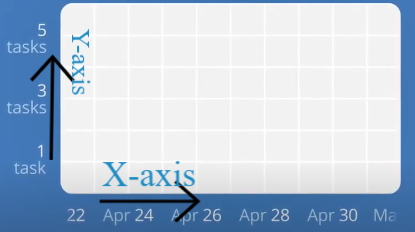
Axes in CFD
2. Areas:
- **Color-Coded Bands or Areas: Each area represents a different workflow state (e.g., "To Do," "In Progress," "Done"). The height of each area at any given point in time indicates the number of work items in that state.
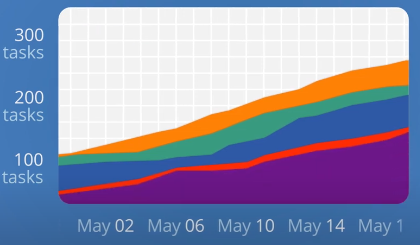
Different colored areas in CFD
3. Boundaries:
- **Top Line: Represents the cumulative total of all work items.
- **Intermediate Lines: Separate different workflow stages, showing the distribution of work items across stages.
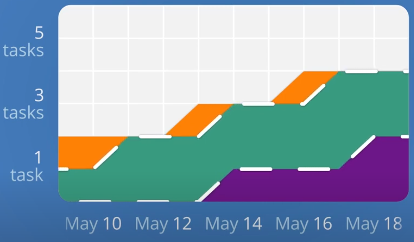
Intermediate lines in CFD
What Does a Cumulative Flow Diagram Show?
1. Visualization of Work Stages
A CFD illustrates the distribution of work items across different stages of a workflow over time. Common stages include:
- **To Do: Items that are planned but not yet started.
- **In Progress: Items that are currently being worked on.
- **Done: Items that are completed.
These stages are represented by different color-coded bands or areas on the CFD. The width of each band at any point in time indicates the number of work items in that stage.
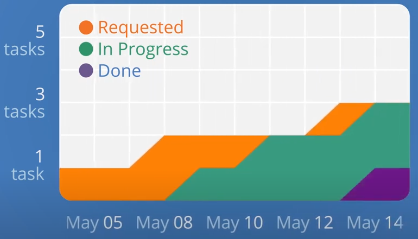
Different work stages in CFD
2. Tracking Work Items Across Different States
The CFD tracks the cumulative count of work items in each state, allowing teams to see how work progresses from one stage to another. As time progresses along the x-axis, the chart shows how work items accumulate and move through the workflow. This tracking helps in identifying:
- **Bottlenecks: If a particular stage's area is growing disproportionately, it indicates a bottleneck where work items are getting stuck.
- **Backlog Growth: The rate at which new work items are added can be observed in the "To Do" area.
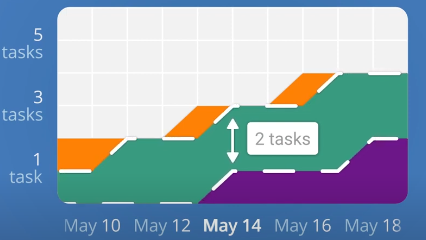
Tracking work items in different stages
3. Understanding Work-In-Progress (WIP), Cycle Time, and Lead Time
**Work-In-Progress (WIP):
- The total number of items in the "In Progress" area represents the WIP. Monitoring WIP is crucial for maintaining a steady flow and preventing overloading the team.
**Cycle Time:
- Cycle time refers to the time it takes for an item to move from the start of "In Progress" to "Done." By observing how long items stay in the "In Progress" area, teams can estimate the cycle time. A stable cycle time indicates a predictable workflow.
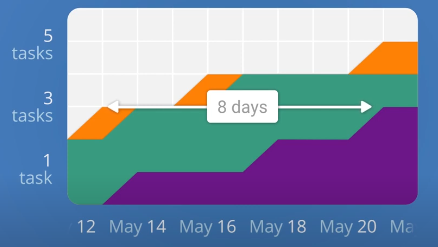
Cycle time in CFD
**Lead Time:
- Lead time is the total time taken from when a work item is requested (entered into "To Do") to when it is completed ("Done"). It includes both the time spent in "To Do" and "In Progress." CFD helps in visualizing and calculating lead time by showing the cumulative progression of items through all stages.
How to Read a Cumulative Flow Diagram?
1. Interpreting the X-Axis (Time) and Y-Axis (Number of Work Items)
- **X-Axis (Time): Tracks the evolution of the workflow.
- **Y-Axis (Number of Work Items): Shows the cumulative count of items.
2. Analyzing the Areas (Representing Different Stages)
- **Color-Coded Bands/Areas: Indicate the number of items in each workflow stage.
3. Identifying Trends and Patterns
- **Bottlenecks: A bottleneck is identified when a particular stage's area widens significantly over time. This suggests that work items are accumulating in that stage faster than they are being processed. Addressing bottlenecks is crucial for maintaining a steady flow.
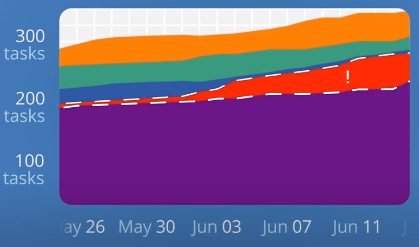
Bottleneck in CFD
- **Flow Issues: Flow issues can be observed through irregular patterns in the CFD. For example, sudden spikes or dips in the "In Progress" area may indicate disruptions in the workflow, such as resource shortages or technical issues.
- **Cycle Time and Lead Time: The horizontal distance between the start and end of an item’s path through the "In Progress" area represents cycle time, while the total distance from entry to "To Do" to exit from "Done" represents lead time. Stable, consistent distances indicate a predictable process.
- **Throughput: The slope of the top line in the "Done" area indicates throughput, or the rate at which work items are completed. A steeper slope suggests higher throughput. Analyzing this slope helps in understanding the team's productivity over time.
- **Work-In-Progress (WIP): The height of the "In Progress" area at any given time indicates the WIP. High WIP may lead to inefficiencies and delays, while low WIP can suggest underutilization of resources.
4. Practical Interpretation
When reading a CFD, start by observing the overall shape and smoothness of the areas. Consistent, smooth curves typically indicate a healthy workflow. Look for sudden changes or irregularities, as these can be signs of issues that need attention. Additionally, compare different time periods to spot trends and shifts in the workflow, helping to identify areas for improvement.
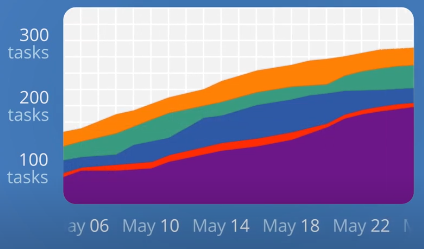
Smooth curves indicating healthy workflow
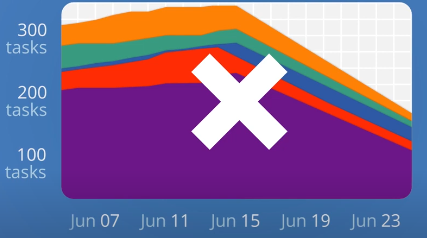
Incorrect CFD
Things to Look Out for in Cumulative Flow Diagrams
1. Signs of Bottlenecks and Delays
- **Widening of Areas: If a particular stage's area widens over time, it indicates that work items are accumulating in that stage. This is a clear sign of a bottleneck, where the throughput is lower than the inflow of work items.
- **Flat or Horizontal Lines: A flat or nearly flat line in the "In Progress" or "Done" areas suggests that no items are moving forward, indicating a blockage or delay. This could be due to resource constraints, technical issues, or other impediments.
- **Sharp Increases in the "To Do" Area: A sudden increase in the "To Do" area without a corresponding increase in subsequent stages can indicate a delay in starting new work. This might be due to prioritization issues or external dependencies.
2. Identifying Capacity Issues
- **Constant WIP Levels: A consistently high WIP level, as shown by a thick "In Progress" area, can indicate that the team is operating at or beyond capacity. This may lead to slower delivery times and increased lead times, as the team struggles to manage the workload.
- **Sudden Changes in Throughput: A sudden drop in the slope of the "Done" area indicates a decrease in throughput, suggesting that the team may be facing capacity issues. Conversely, a sudden increase might indicate overworking or unsustainable practices.
- **Divergence of Lines: If the lines separating different stages diverge, it may indicate that the capacity for handling work in subsequent stages is lower than in previous ones. This can highlight areas where capacity adjustments are needed.
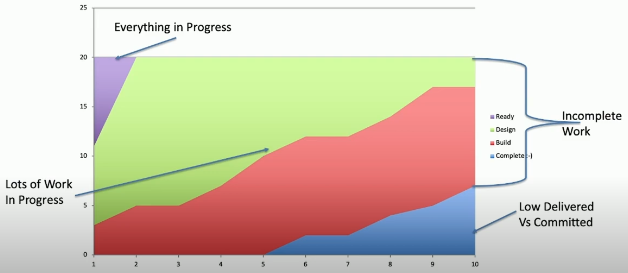
Capacity issues in CFD
3. Recognizing Trends Indicating Process Improvements or Deterioration
- **Consistent Slope Increases: A consistent increase in the slope of the "Done" area over time suggests improvements in throughput and efficiency. This indicates that the team is becoming more effective at completing work items.
- **Decreasing Cycle and Lead Times: A reduction in the horizontal distance between the "To Do" and "Done" areas (lead time) or the "In Progress" start and end (cycle time) indicates improvements in the workflow process, suggesting faster delivery and greater efficiency.
- **Stable WIP Levels: Stable WIP levels, particularly in the "In Progress" area, indicate a balanced and manageable workflow, suggesting that the team has found an optimal work rhythm.
- **Irregular Patterns or Spikes: Irregular patterns, such as sudden spikes or dips in the areas, can indicate issues such as inconsistent workload, unexpected challenges, or changing team dynamics. Consistent irregularities over time may signal a need for process evaluation and adjustment.
- **Convergence of Areas: If the bands representing different stages converge, it may suggest that work is being completed faster than it is being started. While this can sometimes indicate high efficiency, it may also suggest that the team is not receiving enough new work, potentially leading to underutilization.
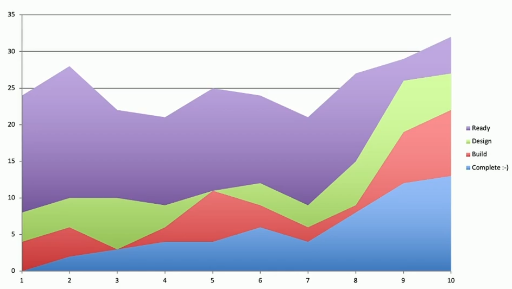
Irregular spikes leads to bad CFD
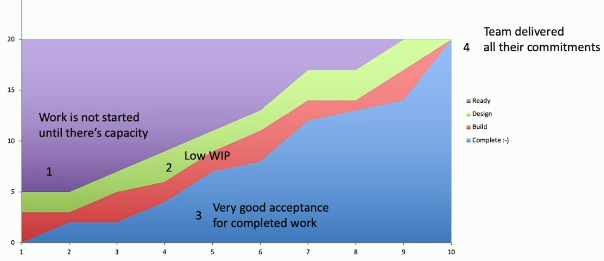
Example of good CFD
Why Cumulative Flow Diagrams Are Useful?
1. Benefits in Project Management:
- **Visualizing Workflow: Provides a clear view of work stages.
- **Tracking Progress: Monitors completion rates and project status.
- **Identifying Bottlenecks: Highlights areas where work accumulates.
- **Monitoring WIP: Helps manage work levels effectively.
2. Enhancing Transparency and Communication:
- **Clear Communication: Improves understanding among team members and stakeholders.
- **Shared Understanding: Ensures alignment on project status and issues.
- **Highlighting Achievements and Issues: Facilitates problem resolution and recognition.
3. Aiding in Continuous Improvement:
- **Identifying Trends: Supports process improvement through trend analysis.
- **Data-Driven Decisions: Enables informed decisions based on CFD data.
- **Optimizing Flow: Enhances efficiency by managing workflow and WIP.
- **Improving Predictability: Helps in forecasting and planning.
4. Supporting Kanban Practices:
- **Visualizing Flow: CFDs provide a clear picture of how work moves through the Kanban system over time.
- **Managing WIP: They help in monitoring and adjusting WIP limits by showing the impact of current limits on flow.
- **Identifying Improvement Opportunities: CFDs highlight areas where flow can be optimized, supporting Kanban's focus on continuous improvement.
Conclusion
In conclusion, **Cumulative Flow Diagrams (CFDs) are essential tools in **Kanban project management. They offer valuable insights into **workflow efficiency and support **continuous improvement in Agile teams. By visualizing **work in progress, identifying **bottlenecks, and tracking **cycle times, CFDs help teams optimize their **Kanban systems.
Incorporating CFDs into your **Agile practices can lead to more **efficient workflows, improved **delivery predictability, and better **resource allocation. Whether you're implementing **Kanban methodology or looking to enhance your existing **project management processes, mastering the use of Cumulative Flow Diagrams is a powerful step towards achieving **operational excellence and **agile maturity.