Hybrid Work Model (original) (raw)
Last Updated : 8 Jun, 2026
A hybrid model in software engineering is created by combining two or more SDLC models. It uses the strengths of each model to improve flexibility, efficiency, and development quality. This approach is used based on specific project needs.
- Combines different SDLC models like Waterfall, Spiral, or Prototype.
- Helps improve flexibility and reduces limitations of a single model.
- Provides better project control, quality, and adaptability.
**Examples: Banks use a hybrid model to combine strong structured development (for security and compliance) with iterative updates for new features like mobile banking and notifications.
Types of Hybrid Models
Hybrid models are formed by combining two or more SDLC models to improve flexibility and performance. Different combinations are used based on project needs.
- **Spiral–Prototype Model: Combines Spiral and Prototype models to support risk analysis along with early prototype development.
It helps in identifying risks early while refining user requirements through prototypes. - **Waterfall–Agile Model: Mixes Waterfall’s structured phases with Agile’s flexibility for better control and adaptability.
It helps balance detailed planning with iterative and flexible development. - **V-Model–Prototype Model: Integrates V-Model’s verification & validation with prototyping for early requirement clarity.
It improves requirement understanding while ensuring strong testing and validation. - **Agile–Scrum–Kanban Hybrid: Uses Agile practices with Scrum planning and Kanban workflow visualization for continuous delivery.
It improves workflow management, collaboration, and faster delivery of software.
**Process of Hybrid Model
The Hybrid Model is divided into eight main stages, with feedback loops and continuous testing applied across all phases:
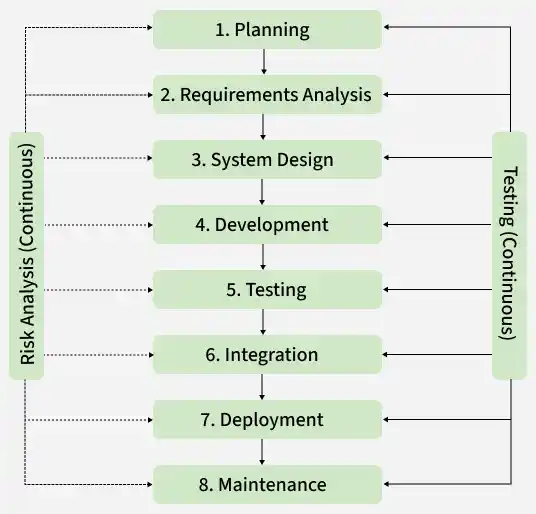
Process of Hybrid Model
- **Planning: This is the initial phase where project goals, scope, timeline, and resources are defined. It sets the foundation for the entire project.
- **Requirements Analysis: In this phase, all functional and non-functional requirements are collected and analyzed to clearly understand what the system must do.
- **System Design: This phase involves creating the architecture and design of the system, including database structure, user interface, and system components.
- **Development: In this phase, developers start writing the actual code based on the design specifications and requirements.
- **Testing: This phase checks the software for defects and ensures that it works correctly by identifying and fixing bugs.
- **Integration: In this phase, all individual modules are combined and tested together as a complete system to ensure proper interaction.
- **Deployment: In this phase, the final software is released and made available for users in the production environment.
- **Maintenance: This is the final phase where the system is updated, bugs are fixed, and improvements are made after deployment.
Variations of the Hybrid Work Model
Hybrid work models come in different forms depending on how organizations balance remote and office work. Each variation offers different levels of flexibility and structure.
- **Flexible Hybrid Model: Employees can choose their office and remote work days based on their convenience and work requirements.
- **Fixed Hybrid Model: Specific days are assigned for working from home and working from the office.
- **Office-First Hybrid Model: Employees primarily work from the office, with limited flexibility to work remotely when needed.
- **Remote-First Hybrid Model: Remote work is the default, and the office is used only for meetings or collaboration.
- **Role-Based Hybrid Model: Work location depends on the employee’s job role and responsibilities.
- **Team-Based Hybrid Model: Different teams follow different hybrid schedules based on their workflow needs.
- **Split-Week Hybrid Model: The workweek is divided between office days and remote working days.
- **Hybrid Model with Core Hours: Employees can work from anywhere but must be available during fixed common working hours.
- **Project-Based Hybrid Model: Employees work from the office during critical project phases and remotely at other times.
- **Hybrid Model with Hot Desking: Employees do not have assigned desks and book workspace as needed when they come to the office.
**Scenarios for Using a Hybrid Model
A hybrid Model is developed when we combine two models and this development is useful when:
- The customer is not fixed on its system requirements.
- The requirements of the system cannot be met by using a single SDLC model.
- The organization wants to use agility but complexity is a barrier.
- A fully planned approach to the budget is needed.
- Teams of the organization want collaboration.
It is up to the organization to choose the best possible combination of base models to make a Hybrid Model that can fulfill both business and customer requirements.
Need for the Hybrid Model
With the increasing use of agility in software development, the traditional model cannot be sustained as it does not help in fast delivery, achieve a high success rate, and cannot deal with changing customer requirements, this is all due to their lengthy process and standards. So, we need a hybrid Model as it:
- Has the benefits of two individual models.
- Resolve the dependency of models.
- Is suitable for both small and medium-sized systems.
- Involves customers at all phases of development.
- Helps in early delivery.
Advantages of Hybrid Work Model
- **Flexibility & Adaptability: Combines structured planning with iterative cycles, allowing the team to respond to changing requirements without restarting the entire process.
- **Risk Control: Continuous risk analysis at every phase helps identify and reduce risks early before they become critical problems.
- **Higher Software Quality: Continuous testing throughout all phases helps detect defects early, reducing cost and effort of fixing them later.
- **Cost & Time Efficiency: Early defect detection and iterative development reduce rework and ensure faster and more efficient delivery.
- **Scalability: Suitable for both small and large projects by effectively combining structured and iterative approaches.
- **Better Stakeholder Collaboration: Regular feedback ensures stakeholders stay involved and the final product meets expectations.
- **Faster Delivery: Incremental releases allow working software to be delivered early and improved continuously.
- **Customisable to Project Needs: Different SDLC models like Agile, Waterfall, Spiral, or V-Model can be combined based on project requirements.
Limitations of Hybrid Model
- **High Complexity: Combines multiple SDLC models, making the process more complex to plan, manage, and implement.
- **Difficult to Manage: Requires experienced teams to coordinate between different methodologies effectively.
- **Increased Cost: Using multiple models together can increase development and management costs.
- **Time-Consuming Planning: Selecting and integrating suitable models takes extra time during the initial stages.
- **Requires Skilled Team: Needs developers and managers who are well-versed in different SDLC approaches.
- **Integration Challenges: Combining different models may lead to confusion and communication gaps between teams.
- **Overhead in Monitoring: More tracking and documentation are required compared to single SDLC models.
Tips for Creating a Hybrid Work Model That Works for Everyone
- **Solicit Employee Feedback: Find out about their preferences and concerns.
- **Set Clear Goals: It define productivity metrics and goals.
- **Encourage Collaboration: Utilize technology for teamwork development.
- **Prioritize Well-being: It ensure availability of mental health support services to staff members.
Impact of the Hybrid Work Model on Company Culture
- **Inclusive Environment: Flexibility can be offered here by addressing diverse employee needs.
- **Increased Autonomy: It makes workers manage their own time.
- **Enhanced Collaboration: Advices on the utilization of digital tools which help to enhance communication
Hybrid Work Challenges
- **Communication Gaps: Lack of face-to-face interaction can lead to misunderstandings and reduced team coordination.
- **Collaboration Issues: Remote and in-office employees may find it difficult to collaborate effectively in real time.
- **Work-Life Balance Problems: Employees may struggle to separate personal and professional life when working from home.
- **Unequal Work Experience: Remote workers may feel less included compared to office-based employees.
- **Technology Dependence: Requires strong internet connection and digital tools, and any failure can disrupt work.
- **Security Risks: Remote access to company systems increases the risk of data breaches and cyber security issues.
- **Management Difficulties: Supervising and tracking productivity of distributed teams can be challenging.
- **Cultural Disconnect: Maintaining company culture becomes harder when teams are physically divided.