JIRA Waterfall Model (original) (raw)
Last Updated : 1 Jun, 2026
JIRA can be used to manage projects using the Waterfall Model, where work is completed step by step in a fixed order. It helps teams track tasks, issues, and project progress efficiently.
- Follows sequential project phases.
- Tracks tasks and bugs easily.
- Suitable for projects with fixed requirements.
Waterfall Model
The Waterfall Model is one of the earliest Software Development Life Cycle (SDLC) models. It follows a sequential approach where each phase is completed before moving to the next phase. Although it is less commonly used today, many modern SDLC models are based on it.
Phases of Jira Waterfall Model
The Jira Waterfall Model has six phases which are:
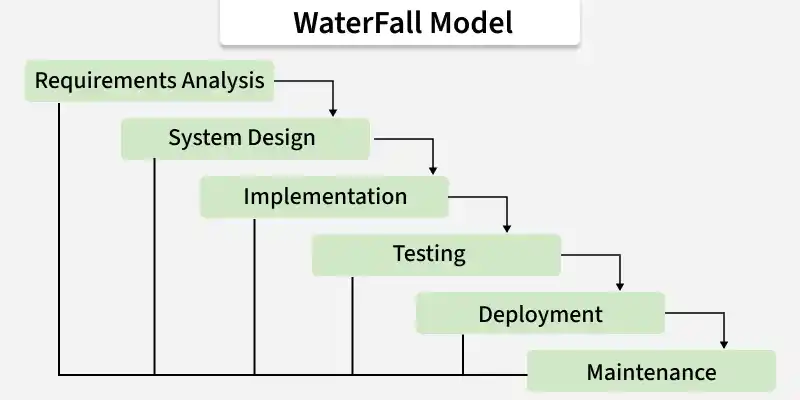
Waterfall Model
- **Requirements: The client provides project requirements and specifications. The company analyzes them to understand the project scope and objectives.
- **Design: The team creates the system architecture and design plan based on the requirements. Client approval is taken before development begins.
- **Development: Developers write the code according to the design specifications. Different tasks are assigned to team members for implementation.
- **Testing: The software is tested to find defects and ensure it works according to requirements. Bugs found are sent to developers for fixing.
- **Deployment: After successful testing, the software is released to the client or production environment for use.
- **Maintenance: The company fixes bugs, provides updates, and improves the software after deployment.
Example of Jira Waterfall Model
A client wants to develop a weather forecasting application and provides all project requirements to the company. The team first analyzes the requirements, designs the system, develops the application, tests it, and finally deploys the product. In this model, making changes after development begins is difficult.
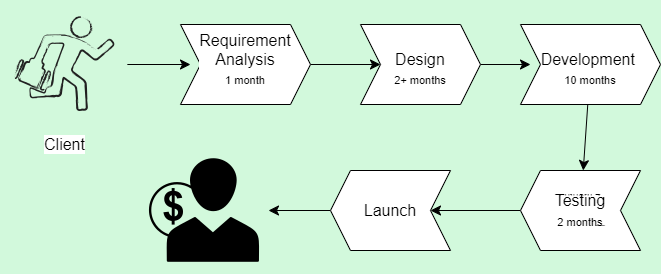
Waterfall Model Example
**Key Points from the Diagram
- Requirement Analysis takes around 1 month.
- Design and Development phases take the maximum project time.
- Testing is completed before the final product launch.
Advantages of the Jira Waterfall Model
- **Simple and Easy to Understand: The Waterfall Model follows a clear and sequential process, making it easy to manage and understand.
- **Well-Defined Phases: Each phase has specific goals and documentation, which helps in better planning and tracking.
- **Easy **Project Management: Since requirements are fixed at the beginning, project scheduling and cost estimation become easier.
- **Good for Small Projects: It works well for projects with clear and stable requirements.
- **Better Documentation: Proper documentation is maintained at every stage, which helps in future maintenance and reference.
Limitations of the Jira Waterfall Model
- **Time Taking: The Waterfall Model follows a sequential process, so each phase must be completed before the next begins. If one phase is delayed, the entire project gets delayed.
- **Unexpected Results: Since all requirements are fixed at the beginning, handling new issues or changes later becomes difficult and costly.
- **Not Suitable for Changing Requirements: This model is very inflexible. If the client wants changes after development starts, the project may need major rework or restart.
Project using Jira Waterfall Model
JIRA is mainly designed for Agile project management, but it can also be customized to manage Waterfall projects. However, JIRA does not provide a built-in Waterfall template by default and is generally more suitable for Agile methodologies.
Agile vs Waterfall in JIRA
| Feature | Agile in JIRA | Waterfall in JIRA |
|---|---|---|
| **Development Approach | Iterative and incremental | Sequential and phase-based |
| **Project Flow | Continuous development in sprints | One phase completed before the next begins |
| **Requirement Changes | Easily adaptable to changes | Difficult to change once development starts |
| **Project Planning | Flexible planning and frequent updates | Fixed planning at the beginning |
| **Team Collaboration | High collaboration and regular meetings | Limited collaboration between phases |
| **JIRA Boards Used | Scrum Board, Kanban Board | Task Lists, Timelines, Gantt-style tracking |
| **Task Management | User stories, epics, sprint tasks | Sequential tasks and milestones |
| **Testing | Continuous testing during development | Testing performed after development |
| **Delivery | Frequent releases and updates | Single final delivery |
| **Best Suitable For | Dynamic projects with changing requirements | Projects with fixed and clear requirements |