Localization Testing (original) (raw)
Last Updated : 23 Jul, 2025
In globalized world, businesses need to make sure their software, websites, and apps are suitable for users in different regions and cultures. This is where **Localization Testing plays a key role. It ensures that a product is properly adapted for a specific region, focusing not only on translating the language but also on cultural, regional, and legal aspects that affect user experience.
In this article, covers what **Localization Testing is, why it's important, what it involves, how it's done, and the best practices to follow for the best results.
What is Localization Testing?
**Localization Testing is a **Type of Software Testing that is performed to verify the quality of a product for a specific culture or locale. Localization testing is performed only on the local version of the product.
Localization testing ensures that the application is capable enough to be used in that specific region. It tests the user interface, language vocabulary, currency format, date & time format for that specific country only.
For example, QQ is a social media platform specifically designed for the chinese people. It supports language chinese and every other aspects in a specific way.
**Features of Localization Testing
- **Localized user interface: It tests the user interface is affected by local. In order it can be said that the user interface is designed in such a way that it is comfortable for specific people.
- **Localized content: Different contents that are in-built in the application are according to the local culture and the test is performed to check whether it is comfortable for locals.
- **Specific Language: A test is performed to check the language supported by the application to know the software's compatibility with the language of the specific region.
- **Hardware Compatibility: Hardware compatibility test is performed to test the compatibility of the software and the hardware toward the specific region.
**Localization Testing Process
Here is the Process of Localization Testing
- **Setup the test environment: First of all testing environment is set up in order to perform a good quality testing process. This helps in getting the good quality software testing process.
- **Choose the product: Choose the product for which the localization testing is going to be performed. This leads to the testing being the product oriented.
- **Generate Script: The script according to the local and the specific culture the script is generated. For example, for a US specific application language is set to the English.
- **Comparison: Now the inbuilt attribute and the local attributes are compared to check the software's quality. For example, the user interface or language is compared with specific region's correspondence.
- **Analysis and Result: After the comparison testing process is analysed whether it was successful or not. Also the result is submitted to the developing team regarding different aspects of the application.
**Localization Testing Life Cycle
**Here is the Localization Testing Life Cycle which is connected through the phases:
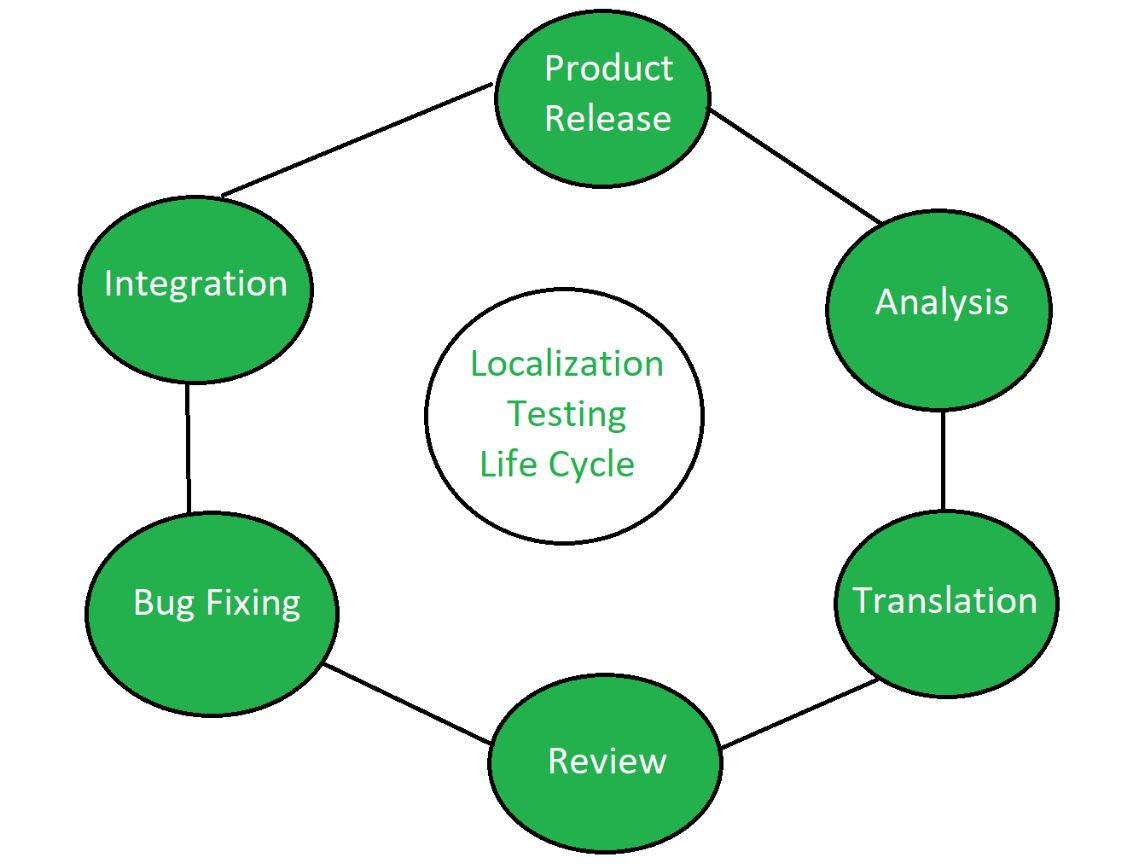
Localization Testing Life Cycle
**1. Analysis: Understand the localization needs of the product. Identify the requirements specific to the target region or locale.
**2. Translation: Translate the product’s content and user interface into the target language. Make sure the translation is culturally appropriate and accurate.
**3. Review: Check the translated content for accuracy and context. Ensure the text fits correctly and doesn’t cause layout issues.
**4. Bug Fixing: Identify and fix any issues found during testing, like language errors or UI problems. Confirm that all features work correctly in the localized version.
**5. Integration: Add the localized version into the main system. Run tests to make sure everything works smoothly after localization.
**6. Product Release: Finalize the localized product and prepare it for release. Ensure that the localized versions meet all quality standards.
**What Does Localization Testing Cover?
Localization testing ensures that a product, such as a website or software, is correctly adapted to meet the needs of users in a specific region. It looks at several key areas to make sure the product aligns with the local language, culture, and standards.
**1. Language
- **Translation Accuracy: The text should be translated correctly into the local language without errors.
- **Grammar and Syntax: The translated text must sound natural and follow proper grammar and language rules.
- **Terminology: Certain words may have different meanings in various cultures. Using the right terms is crucial for clarity.
**2. Culture
- **Visuals and Icons: Images, colors, or symbols can have different meanings in different cultures. Testing ensures that visuals are appropriate and resonate with the local culture.
- **UI Layout: The text direction (left-to-right or right-to-left), font sizes, and arrangement of UI elements may need adjustments based on cultural preferences.
**3. Regional Standards
- **Date and Time Formats: Different regions have different formats for dates and times. For example, the US uses MM/DD/YYYY, while Europe often uses DD/MM/YYYY.
- **Currency and Measurements: Currency symbols and measurement units must match the local region, such as using dollars in the US and euros in Europe.
- **Time Zones: Adjusting the software to reflect local time zones is crucial for accurate scheduling and communication.
**4. Legal Requirements
- **Compliance with Local Laws: Various regions have laws around data privacy (like GDPR in Europe) and content restrictions. Localization testing ensures that the product meets these legal requirements.
- **Taxation and Billing Systems: The product must handle local tax rates and billing systems to ensure accurate financial transactions.
**Advantages of Localization Testing
- Localization testing reduces the overall testing cost.
- Localization testing reduces the overall support cost.
- It helps in reducing the time for testing.
- Localization testing has more flexibility and scalability.
**Disadvantages of Localization Testing
- Localization testing requires a local expert to perform it.
- It is expensive to have the local translator.
- There might be schedule challenges for the tester.
**Conclusion
**Localization testing is important for making sure your product works well for users in different regions. It re-sure that your product is not only functional but also culturally and legally suitable. By focusing on language, culture, local standards, and laws, businesses can provide a smooth, user-friendly experience across different markets. By using both human and automated testing, you can create a high-quality, localized product that meets user expectations and connects with your audience.