Object Oriented Testing in Software Testing (original) (raw)
Last Updated : 13 Jun, 2026
Object-Oriented Testing (OOT) is a software testing approach used to verify applications developed using object-oriented programming concepts. It focuses on testing classes, objects, and their interactions to ensure that OOP features such as encapsulation, inheritance, and polymorphism work correctly.
- Tests the behavior and functionality of classes and objects.
- Verifies interactions between different objects and components.
- Ensures proper implementation of OOP concepts like inheritance and polymorphism.
Dependencies in Object-Oriented Testing
In Object-Oriented Testing, dependencies represent the relationships among classes, methods, variables, and messages. These dependencies must be tested to ensure that objects interact correctly and the system functions as expected.
Types of Dependencies
- **Class-to-Class Dependency: One class depends on another through inheritance, association, or aggregation.
- **Class-to-Method Dependency: A class depends on the methods it contains to perform its operations.
- **Class-to-Message Dependency: A class depends on messages exchanged between objects for communication.
- **Class-to-Variable Dependency: A class depends on its attributes or data members to store and manage information.
- **Method-to-Variable Dependency: A method depends on variables used during its execution.
- **Method-to-Message Dependency: A method depends on messages sent to other objects to complete a task.
- **Method-to-Method Dependency: One method depends on another method to perform its functionality.
Levels of Object-Oriented Testing
Object-Oriented Testing is performed at different levels to ensure that classes, objects, and their interactions function correctly. Each level focuses on a specific aspect of the object-oriented system.
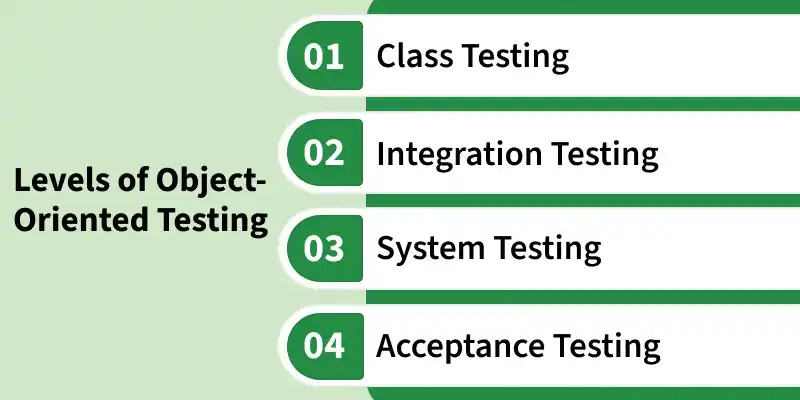
Levels of Object-Oriented Testing
- **Class Testing: Class testing is the lowest level of object-oriented testing. It verifies the functionality of an individual class by testing its methods, attributes, and behavior independently.
- **Integration Testing: Integration testing checks the interaction and communication between multiple classes and objects. It ensures that objects work together correctly and exchange data as expected.
- **System Testing: System testing evaluates the complete integrated application as a whole. It verifies whether the entire object-oriented system meets the specified functional and non-functional requirements.
- **Acceptance Testing: Acceptance testing is performed by end users or clients to validate that the software satisfies business requirements and is ready for deployment in the real-world environment.
Object-Oriented Testing Process
The Object-Oriented Testing (OOT) process follows a systematic approach to verify the correctness of classes, objects, and their interactions in an object-oriented application. It helps ensure that the software functions as expected and meets quality requirements.
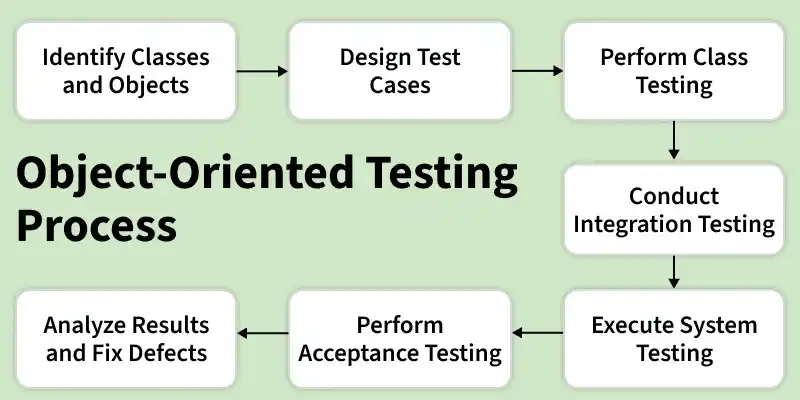
Object-Oriented Testing Process
- **Identify Classes and Objects: The first step is to identify the classes, objects, attributes, and methods that need to be tested within the application.
- **Design Test Cases: Test cases are created to verify the behavior, functionality, and interactions of classes and objects under different conditions.
- **Perform Class Testing: Each class is tested individually to ensure that its methods, data members, and functionalities work correctly.
- **Conduct Integration Testing: Interactions between multiple classes and objects are tested to verify proper communication and data exchange.
- **Execute System Testing: The complete integrated system is tested to validate that all components work together according to the specified requirements.
- **Perform Acceptance Testing: End users or clients test the application to confirm that it meets business needs and is ready for deployment.
- **Analyze Results and Fix Defects: Test results are reviewed, defects are identified and corrected, and the software is retested to ensure quality and reliability.
Testing Techniques in Object-Oriented Testing (OOT)
Object-Oriented Testing uses various techniques to verify the behavior of classes, objects, and their interactions. These techniques help ensure that the application functions correctly under different conditions.
- **State-Based Testing: State-Based Testing focuses on verifying the behavior of an object as it moves through different states during its lifecycle. Test cases are designed to check whether state transitions occur correctly based on specific events or inputs.
- **Class-Based Testing: Class-Based Testing evaluates an individual class by testing its methods, attributes, constructors, and operations. It ensures that the class performs its intended functions correctly and independently.
- **Scenario-Based Testing: Scenario-Based Testing validates the system using real-world scenarios that represent how users interact with objects and components. It helps identify issues that may occur during actual system usage.
- **Use Case Testing: Use Case Testing is based on use case diagrams and user requirements. Test cases are created from different user actions and workflows to verify that the system meets functional requirements and delivers the expected results.
- **JUnit: JUnit is a Java testing framework used for unit testing classes and methods.
- **TestNG: TestNG is an advanced testing framework that supports annotations, grouping, and parallel execution.
- **Selenium: Selenium is an automation tool used for testing web applications through browsers.
- **Mockito: Mockito is a mocking framework used to create dummy objects for testing.
- **Apache JMeter: Apache JMeter is a tool used for performance and load testing of applications.
- **JaCoCo: JaCoCo is a code coverage tool that measures the extent of code tested.
- **Eclipse IDE: Eclipse is an IDE that provides support for developing and executing test cases.
- **IntelliJ IDEA: IntelliJ IDEA is an IDE that offers built-in features for testing and debugging applications.
Advantages of Object-Oriented Testing
- **Improves Software Quality: Helps identify defects in classes and object interactions at an early stage.
- **Supports Reusability: Reusable classes can be tested once and used confidently in multiple applications.
- **Enhances Reliability: Ensures that objects and methods behave correctly under different conditions.
- **Better Coverage: Tests object states, behaviors, and interactions comprehensively.
- **Facilitates Maintenance: Makes it easier to detect and fix issues when changes are made to the code.
- **Validates OOP Features: Ensures proper implementation of encapsulation, inheritance, and polymorphism.
- **Reduces Development Cost: Early defect detection minimizes the cost of fixing errors later.
- **Improves Integration Testing: Verifies smooth communication and cooperation between objects and classes.
Challenges in Object-Oriented Testing
Object-Oriented Testing presents several challenges due to the complexity of object-oriented concepts and interactions between classes and objects.
- **Encapsulation: Accessing and testing private data and methods can be difficult.
- **Inheritance: Changes in parent classes may affect child classes, making testing more complex.
- **Polymorphism: Different object behaviors at runtime can make it difficult to predict and verify outcomes.
- **Object Interactions: Testing communication and dependencies between multiple objects can be challenging.
- **State Management: Objects may change states during execution, requiring extensive testing of state transitions.
- **Reusability of Classes: Reused classes must be tested in different contexts to ensure consistent behavior.
- **Complex Test Case Design: Designing effective test cases for object relationships and interactions requires additional effort.
- **Integration Complexity: Verifying interactions among numerous classes and components can be time-consuming.
Object-Oriented Testing vs Traditional Testing
| Object-Oriented Testing (OOT) | Traditional Testing |
|---|---|
| Focuses on testing classes, objects, and their interactions. | Focuses on testing functions, procedures, and modules. |
| Designed for object-oriented applications. | Designed for procedural or structured applications. |
| Tests OOP concepts such as encapsulation, inheritance, and polymorphism. | Does not specifically address OOP concepts. |
| Emphasizes object behavior and state changes. | Emphasizes input-output validation of functions. |
| Integration testing focuses on object interactions. | Integration testing focuses on module interactions. |
| Test cases are derived from classes, objects, and use cases. | Test cases are derived from functional requirements and program logic. |
| More suitable for modern object-oriented software systems. | More suitable for traditional procedural systems. |