Security Testing Software Testing (original) (raw)
Last Updated : 16 May, 2026
Security Testing is a type of non-functional testing that verifies whether an application, system, or network is protected against security threats and unauthorized access. It helps identify vulnerabilities and ensures the confidentiality, integrity, and availability of data.
- Protects systems from cyberattacks and data breaches.
- Identifies vulnerabilities such as SQL injection and XSS.
- Ensures secure access and data protection.
Types of Security Testing
Security testing is important to ensure that applications and systems are protected from various threats. There are several types of security testing, each targeting specific vulnerabilities and aspects of security.
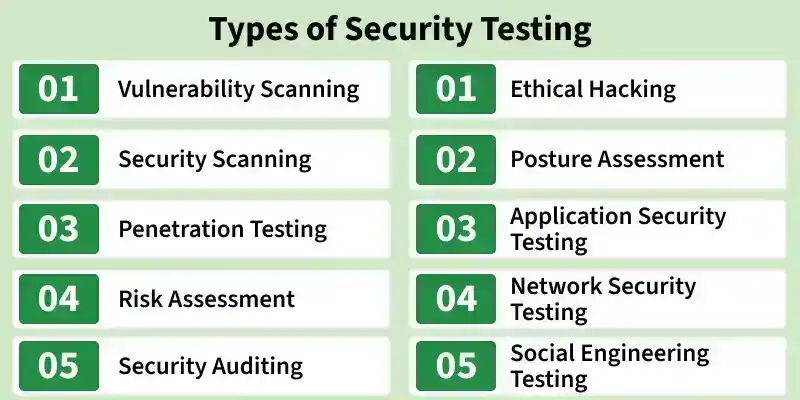
Types of Security Testing
- **Vulnerability Scanning: Uses automated tools to detect known vulnerabilities and helps fix them before exploitation.
- **Security Scanning: Identifies weaknesses in systems or networks and recommends appropriate solutions.
- **Penetration Testing: Simulates real-world cyberattacks to identify exploitable vulnerabilities in applications, systems, or networks.
- **Risk Assessment: Analyzes and categorizes security risks to prioritize mitigation.
- **Security Auditing: Reviews system configurations, code, and policies to ensure compliance with security standards.
- **Ethical Hacking: Authorized security experts use hacking techniques to identify, analyze, and help fix security vulnerabilities. Ethical hacking can include penetration testing as one of its techniques
- **Posture Assessment: Combines multiple testing techniques to evaluate the overall security posture of a system.
- **Application Security Testing: Evaluates application code and configurations to identify and prevent vulnerabilities.
- **Network Security Testing: Examines network infrastructure like routers and firewalls for weaknesses.
- **Social Engineering Testing: Simulates human-based attacks (e.g., phishing) to test user awareness.
Security Testing includes different techniques that help identify and prevent vulnerabilities in applications and systems.
- **SAST ****(Static Application Security Testing)**: Analyzes source code for vulnerabilities without running the program; helps fix issues early.
- **DAST ****(Dynamic Application Security Testing)**: Tests running applications for vulnerabilities like SQL injection or XSS; simulates real attacks.
- **IAST ****(Interactive Application Security Testing)**: Combines static and dynamic testing to provide real-time feedback during application runtime.
- **SCA ****(Software Composition Analysis)**: Scans third-party libraries and dependencies for vulnerabilities, outdated components, and license issues.
- **MAST (Mobile Application Security Testing): Identifies security risks in mobile apps, including session handling and insecure data storage.
- **RASP ****(Runtime Application Self-Protection)**: Embeds security into applications to detect and respond to attacks in real-time.
Goal of Security Testing
The goal of security testing is to identify vulnerabilities, protect systems and data, and ensure secure application behavior against cyber threats.
- Identify security weaknesses such as misconfigurations and vulnerabilities.
- Evaluate system resilience against attacks and unauthorized access.
- Ensure compliance with security standards and regulations.
- Verify secure authentication, authorization, and data protection mechanisms.
- Reduce security risks before deployment and production release.
Principle of Security Testing
Security testing follows seven core principles, often referred to as the CIA triad (Confidentiality, Integrity, Availability) along with seven basic principles of security testing:
- **Confidentiality: Ensures that sensitive data is protected from unauthorized access and is only available to intended users.
- **Integrity: Guarantees that data remains accurate, consistent, and is not altered or tampered with by unauthorized entities.
- **Authentication: Verifies the identity of users, systems, or applications before granting access to resources.
- **Authorization: Controls user permissions and ensures that authenticated users can only access resources they are allowed to use.
- **Availability: Ensures that systems, applications, and data are accessible and operational whenever needed, even under attack or heavy load.
- **Non-Repudiation: Prevents users from denying their actions by providing proof of activities such as transactions or data changes.
- **Resilience: Ensures the system can withstand attacks, failures, or unexpected events and recover quickly with minimal impact.
Major Focus Areas in Security Testing
Security testing targets critical areas to ensure comprehensive protection:
- **Authentication and Authorization****:** Ensure only authorized users can access the system and resources.
- **Network and Infrastructure Security****:** Protect firewalls, routers, and networks against attacks like DoS and MitM.
- **Database Security****:** Safeguard databases from SQL injection, XSS, and other vulnerabilities.
- **Application Security****:** Identify and fix application-level flaws such as injection attacks and XSS.
- **Data Security: Ensure data is encrypted, intact, and protected from leakage.
- **Compliance: Verify adherence to standards like HIPAA (protects healthcare data), PCI DSS (secures payment card information), and SOC2 (ensures secure handling of customer data and services).
- **Cloud Security****:** Protect cloud environments and services from threats and misconfigurations.
Advantages **of Security Testing
Security testing offers significant benefits that enhance system protection and user trust:
- **Identify Vulnerabilities: Detect weak passwords, unpatched software, and misconfigurations.
- **Improve System Security: Fix vulnerabilities and strengthen defenses.
- **Ensure Compliance: Meet standards like HIPAA, PCI DSS, and SOC2.
- **Reduce Risk: Prevent security incidents before the production to deployment.
- **Enhance Incident Response: Prepare organizations to handle potential threats effectively.
Limitations of Security Testing
Security testing is essential for identifying vulnerabilities, but it also has certain limitations related to time, cost, and the evolving nature of cyber threats.
- **Time-Consuming Process: Comprehensive security testing can require significant time and effort, especially for large applications.
- **High Cost: Advanced security tools, skilled professionals, and continuous testing may increase overall project costs.
- **Cannot Guarantee Complete Security: Security testing reduces risks but cannot ensure that an application is completely free from vulnerabilities.
- **Requires Skilled Professionals: Effective security testing needs experienced testers with knowledge of cybersecurity threats and techniques.
Application of Security Testing
Security Testing is applied across different industries and applications to identify vulnerabilities, protect sensitive data, and ensure system security against cyber threats.
- Web and mobile applications use security testing to detect issues like SQL injection, XSS, and authentication flaws.
- Banking and financial systems apply it to secure customer data and meet compliance standards such as PCI-DSS.
- E-commerce platforms use security testing to protect online transactions, payment systems, and customer accounts.
- Healthcare applications and medical devices rely on it to secure patient records and prevent data breaches.
- Enterprise software, cloud services, and government systems use security testing to strengthen access control and defend against cyberattacks like malware and DDoS attacks.
Modern Security Practices
Modern security testing also includes advanced practices to improve security throughout the software development lifecycle.
- **Zero Trust Security: Follows a “never trust, always verify” approach for user and system access.
- **DevSecOps: Integrates security testing into CI/CD pipelines for continuous and automated security validation.
- **Continuous Security Testing: Regularly scans applications and infrastructure for vulnerabilities during development and deployment
- **API Security Testing: Verifies the security of APIs against threats such as broken authentication, injection attacks, and unauthorized access.