Software Testing Error vs Defect vs Bug vs Fault vs Failure (original) (raw)
Last Updated : 16 May, 2026
In software testing, terms like bug, defect, error, fault, and failure are often used interchangeably, but they have different meanings. Understanding these differences helps testers and developers communicate more effectively. Each term represents a different stage of an issue in the software lifecycle.
- These terms are related but not identical
- They help in better defect tracking and analysis
- Important for interviews and real-world testing scenarios
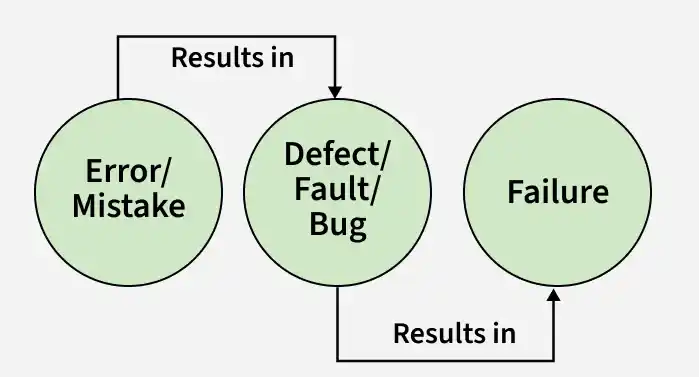
Bug vs Defect vs Error vs Fault vs Failure
Error
An error is a human mistake made during software development. It occurs when a developer, tester, or analyst makes an incorrect decision or misunderstanding.
- Caused by human mistakes such as logic errors, syntax errors, or misunderstandings.
- Occurs during coding, design, or requirement phase
- **Example: Writing wrong logic in code
Defect
A defect is a flaw in the software that occurs when expected results do not match actual results. It is identified during testing when the application behaves incorrectly.
- Found during testing phase
- Indicates incorrect implementation of requirements
- **Example: Login fails even with correct credentials
Bug
A bug is an informal term used to describe a defect in the software. It is commonly used by testers and developers in day-to-day communication.
- Synonym of defect (informal term)
- Used in bug tracking tools (e.g., Jira)
- **Example: UI button not working properly
Fault
A fault is the root cause in the code that leads to a defect. It represents the incorrect implementation or logic in the system.
- Exists in the code or design
- Causes defects when executed
- **Example: Wrong condition in if-statement
Failure
A failure occurs when the system does not perform its intended function during execution. It is the visible result of a defect when the software runs.
- Occurs during execution of the software
- End result of defect/fault
- **Example: Application crashes on clicking login
Error vs Defect vs Bug vs Fault vs Failure
| Term | Definition | Cause | Stage | Example |
|---|---|---|---|---|
| **Error | A Human mistake in code or design | Developer/Tester mistake | Development phase | Wrong logic written |
| **Defect | A Flaw in software | Error in implementation | Testing phase | Login not working |
| **Bug | An Informal term for defect | Same as defect | Testing/Production | Button not clickable |
| Fault | Root cause in code | Incorrect logic/design | Development phase | Wrong condition |
| Failure | System not working as expected | Defect during execution | Runtime | App crash |