How to Write Test Cases in Software Testing (original) (raw)
Last Updated : 18 May, 2026
Writing effective test cases ensures that software functions correctly and meets requirements. A clear test case defines the steps, inputs, and expected results, helping identify defects early and maintain consistent software quality.
- Validates functionality by ensuring the system behaves as expected.
- Detects defects early in the development cycle, reducing cost and effort.
- Improves overall software quality by ensuring reliable and accurate performance.
Flow of Test Case
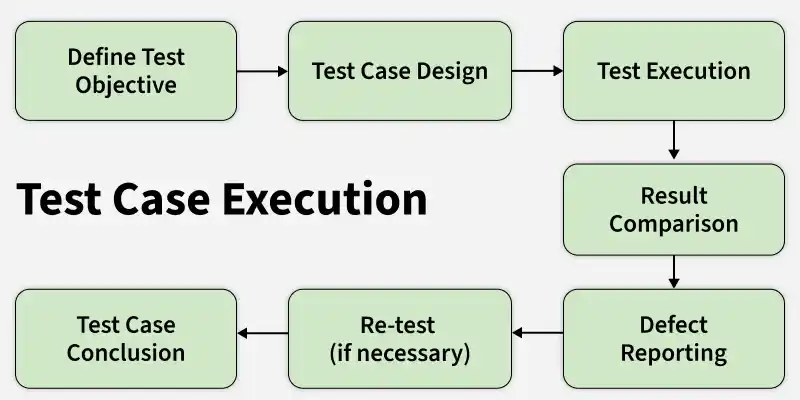
Flow Test Case
The flow of a test case follows a structured sequence from defining objectives to final conclusion. It helps ensure proper validation, defect detection, and accurate results.
- **Define Test Objective: Identify what needs to be tested
- **Test Case Design: Create test cases with steps and inputs
- **Test Execution: Execute test cases on the application
- **Result Comparison: Compare actual and expected results
- **Defect Reporting: Report any issues found
- **Re-test (if necessary): Re-run test cases after fixes
- **Test Case Conclusion: Mark final status (Pass/Fail)
Test Case Template and Key Parameters
A test case template is a structured format used to create clear and consistent test cases. It helps organize test information and ensures proper validation.
Main Sections
A test case template is divided into main sections to organize test information clearly and systematically.
- **Header Section: Tester name, description, prerequisites
- **Body Section: Steps, data, expected and actual results
Key Parameters
Key parameters define the essential elements required to create, execute, and validate a test case effectively.
- **Test Case ID & Description: Each test case has a unique ID and a clear description to explain its purpose.
- **Pre/Post Conditions: Conditions that must be satisfied before execution and after completion of the test case.
- **Test Steps & Test Data: Step-by-step actions to perform along with required input values for testing.
- **Expected & Actual Result: The expected outcome versus the actual result observed after execution.
- **Status & Comments: Final result (Pass/Fail) along with any remarks or observations.
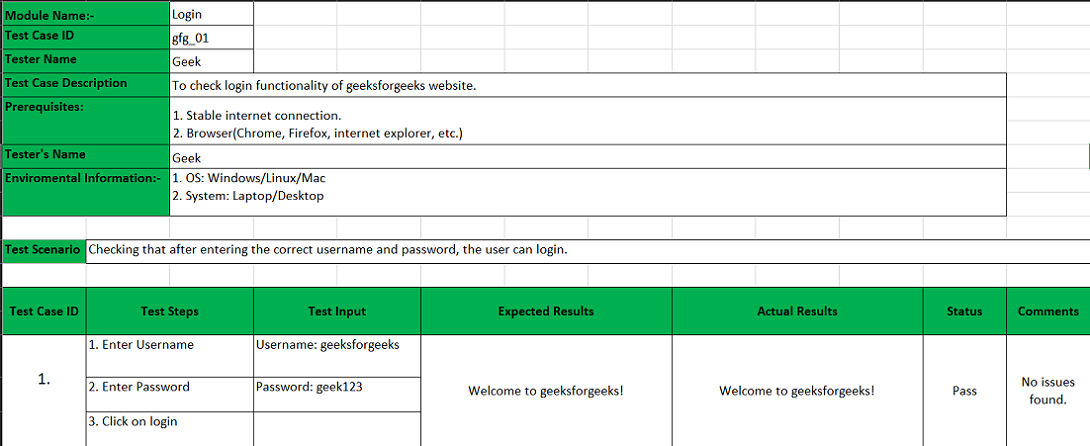
Test Case Template
The section from Module Name to Test Scenario represents the header, while the table below represents the body. A login test case template is created with its parameters and values.
Example: Test Cases for a Login Page
Below is an example of preparing various test cases for a login page with a username and password.
**Unit Test Case: This test checks if the username meets the minimum length requirement. The input “geeksforgeeks” is accepted, so the test passes.
- **Condition: Check username length
- **Input: geeksforgeeks
- **Expected Result: Username accepted
- **Actual Result: Username accepted
- **Status: Pass
**Functionality Test case: This test checks whether the username and password work correctly when the login button is clicked. These tests validate the login functionality using valid and invalid credentials.
- **Valid Login: Enter valid credentials -> Login successful (**Pass)
- **Invalid Login: Enter wrong credentials -> Login unsuccessful (**Pass)
**User Acceptance Test Case: This test checks if the login page loads properly based on user feedback. It failed due to a browser compatibility issue.
- **Condition: Check login page loading
- **Steps: Click login button
- **Expected Result: Login page loads
- **Actual Result: Page not loaded
- **Status: Fail
Stages of Writing Test Cases
Test cases can be written at different stages of the software development lifecycle:
- **Before Development: Based on requirements to ensure clarity and support early validation (shift-left testing).
- **During Development: Written alongside coding to test modules as they are built.
- **After Development: Created before release to verify completed features and overall functionality.
Test case management tools help organize, execute, and track test cases efficiently, improving collaboration, reducing manual effort, and providing better visibility through reporting and dashboards.
- **TestLink: Open-source tool for managing test cases, plans, and executions with bug-tracking integration.
- **Xray: Jira-based test management tool supporting manual and automated tests with strong traceability.
- **TestRail: Manages test cases, plans, and runs with detailed reporting and team collaboration features.
- **PractiTest: End-to-end test management with reporting and integration capabilities.
Benefits of Writing High-Quality Test Cases
High-quality test cases ensure accurate and efficient testing of software applications. They help improve test coverage, detect defects early, and maintain overall product quality.
- **Improves Test Coverage: Ensures all functionalities and scenarios are properly tested.
- **Early Defect Detection: Helps identify bugs at an early stage, reducing cost and effort.
- **Ensures Consistency: Provides a standardized approach to testing across the team.
- **Enhances Documentation: Acts as a reference for future testing and maintenance.
- **Saves Time and Effort: Reduces rework and improves testing efficiency.