Types of Data Warehouses (original) (raw)
Last Updated : 24 Oct, 2025
A **data warehouse is a centralized repository that allows you to store large volumes of structured and unstructured data from multiple sources. Data warehouses are essential for data analysis, business intelligence, and reporting. Understanding the different **types of data warehouses can help organizations choose the best solution for their specific needs.
Each type of data warehouse serves different purposes and is optimized for various business requirements, making it essential for businesses to understand which type aligns best with their goals and data strategies.
What are Data Warehouses?
A **data warehouse is a centralized repository designed to store large volumes of **structured and **unstructured data from multiple sources. It supports **data analysis, **business intelligence, and **reporting by consolidating data into a single, comprehensive system. The process typically involves **extracting, **transforming, and **loading (ETL) data into the warehouse, where it can be organized and queried efficiently.
Features of Data Warehouses
- **Subject-Oriented: Information being stored and processed is related to important user topics including customers, sales, and products among others giving a clear and overall view of certain business areas of interest.
- **Integrated: Access to the collected data takes place and it is compiled to have standard names, measurements and encoding structures.
- **Non-Volatile: The data being stored, is not changed or erased in the warehouse so that history and trends can be checked reliably over time.
- **Time-Variant: Data warehouses contain past information, and, as a rule, information for several years is contained in the data warehouse that allows realizing analyses of tendencies, and chronological changes, etc.
- **Optimized for Query Performance: Integrated in such a way that it allows easy search and query method through indexing and partitioning for large Data sets.
How do Data Warehouses work?
- **Data Extraction: It pulls data from several transactional sources including but not limited to transactional databases, customer relationship management systems, enterprise resource planning systems, and from external sources. In this step, focus and collect information that is pertinent to the warehouse.
- **Data Transformation: The extracted data goes through integration processes to make them uniform and accurate. This concerns data pre-processing that involves deleting duplicate records or observations, actual error checking and rectification, data sources consolidation, adding value to the data, and format and unit harmonization.
- **Data Loading (ETL): Implemented data is transferred to data warehouses. This process can be executed and completed at a large scale in a predetermined period (Batch) or incremental from the source to update the data warehouse constantly (Real-time).
- **Data Storage: Encapsulated data is integrated into an architecture known as a schema such as a star schema and snowflake schema, because of query and designing optimization for analysis. Information is usually maintained in dimensional models containing facts which are numerical and dimensions which are attributes.
- **Data Indexing and Partitioning: To improve the efficiency of queries that are submitted to it, data in the warehouse is segmented and indexed. Indexing optimizes the speed at which data is accessed because pointers to the location of data are created; partitioning, on the other hand, breaks a large table into smaller tables thus making them easier to manage.
- **Metadata Management: About data, there is metadata to offer details on its source, organization, manipulation and utilization. This is useful for a user in figuring out the history and origin of the data.
- **Data Access and Querying: BI( Business intelligence) tools, query engines and reporting tools are integrated into the data warehouse where; data analysis is done, report generation and even dashboard creation is conducted. Employees and customers can apply versatile queries, execute some calculations for solving unpredictable tasks, and obtain some valuable conclusions based on the united data from the sources.
- **Data Security and Governance: Data warehouses therefore apply security functions for regulating access to the data as well as other related data. Policies focus on data quality, compliance as well as utilization to eliminate problems related to data quality, data compliance and data utilization during its lifetime.
Types of Data Warehouses
Data warehouses come in various forms, each designed to meet specific organizational needs and data handling approaches. Understanding these different types is crucial for choosing the right solution to improve data management and support business intelligence efforts.
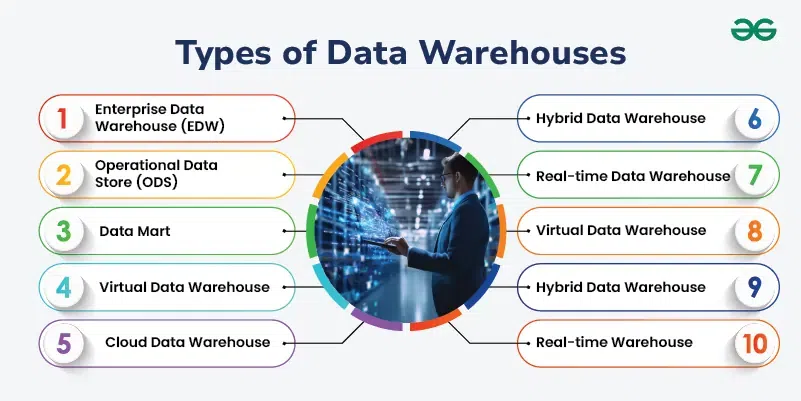
Types of Data Warehouses
Let's explore the main types of data warehouses, their strengths, and their current uses in global data management.
1. Enterprise Data Warehouse (EDW)
An Enterprise Data Warehouse (EDW) refers to a comprehensive data repository that integrates data drawn from different areas of an organisation. It holds all information for all business units required giving a consolidated and unified view of the organization.
Features of Enterprise Data Warehouse (EDW)
- **Scope and Scale: The EDWs are deployed for managing data generated from diverse business areas including finance, marketing, selling, and operations.
- **Integration: It gathers information from transactional databases, ERP systems, CRM systems and other data feeds from outside the business environment.
- **Architecture: Usually, the structure of an EDW complies with a star/snowflake scheme containing facts (numeric, measurable information) and dimensions (qualitative and contextual data).
- **Usage: They facilitate complex queries, high-level analysis, and business insight information within the business.
- **Maintenance: Being central repositories of an organization’s data, EDWs demand investments in infrastructure, upkeep, as well as stewardship for the quality of data kept in them.
2. Operational Data Store (ODS)
An ODS is another form of data warehouse data layer that holds data from operational systems in a consolidated and integrated format for near real-time reporting and operational analysis.
Features of Operational Data Store (ODS)
- **Real-Time Data: ODSs are intended for the incorporation of updated information as close as possible to the operational time, so they offer the current look at the operational data.
- **Scope: While EDWs are used for strategic decision-making, ODSs deal with the organization’s operational activities and transactional requirements.
- **Integration: They collect data from different operational sources like transactional, ERP, CRM and so on for which the data is denormalized mostly.
- **Usage: Other Decision Support System is utilized for short-term decisions and comprises inventory control, customers’ orders and control of employee scheduling.
- **Architecture: Generally, ODSs do not retain data history; they provide real-time data for fast read and write operations and are data marts for loading data into the EDW.
3. Data Mart
A Data Mart can be defined as an element of a Data Warehouse system designed to hold data from a particular business division, department or user type. It is created to serve the specific interests of a specific class of people.
Features of Data Mart
- **Scope: Data marts are less comprehensive than EDWs and relevant to the organization’s specific departments, such as sales, finance, or marketing.
- **Integration: They routinely pull or gather data from the EDW and other operation sources to develop a specific data set.
- **Usage: Data marts are used to supply departmental reporting and analysis as the users of this type of data get real-time access to the data that can be useful for their organizational tasks.
- **Architecture: Data marts can be deployed based on the star schema or any other simplification of a star-war structure. They can be operations-based or derived (extracted from the operational system directly) or they can be dependent, that is, retrieved from the EDW.
- **Flexibility: They also introduce faster implementation and lower cost than building an entire EDW to satisfy all the needs of an organization because they can address departmental requirements instead.
4. Cloud Data Warehouses
Cloud Data Warehouses are Data Warehousing solutions that are located on the cloud platform that offer a scalable platform for effective usage of data storage and analysis.
Features of Cloud Data Warehouses
- **Scalability: Cloud data warehouses mean that you can adjust the storage or computational power as required to fit various loads and data amounts.
- **Cost-Effectiveness: It is a logical model because it entails organizations making payments only to the extent of the services they want, therefore departing from huge initial capital investments.
- **Maintenance: Cloud service providers take care of the infrastructure, and manage their upgrades and security thus freeing managers to give their time to analysis on data patterns.
- **Integration: They enable the easy integration of different forms of data, the cloud, and other applications to help with data ingestion.
- **Flexibility: Cloud data warehouses facilitate several analytics, including operational processing, near real-time, machine learning, and complex business analytics. Some examples include Amazon Redshift, Google BigQuery, and most recently, Snowflake.
5. Big Data Warehouses
Big Data Warehouses are advanced preparation instruments for data warehousing to address gigantic volumes of structured and unstructured data that are created with velocity.
Features of Big Data Warehouses
- **Volume, Variety, and Velocity: They can analyze and retain wide arrays of data collected from social media platforms, IoT devices, logs, and many others.
- **Architecture: Large buckets usually take advantage of distributed computing software like Hadoop and Apache Spark in technologies like HDFS, No SQL database, and columnar storage.
- **Analytics: They enable data mining, machine learning and real-time analysis techniques that are used in decision-making from the big data.
- **Integration: Most big data platforms and tools interconnect with various big data warehouses that facilitate data ingestion, transformation, as well as analysis.
- **Use Cases: They are applied in areas like finance, healthcare, retail/wholesale, telecom, and oil & gas, to name a few: consumer behaviour analysis, fraud detection, predictive maintenance, and the like.
6. Virtual Data Warehouse
A Virtual Data Warehouse provides a logical view of data from multiple sources without physically storing the data in a central location.
Features of Virtual Data Warehouses:
- Data Integration: Combines data from various sources without physical movement.
- Real-time Access: Provides up-to-date information directly from source systems.
- Reduced Storage Costs: Minimizes the need for additional storage infrastructure.
- Flexibility: Easily adapts to changes in source systems.
7. Hybrid Data Warehouse
A Hybrid Data Warehouse combines on-premises and cloud-based data storage and processing capabilities.
Features of Hybrid Data Warehouses:
- Flexibility: Allows organizations to keep sensitive data on-premises while leveraging cloud benefits.
- Scalability: Can scale resources up or down based on needs.
- Cost-Effective: Balances the benefits of cloud and on-premises solutions.
- Data Sovereignty: Helps comply with data residency requirements.
8. Real-time Data Warehouse
A Real-time Data Warehouse is designed to process and analyze data as it's generated, providing immediate insights.
Features of Real-time Data Warehouses:
- Immediate Data Processing: Analyzes data in real-time or near-real-time.
- Low Latency: Minimizes delay between data generation and availability for analysis.
- Streaming Data Support: Handles continuous data streams effectively.
- Time-Sensitive Decision Support: Enables quick responses to changing conditions.
Comparison of Data Warehouse Types
To help you choose the right type of data warehouse for your needs, here's a comparison table:
| Type | Best For | Scalability | Cost | Complexity | Real-time Capability |
|---|---|---|---|---|---|
| EDW | Large enterprises | High | High | High | Limited |
| ODS | Operational reporting | Medium | Medium | Medium | High |
| Data Mart | Department-specific needs | Low | Low | Low | Medium |
| Cloud DW | Flexible, scalable needs | Very High | Pay-as-you-go | Medium | High |
| Big Data DW | Large, varied datasets | Very High | High | High | High |
| Virtual DW | Distributed data sources | Medium | Low | Medium | High |
| Hybrid DW | Balancing security and scalability | High | Medium | High | Medium |
| Real-time DW | Immediate insights | High | High | High | Very High |
When choosing a data warehouse type, consider factors such as your organization's size, data volume, analytical needs, budget, existing infrastructure, and real-time requirements.
Benefits of Data Warehouses
1. Improved Decision-Making
- **Comprehensive View: Data warehouses are useful as they combine data from several sources in such a way that organisation's get a single picture of their data thus backing up important decisions.
- **Historical Analysis: In keeping a record of the past data it becomes easy to predict the future, and come up with blueprints and long-term plans.
2. Improved Data Accuracy and Uniformity
- **Data Integration: Data warehousing allows consolidation of data from disparate sources into standard units thereby eliminating issues of inconsistency.
- **Data Cleansing: Data cleaning and transformation are some of the processes that enhance the quality and credibility of data.
3. Faster Query Performance
- **Optimized Storage: Data warehouses are built with indexing, partitioning and optimized schema designs which help to increase the query performance and decrease the response time.
- **Advanced Query Capabilities: They provide additional possibilities for querying as well as analytical operations that cannot be processed in operational databases.
4. Scalability and Flexibility
- **Scalable Infrastructure: Another reason is that modern data warehouses, especially cloud-based ones, allow the purposes of extended and scalable storage and computing resources.
- **Adaptability: They can process and accommodate a significant amount of data and can complete any type of analysis, live or over some time.
5. Centralized Data Management
- **Single Source of Truth: Data warehouses avoid the problem of the presence of a large number of isolated data sources within an organization, and guarantee that all departments use unified data.
- **Efficient Data Management: The major advantage of centralization data management, security and even maintenance become easy to conduct.
6. Improved Reporting and Analysis
- **Advanced Analytics: The data warehouses enable complex analytical applications and techniques like data mining, machine learning and business intelligence (BI) applications.
- **Custom Reporting: Audiences can develop their report and analysis by more or less their wants and necessities.
7. Increased Productivity
- **Reduced Data Retrieval Time: Quicker response to the query and effective operations that provide data save users time as they begin to analyze data as opposed to searching for it.
- **Streamlined ETL Processes: Automated ETL means extract, transform, and load are the processes that help in organizing data integration and processing.
8. Enhanced Data Security
- **Controlled Access: It should be noted that data warehouses tend to be very secure and frequently contain features such as access control mechanisms, encryption, and auditing.
- **Compliance: They assist organizations in meeting data governance and regulatory compliance by managing and protecting the data.
9. Cost Efficiency
- **Reduced Operational Costs: Currently, cloud data warehouses come with a service model whereby customers are charged for the services used; this is relatively cheaper as compared to operating on-premises infrastructure.
- **Lower Maintenance Costs: With localized service delivery, cloud providers take control of patching hardware and software thus putting lesser demands on in-house IT.
10. Support for Business Intelligence(BI)
- **Integrated BI Tools: Generally, BI tools are incorporated into data warehouses to support applications with enhanced visualization, reporting, and analytics.
- **Strategic Insights: It assists the strategic initiatives of an organization in terms of recognition of business opportunities and threats by ensuring that complete and current data is available.