Mobile Application Testing (original) (raw)
Last Updated : 18 May, 2026
Mobile Application Testing is the process of testing mobile apps to ensure they work correctly, securely, and efficiently on different mobile devices and operating systems. It helps improve app quality and user experience before release.
- Ensures the app functions properly on Android and iOS devices
- Identifies bugs related to performance, security, and usability
- Improves user satisfaction and application reliability
Mobile Applications
Mobile applications are software programs designed to run on mobile devices such as smartphones and tablets. They help users perform various tasks like communication, entertainment, shopping, banking, and learning.
- Available on platforms such as Android and iOS
- Can be downloaded from app stores like Google Play Store and Apple App Store
- Provide easy access to services anytime and anywhere
**Types of Mobile Applications
- **Native Apps: Developed for a specific platform (e.g., iOS, Android) using platform-specific programming languages and APIs.
- **Web Apps: Accessed through mobile web browsers and often built using web technologies like HTML5, CSS, and JavaScript.
- **Hybrid Apps: Combine elements of both native and web apps, typically using web technologies but wrapped in a native shell for distribution.
Types of Mobile Application Testing
Mobile application testing includes different testing types used to verify the quality, performance, security, and usability of a mobile app. Each testing type focuses on a specific area of the application.
- **Functional Testing: Checks whether all app features and functions work correctly according to requirements. Ensures buttons, forms, and navigation work properly.
- **Usability Testing: Ensures the application is easy to use and user-friendly. Focuses on navigation, design, and overall user experience.
- **Performance Testing: Evaluates the app’s speed, responsiveness, and stability. Ensures the app performs well under different workloads.
- **Compatibility Testing: Verifies that the app works correctly on different devices, operating systems, and screen sizes. Helps ensure consistent performance across platforms.
- **Security Testing: Tests the application for data protection and security vulnerabilities. Ensures secure authentication and safe user data handling.
- **Installation Testing: Checks the installation, updating, and uninstallation process of the application. Ensures the app installs and launches without issues.
Mobile testing tools are software applications used to test mobile apps for functionality, performance, usability, and compatibility across different devices and platforms.
- **Appium: An open-source automation tool used for testing Android and iOS mobile applications.
- **Espresso: A testing framework developed by Google for Android application UI testing.
- **XCUITest: An automation testing framework provided by Apple for testing iOS applications.
- **Selenium: A popular automation tool mainly used for testing mobile web applications.
- **Robotium: An Android testing framework used for automated functional and UI testing.
- **Perfecto: A cloud-based mobile testing tool used for testing applications on real devices and browsers.
Approaches to Test the Mobile Application
Mobile testing approaches are methods used to test mobile applications effectively to ensure quality, performance, and reliability across different devices and environments.
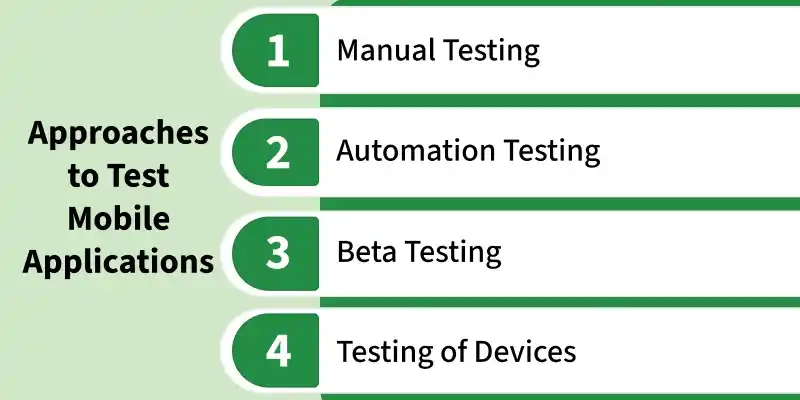
Approaches to Test Mobile Application
1. Manual Testing
Manual testing is a process where testers evaluate a mobile app without automation tools to find functional and usability issues from a user’s perspective.
- **Exploratory Testing: Testers explore the application without predefined test cases to identify bugs and unexpected behavior.
- **Ad Hoc Testing: Testers perform random testing without a structured process to quickly find defects.
- **Usability Testing: Evaluates the user interface, navigation, and overall user experience to ensure the app is easy to use.
2. Automation Testing
Automation testing uses scripts and tools to automatically validate mobile application functionality, performance, and compatibility across different scenarios and environments.
- **Functional Testing: Automation scripts are used to verify the application’s functionality under different scenarios and user interactions.
- **Regression Testing: Automated tests are executed after code changes to ensure new updates do not affect existing features.
- **Compatibility Testing: Automation scripts check whether the application works properly across different devices, operating systems, and screen sizes.
3. Beta Testing
Beta testing allows a limited group of real users to test the application before its official release. User feedback helps identify bugs, usability issues, and areas for improvement.
- Users test the app in real environments before final launch.
- Helps identify bugs and usability issues missed during internal testing.
- Collects real user feedback for improvements.
- Improves overall app quality and user experience.
4. Device Testing
Device testing ensures that a mobile application performs correctly across real devices and virtual environments to validate real-world behavior and compatibility.
- **Real Device Testing: The application is tested on actual mobile devices to verify real-world performance and device-specific features.
- **Emulator/Simulator Testing: The application is tested using virtual devices that simulate real device environments. Emulators are mainly used for Android, while simulators are commonly used for iOS testing.
Mobile Application Testing Strategies
Mobile application testing strategies are techniques and approaches used to ensure the quality, performance, security, and reliability of mobile applications across different devices and platforms.
- **Test on Real Devices: Testing on actual devices helps verify real-world performance and user experience.
- **Use Automation Testing: Automation improves testing speed, accuracy, and efficiency for repetitive tasks.
- **Perform Cross-Platform Testing: Ensures the application works properly on Android, iOS, and different screen sizes.
- **Test Under Different Network Conditions: Verifies application performance on Wi-Fi, 4G, 5G, and low-speed networks.
- **Focus on Security Testing: Ensures user data protection, secure authentication, and vulnerability prevention.
- **Conduct Regular Regression Testing: Confirms that new updates do not affect existing application functionality.
Challenges in Mobile Testing
- **Device Fragmentation: Mobile apps must work on different devices, screen sizes, and hardware configurations.
- **Operating System Variations: Testing is required across multiple Android and iOS versions for compatibility.
- **Network Conditions: Applications must perform properly under different network speeds such as 3G, 4G, 5G, and Wi-Fi.
- **Battery Consumption: Mobile apps should use battery power efficiently without draining the device quickly.
- **Security Risks: Protecting user data and preventing security vulnerabilities is a major challenge.
- **Frequent Updates: Continuous updates in devices and operating systems require regular testing and maintenance.
Advantages of Mobile Testing Automation
Mobile testing automation improves efficiency, accuracy, and scalability of testing processes by reducing manual effort and enabling faster execution of test cases.
- Reduces testing time by executing repetitive test cases quickly and efficiently.
- Improves accuracy by minimizing human errors in test execution and validation.
- Enhances test coverage across multiple devices, platforms, and scenarios.
- Supports regression testing by quickly validating existing functionality after updates.
- Enables continuous testing by integrating with CI/CD pipelines.
- Optimizes long-term testing efforts by allowing reuse of automated test scripts.
Types of Mobile Emulator
Mobile emulators are virtual environments used to simulate mobile devices for testing applications without using real hardware.
- **Android Emulator: Simulates Android devices and is commonly used for testing Android applications in a virtual environment.
- **iOS Simulator: Simulates iOS devices and is used to test Apple applications on macOS systems.
- **Cloud-Based Device Emulators: Provide access to real device simulations hosted on cloud platforms for cross-device and cross-browser testing.
- **Browser-Based Mobile Emulators: Allow basic mobile UI testing directly within web browsers to simulate different screen sizes and resolutions.
Mobile Application Testing Vs Desktop Application Testing
| Parameters | Mobile Application Testing | Desktop Application Testing |
|---|---|---|
| User Interaction | Mobile apps use touch gestures, sensors, GPS, camera, and push notifications, so these features must be tested. | Desktop applications mainly use keyboard and mouse interactions with fewer input variations. |
| Platforms | Mobile apps are tested on Android and iOS devices with different screen sizes and OS versions. | Desktop apps are usually tested on Windows, macOS, and Linux systems with less hardware variation. |
| Network Conditions | Mobile apps are tested under different network conditions such as 3G, 4G, 5G, and Wi-Fi. | Desktop applications generally work in stable network environments. |
| Testing Tools and Frameworks | Mobile testing uses tools like Appium, Espresso, emulators, and simulators for device testing. | Desktop testing uses automation and compatibility testing tools focused on desktop operating systems. |