Test Data in Software Testing (original) (raw)
Last Updated : 28 Apr, 2026
Test data refers to the set of input values used to verify the functionality, performance, and reliability of a software application. It includes various data conditions to ensure the system behaves correctly under normal, boundary, and exceptional scenarios.
- Used to validate software behavior across different conditions and scenarios
- Helps identify defects and ensures accurate and reliable results
- Supports comprehensive testing by covering both typical and edge cases
**Example: For a login page, entering a valid username and password should allow access, while incorrect or empty inputs should show an error message.
Types of Test Data
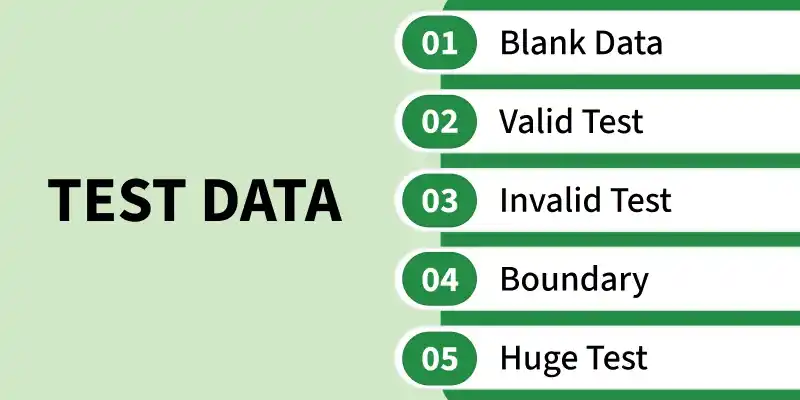
Types of Test Data
1. Blank Data
Blank or missing data refers to input fields that are left empty to verify how the system handles the absence of required information.
- Helps ensure that mandatory fields are properly validated before submission.
- Verifies that appropriate error messages or prompts are displayed to the user.
2. Valid Data
Valid data consists of correct and acceptable input values that follow all required formats and constraints to verify normal system functionality.
- Confirms that the application produces expected and accurate results
- Ensures that all functionalities work correctly under normal conditions
3. Invalid Data
Invalid data includes incorrect, unexpected, or improperly formatted inputs used to test the system’s validation and error-handling capabilities.
- Checks whether the system correctly identifies and rejects wrong inputs.
- Ensures meaningful and user-friendly error messages are displayed.
4. Boundary Data
Boundary data refers to input values at the extreme ends of allowed limits, such as minimum and maximum values, to test edge conditions.
- Helps identify errors that occur at the limits of input ranges.
- Ensures the system behaves correctly at both lower and upper boundaries.
5. Huge Data
Huge or large data refers to very large input values or datasets used to evaluate system performance, scalability, and stability under heavy load conditions.
- Tests how the system handles large volumes of data without crashing
- Evaluates performance factors such as response time and processing speed
Test Data Generation
Test data generation is the process of creating and preparing input data required for executing test cases effectively. It ensures that the application is tested under different scenarios, including normal, boundary, and error conditions.
- Supports effective testing by providing relevant data for validation
- Improves defect detection by including diverse data sets such as valid, invalid, and edge case inputs
- Enhances test coverage by ensuring all functionalities and conditions are properly tested
Role of Test Data Before Execution
Preparing test data in advance helps ensure smooth and efficient test execution. It allows testers to validate functionality without delays and improves overall testing quality.
- Prevents delays by having ready data before execution starts
- Ensures accurate validation using correct and well-prepared inputs
- Improves efficiency by enabling faster and smoother testing process
**Test Data in Different Testing Types
Test data varies based on the type of testing to ensure proper validation of different aspects of the software.
- **White Box Testing: Data is designed to cover code paths, conditions, and logic
- **Black Box Testing: Data focuses on inputs and expected outputs without knowing internal code
- **Performance & Security Testing: Data simulates high load, user behavior, and security threats
Automated test data generation tools help create large volumes of test data quickly and efficiently. They reduce manual effort and improve the accuracy and coverage of testing.
- **Faster Data Creation: Generate large datasets in less time
- **Improved Accuracy: Reduce human errors in test data
- **Better Test Coverage: Create diverse data for multiple scenarios
- **Popular Tools: Mockaroo, GenRocket, Informatica TDM, Delphix