Solidity Programming ERC20 Token (original) (raw)
Last Updated : 3 Jul, 2021
ERC token standard 20 tokens in a smart contract token that follows the Ethereum Request for Comment proposal 20 guidelines. Our program will have the following mandatory functions:
- function totalSupply() public view returns (uint256);
- function balanceOf(address tokenOwner) public view returns (uint);
- function allowance(address tokenOwner, address spender)
- function transfer(address to, uint tokens) public returns (bool);
- function approve(address spender, uint tokens) public returns (bool);
- function transferFrom(address from, address to, uint tokens) public returns (bool);
And two events which emit to the external application:
- event Approval(address indexed tokenOwner, address indexed spender, uint tokens);
- event Transfer(address indexed from, address indexed to, uint tokens);
Important keywords used:
- Event: An event is Solidity’s way of allowing clients e.g notifying your front end application about the occurrence of a specific event.
- View: View functions ensure that they will not modify the state
- public: A public function can be accessed outside the contract itself
- indexed: Up to three parameters can receive the attribute indexed through which we can search respective arguments.
Step 1: The expression mapping(address => uint256) defines an associative array whose keys are of type address and value of type uint256 used to store the balance.
- balances will hold the token balance of each owner's account.
- allowed will include all the accounts approved to withdraw from a given account together with the withdrawal sum allowed for each.
mapping(address => uint256) balances; mapping(address => mapping (address => uint256)) allowed;
Step 2: Define the total supply of the token.
Step 3: Declare the events required and add the compulsory functions as per the specified signature.
Solidity `
// Compatible with version // of compiler upto 0.6.6 pragma solidity ^0.6.6;
// Creating a Contract contract GFGToken {
// Table to map addresses // to their balance mapping(address => uint256) balances;
// Mapping owner address to // those who are allowed to // use the contract mapping(address => mapping ( address => uint256)) allowed;
// totalSupply uint256 _totalSupply = 500;
// owner address address public owner;
// Triggered whenever // approve(address _spender, uint256 _value) // is called. event Approval(address indexed _owner, address indexed _spender, uint256 _value);
// Event triggered when // tokens are transferred. event Transfer(address indexed _from, address indexed _to, uint256 _value);
// totalSupply function function totalSupply() public view returns ( uint256 theTotalSupply) { theTotalSupply = _totalSupply; return theTotalSupply; }
// balanceOf function function balanceOf(address _owner) public view returns ( uint256 balance) { return balances[_owner]; }
// function approve function approve(address _spender, uint256 _amount) public returns (bool success) { // If the address is allowed // to spend from this contract allowed[msg.sender][_spender] = _amount;
// Fire the event "Approval" // to execute any logic that // was listening to it emit Approval(msg.sender, _spender, _amount); return true; }
// transfer function function transfer(address _to, uint256 _amount) public returns (bool success) { // transfers the value if // balance of sender is // greater than the amount if (balances[msg.sender] >= _amount) { balances[msg.sender] -= _amount; balances[_to] += _amount;
     // Fire a transfer event for
     // any logic that is listening
    emit Transfer(msg.sender,
                  _to, _amount);
        return true;
}
else
{
    return false;
}
}
/* The transferFrom method is used for a withdraw workflow, allowing contracts to send tokens on your behalf, for example to "deposit" to a contract address and/or to charge fees in sub-currencies;*/ function transferFrom(address _from, address _to, uint256 _amount) public returns (bool success) { if (balances[_from] >= _amount && allowed[_from][msg.sender] >= _amount && _amount > 0 && balances[_to] + _amount > balances[_to]) { balances[_from] -= _amount; balances[_to] += _amount;
    // Fire a Transfer event for
    // any logic that is listening
    emit Transfer(_from, _to, _amount);
 return true;
} else { return false; } }
// Check if address is allowed // to spend on the owner's behalf function allowance(address _owner, address _spender) public view returns (uint256 remaining) { return allowed[_owner][_spender]; } }
`
Output:
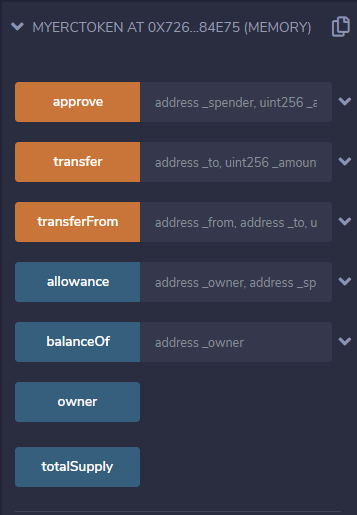
Function calls after deploying