SQL UNIQUE Constraint (original) (raw)
Last Updated : 10 Feb, 2026
The UNIQUE constraint in SQL prevents duplicate entries in specified column(s) while still allowing multiple NULL values. It helps maintain data accuracy without the strict non-NULL requirement of a PRIMARY key.
- Supports single or multi-column definitions.
- Can be added or removed using ALTER TABLE.
- Index creation depends on the database.
**Query:
CREATE TABLE Employees (
EmpID INT,
Email VARCHAR(100) UNIQUE
);
-- Insert data into Employees table
INSERT INTO Employees (EmpID, Email) VALUES
(1, 'alex@example.com'),
(2, NULL),
(3, NULL); -- Allowed because multiple NULLs are treated as unique
**Output:
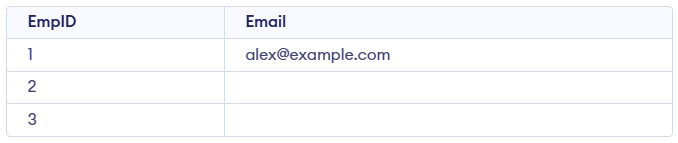
Employees Table
- UNIQUE prevents duplicates; only non-NULL values must remain strictly distinct.
- Multiple NULLs allowed because SQL treats every NULL as unique.
**Query:
INSERT INTO Employees (EmpID, Email)
VALUES (4, 'alex@example.com');
**Error:

- The value 'alex@example.com' already exists in the Email column.
- UNIQUE constraint blocks inserting a duplicate, so the query fails.
**Syntax:
CREATE TABLE table_name (
column1 datatype UNIQUE,
column2 datatype,
...
);
Example of Using the SQL UNIQUE Constraint
In these examples, we demonstrate the implementation of SQL UNIQUE constraint:
Example 1: Creating a Table with UNIQUE Constraints
Let's create a Customers table where the Email column must be unique.
**Query:
CREATE TABLE Customers (
CustomerID INT PRIMARY KEY,
Name VARCHAR(100),
Email VARCHAR(100) UNIQUE,
Country VARCHAR(50)
);
--Insert data into Customers table
INSERT INTO Customers (CustomerID, Name, Email, Country) VALUES
(1, 'John Doe', 'john.doe@example.com', 'USA'),
(2, 'Jane Smith', 'jane.smith@example.com', 'Canada');
**Output:

Customers Table
- The Email column uses a UNIQUE constraint, so no two customers can share the same email.
- Both inserted rows succeed because each email value is different.
**Query:
-- This will fail because 'john.doe@example.com' already exists
INSERT INTO Customers (CustomerID, Name, Email, Country) VALUES
(3, 'Alice Johnson', 'john.doe@example.com', 'UK');
**Error:

- The insert fails because the Email value already exists in a UNIQUE-restricted column.
- UNIQUE prevents duplicate non-NULL emails, so the row is rejected.
Example 2: Using UNIQUE with Multiple Columns
We can also apply the UNIQUE constraint to multiple columns to ensure that the combination of those columns is unique.
**Query:
CREATE TABLE Orders (
OrderID INT PRIMARY KEY,
CustomerID INT,
ProductID INT,
OrderDate DATE,
UNIQUE (CustomerID, ProductID)
);
--Insert data into Orders table
INSERT INTO Orders (OrderID, CustomerID, ProductID, OrderDate) VALUES
(1, 101, 501, '2024-01-10'),
(2, 102, 501, '2024-01-12');
**Output:

Orders Table
- The UNIQUE(CustomerID, ProductID) constraint ensures that the same customer cannot order the same product more than once.
- Both inserted rows are valid because each CustomerID and ProductID pair is different.
**Query:
-- This will fail: duplicate CustomerID–ProductID pair
INSERT INTO Orders (OrderID, CustomerID, ProductID, OrderDate) VALUES
(3, 101, 501, '2024-01-15');
**Error:

- The pair (101, 501) already exists, violating the UNIQUE(CustomerID, ProductID) constraint.
- UNIQUE prevents the same customer from ordering the same product twice, so the insert fails.