Adapter Design Pattern (original) (raw)
Last Updated : 6 May, 2026
Adapter Design Pattern is a structural pattern that acts as a bridge between two incompatible interfaces, allowing them to work together. It is especially useful for integrating legacy code or third-party libraries into a new system.
- It enables classes with incompatible interfaces to collaborate without modifying their source code.
- It promotes code reusability by allowing existing functionality to be used in new systems.
- It can be implemented in two ways: Class Adapter (using inheritance) and Object Adapter (using composition).
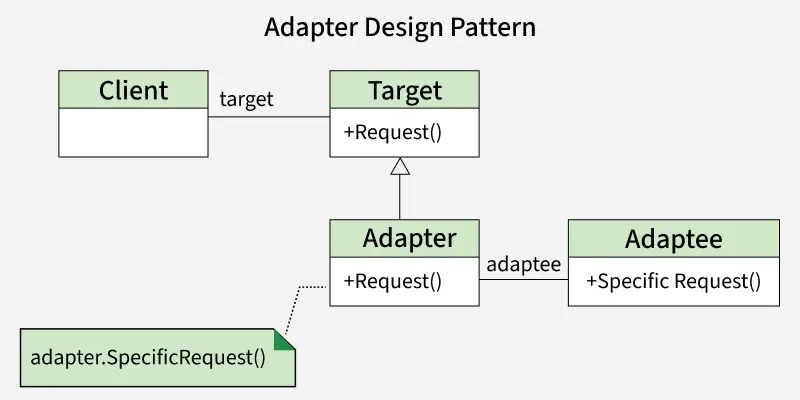
Adapter Design Pattern
In the above Diagram
- Client wants to use a Target interface (it calls Request()).
- Adaptee already has useful functionality, but its method (SpecificRequest()) doesn’t match the Target interface.
- Adapter acts as a bridge: it implements the Target interface (Request()), but inside, it calls the Adaptee’s SpecificRequest().
- This allows the Client to use the Adaptee without changing its code.
Real-World Example
Adapter Design Pattern can be seen as a mobile adapter that helps in matching the device's power and voltage requirements. Similarly in software development, we use adapter for enabling interoperability between incompatible interfaces
- Software that use different file formats (like CSV, JSON, XML) uses adapters to convert these into a format that the application can work with, facilitating data interoperability.
- Device Drivers in Operating Systems, Database Connectors and Language Converters (Chinese to English and English to Hindi) are more examples of adapters.
- In situations where we have a major change in new vs old APIs, instead of writing the whole old code again, we can use an adapter that does the conversion.
Components
The components of adapter design pattern:
- **Target Interface: The interface expected by the client, defining the operations it can use.
- **Adaptee: The existing class with an incompatible interface that needs integration.
- **Adapter: Implements the target interface and uses the adaptee internally, acting as a bridge.
- **Client: Uses the target interface, unaware of the adapter or adaptee details.
Working
The Working of adapter design pattern:
- **Step 1: The client initiates a request by calling a method on the adapter via the target interface.
- **Step 2: The adapter maps or transforms the client's request into a format that the adaptee can understand using the adaptee's interface.
- **Step 3: The adaptee does the actual job based on the translated request from the adapter.
- **Step 4: The client receives the results of the call, remaining unaware of the adapter's presence or the specific details of the adaptee.
Uses
We can use adapter design pattern when:
- Reuses existing code or libraries without rewriting.
- Simplifies integration of new components, keeping the system flexible.
- Centralizes compatibility changes, making maintenance easier and safer.
Different implementations
The Adapter Design Pattern can be applied in various ways depending on the programming language and the specific context. Here are the primary implementations:
1. Class Adapter (Inheritance-based)
Uses inheritance to adapt the interface of an existing class to the target interface expected by the client.
- In this approach, the adapter class inherits from both the target interface (the one the client expects) and the adaptee (the existing class needing adaptation).
- Programming languages that allow multiple inheritance, like C++, are more likely to use this technique.
- However, in languages like Java and C#, which do not support multiple inheritance, this approach is less frequently used.
2. Object Adapter (Composition-based)
Uses composition to wrap the adaptee object and provide the required interface to the client.
- The object adapter employs composition instead of inheritance. In this implementation, the adapter holds an instance of the adaptee and implements the target interface.
- This approach is more flexible as it allows a single adapter to work with multiple adaptees and does not require the complexities of inheritance.
- The object adapter is widely used in languages like Java and C#.
3. Two-way Adapter
Enables two different interfaces to work together by allowing conversion in both directions.
- A two-way adapter can function as both a target and an adaptee, depending on which interface is being invoked.
- This type of adapter is particularly useful when two systems need to work together and require mutual adaptation.
4. Interface Adapter (Default Adapter)
Provides default implementations for interface methods so only required methods need to be overridden.
- When only a few methods from an interface are necessary, an interface adapter can be employed.
- This is especially useful in cases where the interface contains many methods, and the adapter provides default implementations for those that are not needed.
- This approach is often seen in languages like Java, where abstract classes or default method implementations in interfaces simplify the implementation process.
Implementation Example
Understand adapter design pattern through an example:
Problem Statement
Let's consider a scenario where we have an existing system that uses a LegacyPrinter class with a method named printDocument() which we want to adapt into a new system that expects a Printer interface with a method named print(). We'll use the Adapter design pattern to make these two interfaces compatible.
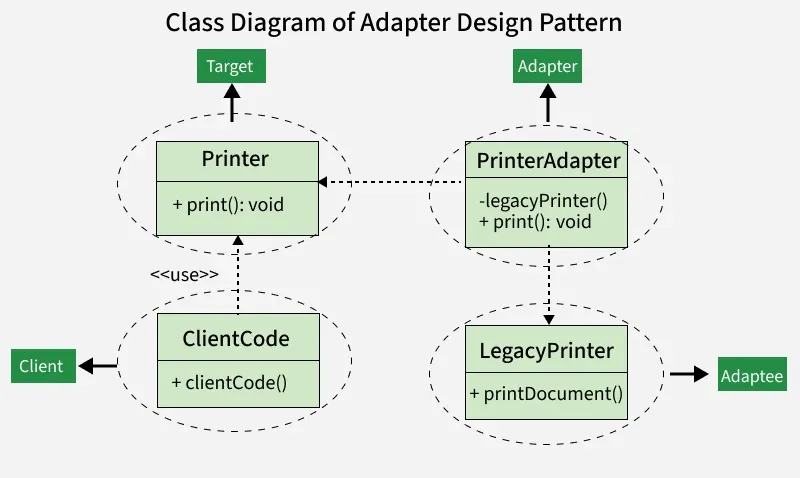
Class Diagram
1. Target Interface (Printer)
The interface that the client code expects.
C++ `
// Target Interface class Printer { public: virtual void print() = 0; // Pure virtual function (abstract method) };
Java
/* Target Interface */ interface Printer { void print(); }
Python
""" Target Interface """ from abc import ABC, abstractmethod
class Printer(ABC): @abstractmethod def print(self): pass
JavaScript
// Target Interface class Printer { print() { throw new Error('Method not implemented.'); } }
`
2. Adaptee (LegacyPrinter)
The existing class with an incompatible interface.
C++ `
// Adaptee
class LegacyPrinter { public: void printDocument() { std::cout << "Legacy Printer is printing a document." << std::endl; } };
Java
/* Adaptee */
class LegacyPrinter { public void printDocument() { System.out.println("Legacy Printer is printing a document."); } }
Python
Adaptee
class LegacyPrinter: def print_document(self): print('Legacy Printer is printing a document.')
JavaScript
// Adaptee
class LegacyPrinter { printDocument() { console.log('Legacy Printer is printing a document.'); } }
`
3. Adapter (PrinterAdapter)
The class that adapts the LegacyPrinter to the Printer interface.
C++ `
// Adapter
class PrinterAdapter : public Printer { private: LegacyPrinter legacyPrinter;
public: void print() override { legacyPrinter.printDocument(); } };
Java
/* Adapter */
class PrinterAdapter implements Printer { private LegacyPrinter legacyPrinter;
public PrinterAdapter(LegacyPrinter legacyPrinter) {
    this.legacyPrinter = legacyPrinter;
}

@Override
public void print() {
    legacyPrinter.printDocument();
}
}
Python
Adapter
class PrinterAdapter(Printer): def init(self, legacy_printer): self.legacy_printer = legacy_printer
def print(self):
    self.legacy_printer.print_document()
JavaScript
// Adapter
class PrinterAdapter { constructor(legacyPrinter) { this.legacyPrinter = legacyPrinter; }
print() {
    this.legacyPrinter.printDocument();
}
}
`
4. Client Code
The code that interacts with the Printer interface.
C++ `
// Client Code
void clientCode(Printer& printer) { printer.print(); }
Java
/* Client Code */ interface Printer { void print(); }
void clientCode(Printer printer) { printer.print(); }
Python
Client Code
from abc import ABC, abstractmethod
class Printer(ABC): @abstractmethod def print(self): pass
def clientCode(printer): printer.print()
JavaScript
// Client Code function clientCode(printer) { printer.print(); }
`
Complete Code for the above example:
C++ `
// Adapter Design Pattern Example Code
#include
// Target Interface class Printer { public: virtual void print() = 0; };
// Adaptee class LegacyPrinter { public: void printDocument() { std::cout << "Legacy Printer is printing a document." << std::endl; } };
// Adapter class PrinterAdapter : public Printer { private: LegacyPrinter legacyPrinter;
public: void print() override { legacyPrinter.printDocument(); } };
// Client Code void clientCode(Printer& printer) { printer.print(); }
int main() { // Using the Adapter PrinterAdapter adapter; clientCode(adapter);
return 0;}
Java
/* Adapter Design Pattern Example Code */
// Target Interface interface Printer { void print(); }
// Adaptee class LegacyPrinter { public void printDocument() { System.out.println("Legacy Printer is printing a document."); } }
// Adapter class PrinterAdapter implements Printer { private LegacyPrinter legacyPrinter = new LegacyPrinter();
@Override
public void print() {
    legacyPrinter.printDocument();
}
}
// Client Code public class Client { public static void clientCode(Printer printer) { printer.print(); }
public static void main(String[] args) {
    // Using the Adapter
    PrinterAdapter adapter = new PrinterAdapter();
    clientCode(adapter);
}
}
Python
''' Adapter Design Pattern Example Code '''
Target Interface
from abc import ABC, abstractmethod
class Printer(ABC): @abstractmethod def print(self): pass
Adaptee
class LegacyPrinter: def print_document(self): print('Legacy Printer is printing a document.')
Adapter
class PrinterAdapter(Printer): def init(self): self.legacy_printer = LegacyPrinter()
def print(self):
    self.legacy_printer.print_document()
Client Code
def client_code(printer): printer.print()
if name == 'main': # Using the Adapter adapter = PrinterAdapter() client_code(adapter)
JavaScript
/* Adapter Design Pattern Example Code */
// Target Interface const Printer = { print: function() { throw new Error('print method must be implemented!'); } };
// Adaptee class LegacyPrinter { printDocument() { console.log('Legacy Printer is printing a document.'); } }
// Adapter class PrinterAdapter { constructor() { this.legacyPrinter = new LegacyPrinter(); }
print() {
    this.legacyPrinter.printDocument();
}
}
// Client Code class Client { static clientCode(printer) { printer.print(); }
static main() {
    // Using the Adapter
    const adapter = new PrinterAdapter();
    this.clientCode(adapter);
}
}
// Running the client code Client.main();
`
Output
Legacy Printer is printing a document.
Advantages
The pros of Adapter Design Pattern:
- Promotes code reuse without modification.
- Keeps classes focused on core logic by isolating adaptation.
- Supports multiple interfaces through interchangeable adapters.
- Decouples system from implementations, easing modifications and swaps.
Disadvantages
The cons of Adapter Design Pattern:
- Adds complexity and can make code harder to follow.
- Introduces slight performance overhead due to extra indirection.
- Multiple adapters increase maintenance effort.
- Handling many interfaces may require multiple adapters, complicating design.