Centralized vs. Decentralized vs. Distributed Systems (original) (raw)
Last Updated : 23 Mar, 2026
Centralized, decentralized and distributed models present the different methods used to design and manage modern computing systems.
- Influences system scalability and growth handling.
- Affects reliability and failure management.
- Determines performance under varying workloads.
- Impacts security, maintenance, and overall system complexity.
Centralized System
It is a computing architecture in which a single central server or authority manages all processing, data storage, and decision-making for connected clients.
- All requests from clients are handled by a central server.
- Data is stored and maintained at one primary location.
- System control and administrative decisions are managed centrally.
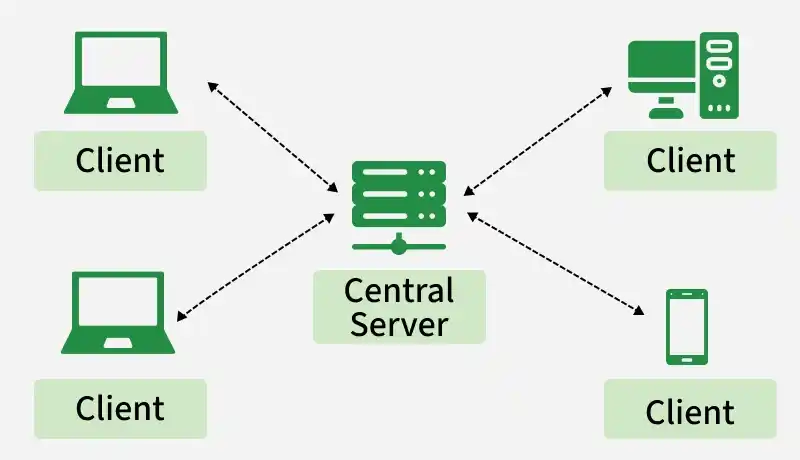
Centralized System
Advantages
- The system design is simple and easier to implement.
- Security policies and access control can be managed from one place.
- System updates and maintenance are easier to perform.
- Data management remains consistent due to centralized storage.
Disadvantages
- The central server becomes a single point of failure.
- System performance may degrade under heavy traffic or workload.
- Scalability is limited compared to distributed models.
- High dependency on continuous network connectivity.
Examples
- Traditional client–server banking systems.
- Centralized database management systems.
- Early mainframe computing environments.
Decentralized System
This is a computing model in which control and decision-making powersare distributed among multiple independent nodes.
- Multiple nodes participate in decision-making and system management.
- Each node operates independently while following common protocols or rules.
- Authority is distributed, reducing dependence on one controlling entity.
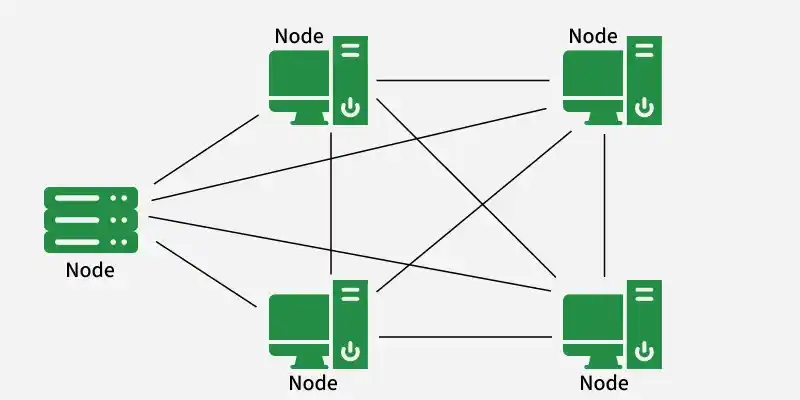
Decentralized System
Advantages
- The system continues to function even if some nodes fail.
- It improves resilience against attacks targeting a single authority.
- Scalability can be achieved by adding more independent nodes.
- It reduces the risk of misuse or control by a single organization.
Disadvantages
- Coordination between independent nodes can become complex.
- Maintaining data consistency across nodes can be challenging.
- Governance and policy enforcement may require additional mechanisms.
- Network communication overhead may increase as the system grows.
Examples
- Blockchain networks such as Bitcoin.
- Decentralized finance platforms.
- Federated social networking platforms.
Distributed System
This is a computing model in which multiple interconnected nodes work together over a network.
- Multiple nodes collaborate to complete tasks collectively.
- Nodes communicate through message passing over a network.
- The system supports concurrent processing across different machines.
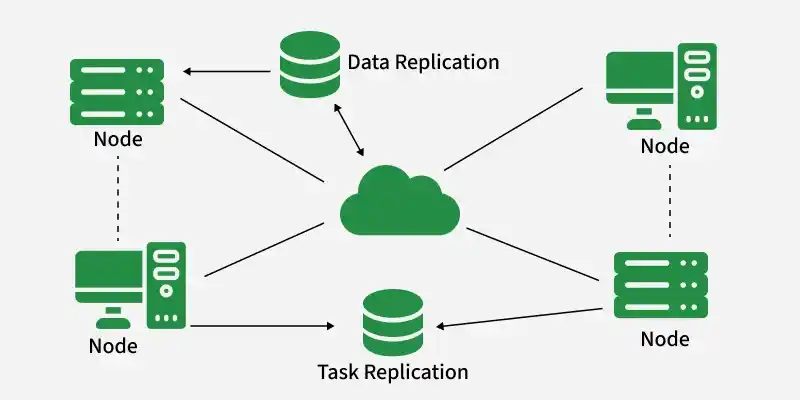
Distributed System
Advantages
- It improves performance by dividing tasks among multiple machines.
- It enhances scalability by allowing horizontal expansion.
- It increases availability through replication of services or data.
- It supports resource sharing across geographically distributed locations.
Disadvantages
- Designing and managing the system is technically complex.
- Network failures can affect communication between nodes.
- Maintaining data consistency across nodes can be difficult.
- Debugging and monitoring distributed components require advanced tools.
Examples
- Content Delivery Networks (CDNs).
- Distributed database systems like Google Spanner.
- Microservices-based architectures.
Comparison Table
| Basis | Centralized System | Decentralized System | Distributed System |
|---|---|---|---|
| **Control | One central authority controls everything. | Multiple authorities share control. | Control may vary, but processing is spread across nodes. |
| **Data Storage | Data is stored at one main location. | Data is maintained by multiple independent nodes. | Data is partitioned or replicated across several machines. |
| **Scalability | Scaling requires upgrading the central server. | Scaling is done by adding more independent nodes. | Scaling is achieved by distributing the workload across machines. |
| **Performance | Performance depends on the central unit’s capacity. | Load is shared among multiple authorities. | Tasks run in parallel on multiple nodes. |
| **Complexity | Architecture is simple and easy to manage. | Coordination between nodes increases complexity. | Synchronization and consistency management are complex. |
| **Best Suited For | Small or tightly controlled environments. | Systems needing shared governance. | Large-scale and high-availability applications. |