Consistency Patterns (original) (raw)
Last Updated : 16 Apr, 2026
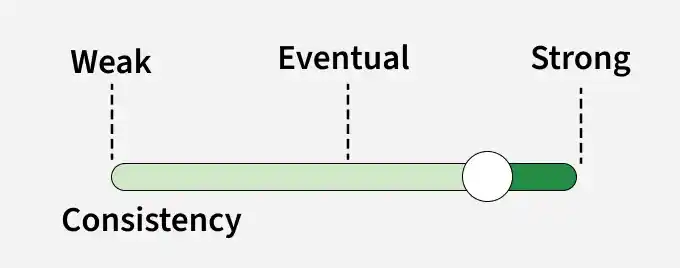
Consistency patterns in system design are approaches used to manage data consistency across distributed systems where multiple users read and write data simultaneously. They ensure data remains accurate and coherent across different nodes.
- Strong Consistency ensures all nodes always see the latest data with no mismatch between replicas.
- Eventual Consistency allows temporary differences but guarantees all replicas will eventually become consistent.
- Causal Consistency maintains the order of related operations so dependent events are seen in the same sequence.
These patterns help designers make informed decisions about how to manage data consistency based on the specific requirements and constraints of their systems
Use Cases and Applications
Consistency patterns find applications across various domains where distributed systems are prevalent. Here are some use cases and applications:
- **Financial Transactions: Strong consistency ensures accurate and up-to-date data so transactions and balances are always correct.
- **E-commerce Platforms: Strong consistency maintains correct inventory levels across systems and prevents overselling of products.
- **Social Media Platforms: Eventual consistency allows posts and interactions to spread to all users over time without immediate synchronization.
- **Collaborative Editing Tools: Weak consistency enables multiple users to edit simultaneously with eventual synchronization of changes.
- **Content Delivery Networks (CDNs): Weak consistency improves performance and scalability by allowing content to sync gradually across edge servers.
- **Real-Time Analytics: Strong consistency ensures accurate and consistent results across distributed data sources.
Types of Consistency Patterns
This section explains different consistency patterns used in distributed systems.
Strong Consistency Patterns
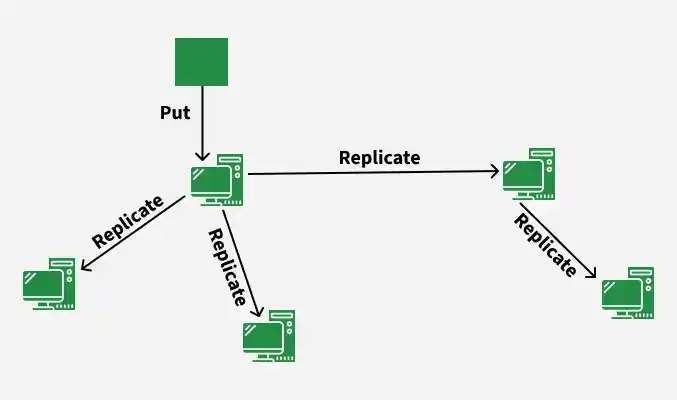
Strong consistency ensures that whenever you make a change to data in a distributed system, every part of that system immediately knows about and agrees on that change. It's like everyone seeing the same picture at the same time, no matter where they are.
- This pattern prioritizes accuracy and reliability, making sure that all users get the most up-to-date information without any differences.
- It ensures strong data integrity but can reduce performance in large distributed systems. It is best suited for critical applications like banking and healthcare where accuracy is essential.
Strong consistency
Strong consistency patterns ensure that all replicas of data in a distributed system are updated synchronously and uniformly. Here are a few key patterns:
- **Strict Two-Phase Locking: Uses a locking system so only one transaction accesses data at a time, ensuring serial execution and strong consistency.
- **Serializability: Ensures transactions behave as if they were executed one after another, even when run concurrently, maintaining a consistent final state.
- **Quorum Consistency: Requires a majority of replicas to agree on a value before committing, helping consistency but not always guaranteeing strict strong consistency.
- **Synchronous Replication: Updates are written to all replicas at the same time before completion, ensuring all nodes stay fully consistent.
These patterns prioritize consistency over availability and partition tolerance, making them suitable for critical systems like financial transactions, but they can increase latency and reduce availability compared to eventual consistency.
Eventual Consistency Patterns
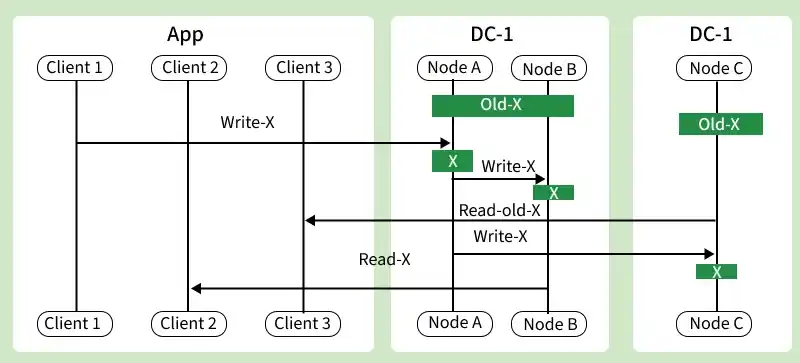
Eventual consistency patterns allow temporary differences between replicas but ensure they eventually synchronize automatically without intervention. They are suitable for systems where real-time synchronization is not critical.
- Data repair and periodic reconciliation help fix inconsistencies and align replicas over time.
- Causal tracking and conflict-free data types ensure updates are applied correctly without conflicts while maintaining performance balance
Eventual Consistency
Eventual consistency patterns allow temporary inconsistencies in distributed systems but ensure all replicas eventually converge to a consistent state without intervention.
- **Read Repair: Fixes stale or inconsistent data during read operations by updating it to the latest version, helping replicas converge over time.
- **Anti-Entropy Mechanisms: Periodically compares replicas and reconciles differences to reduce inconsistencies and ensure eventual consistency.
- **Vector Clocks: Track the order of updates across replicas to identify causality and resolve conflicts correctly.
- **Conflict-free Replicated Data Types (CRDTs): Enable concurrent updates without conflicts and ensure all replicas converge without coordination.
These patterns are useful when immediate consistency is not required and eventual consistency is acceptable. They balance consistency, availability, and partition tolerance, making them suitable for applications like collaborative tools, CDNs, and social media platforms.
Hybrid Consistency Patterns
Hybrid consistency patterns combine strong and eventual consistency, providing immediate accuracy for critical updates while allowing less important data to synchronize gradually.
- These patterns let developers fine-tune consistency levels based on needs, workload, or network conditions, optimizing performance without sacrificing reliability.
- It is like different gears in a car, allowing systems to switch between speed and precision based on application needs.
Hybrid consistency patterns balance availability, correctness, and performance by combining strong and eventual consistency in distributed systems.
- **Eventual Consistency with Strong Guarantees: Combines eventual consistency with strong consistency enforcement for critical operations or conflict situations.
- **Consistency Levels: Allows different consistency settings per operation or data type based on use case requirements.
- **Tunable Consistency: Lets systems dynamically adjust consistency based on network, load, or user needs.
- **Consistency Buckets: Splits data into groups, each assigned a different consistency model based on importance or usage.
Hybrid consistency patterns provide flexibility and customization in distributed systems, adapting to different requirements and trade-offs. They balance strong consistency and eventual consistency to meet specific application needs.
Weak Consistency Patterns
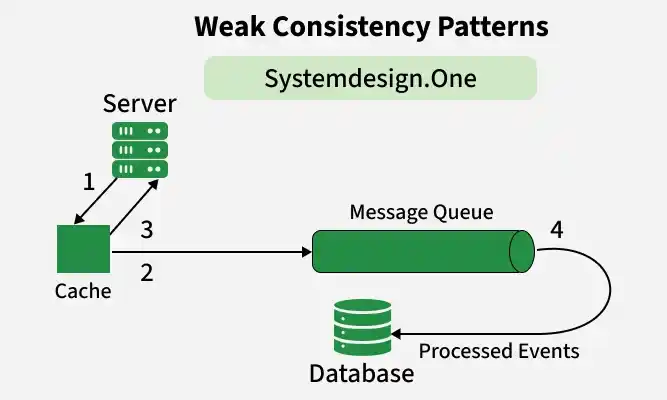
Weak consistency patterns prioritize availability and partition tolerance over strict consistency. They allow temporary inconsistencies between replicas but ensure eventual convergence, similar to shared files syncing across devices over time.
- Weak consistency patterns include eventual consistency, read-your-writes consistency (users see their own updates), and monotonic reads/writes consistency (ensuring no older values are observed in sequence).
- These patterns are useful for systems where real-time consistency isn't crucial, emphasizing system availability and fault tolerance over immediate data accuracy.
Weak Consistency
Weak consistency patterns prioritize availability and partition tolerance over strict data consistency in distributed systems. Here are some common weak consistency patterns:
- **Eventual Consistency: Allows replicas of data to be inconsistent temporarily but ensures they will eventually converge to a consistent state without human intervention.
- **Read Your Writes Consistency: Guarantees that a process will always see its own writes, even in a weakly consistent system. This ensures that users perceive consistency based on their own actions.
- **Monotonic Reads/Writes Consistency: Monotonic Reads ensure a client never sees older values in subsequent reads, while Monotonic Writes guarantee that write operations from a client are applied in the same order.
- **Causal Consistency: Maintains causal relationships between related operations, ensuring that causally related events are seen by all nodes in the same order.
Weak consistency patterns are suitable when immediate consistency is not required, such as in caching, CDNs, and collaborative tools, prioritizing availability and partition tolerance over strict consistency.
Importance
Consistency patterns are vital in system design for several reasons:
- **Data Integrity: Ensures data remains accurate and consistent across distributed systems, preventing conflicts from concurrent updates.
- **User Experience: Provides reliable and predictable data, though freshness may vary depending on the consistency model.
- **Reliability: Improves system resilience by maintaining consistency even during node failures or network partitions.
- **Scalability: Helps systems scale efficiently by managing consistency without reducing performance or availability.
- **Performance Optimization: Allows selection of appropriate consistency models to balance performance and data accuracy based on use case.
Challenges
Implementing consistency patterns in distributed systems comes with several challenges:
- **Performance Overhead: Strong consistency adds overhead due to synchronization and coordination, increasing latency and reducing throughput.
- **Scalability Limitations: Strict consistency becomes harder to scale as the number of nodes and data volume increases.
- **Availability Trade-offs: Strong consistency may reduce availability during network partitions or failures to maintain correct data.
- **Complexity: Implementing consistency models increases system complexity, requiring advanced coordination and conflict handling.
- **Conflict Resolution: Weak consistency systems can face challenges handling conflicts from concurrent updates on shared data.
- **Operational Complexity: Managing consistency in distributed systems requires expertise and careful monitoring, making operations complex.
- **Trade-offs with Performance and Latency: Weak consistency improves scalability but can introduce delays due to synchronization and conflict resolution.